


The Hypnotic Show. Part 11
Description
This section is from the book "Stage Hypnotism - A Text Book Of Occult Entertainments", by Prof. Leonidas. See also: The New Encyclopedia of Stage Hypnotism.
The Hypnotic Show. Part 11
Now, student, a word as to why I chose Mr. Williams: It was not merely because he was a rather somber, quiet-looking man, but because he was a good subject and an excellent, active somnambulist. Besides, his age was greatly in my favor, for the act he was to go through would appear more ridiculous for a man of his age than it would were a boy of fifteen to go through it. I had noticed him in some of the other acts and knew that he was well adapted for the one through which he has just gone. Always keep an eye open for these things. You know your programme before you start. Of course, you will see opportunities of working in many little things additional, but on the whole you have a good idea just what you will present, having a certain number of subjects. All of the acts I have given could be given with but three or four subjects. But the more the operator has, the better the show, for he can vary his acts and assemble more in a good act than he could were his numbers smaller.
Mr. Williams has gone back to his seat now and I will present for the next act a case of anaesthesia. As I stated when I was preparing my subject for the window, I always take care to have my needles antiseptic. There is no need of running chances. There might be such a thing as one of the subjects being in a bad condition physically, in which case a little rust on the needle might produce blood-poisoning. I am always disgusted with these hair-brained youth who plunge into this thing with an idea that they change the subject from something human to something inanimate and impose all kinds of things upon him. Such children should be restricted by law and kept off the stage and, in short, compelled to go out of business entirely, from the hypnotic standpoint.
In placing the subject in anaesthesia, the work must be done so that it is presented to the audience as a scientific demonstration and not as an act of cruelty. There will be many who object to such proceedings strenuously. but the operator can always overcome all opposition if he demonstrates to the audience that he is doing this in the interest of science. Here it will he wise to have a doctor come upon the stage: or two or three would be still better.
So I step forward and say: "Will two or three of the physicians present step forward and examine my next subject? I wish to present the scientific side of hypnotism and physicians are the most competent judges when it comes to matters of this kind. Don't be backward, gentlemen; two, three or four or half a dozen - as many as there are present. Kindly step up on the stage".
The doctors respond readily enough, and I have three of them up on the stage before any time has been lost. I will now take two of the boys and place them in anaesthesia and when they are thoroughly hypnotized I will proceed to demonstrate to the doctors - which is the most direct way of demonstrating to the audience - the possbilities of hypnotism in a therapeutic sense. The medical side of the subject should always be shown to the audience, as it tones down the lighter sides and gives the spectators something over which to feel sober. Too much laughter at one time must be avoided: it becomes very tiresome to the audience and they grow weary of it. But, by adding a little of the serious side, they will fully appreciate anything funny that is given them afterward.
I call two of the boys forward and they are placed in somnambulism while they are standing. I now seat them side by side and tell one to go sound to sleep. When his head is away down on his breast, I take the other one in hand in this manner:
"As I rub your arm. all the feeling will go out of it, the circulation will decrease, you can feel nothing, all the feeling has gone. Now, I want you to tell me when I touch your arm." Hold my hand aloft, but do not lower it. The subject's eyes are tightly closed. "Did you feel that?" "No," he answers in a whisper. This time I touch him gently. "Did you feel that?" "No," he again says. and I touch him harder and harder, finally pinching him severely, but he feels nothing, His arm has a chalky appearance and the doctors are deeply interested.
"You will feel nothing whatever in that arm until I tell you that you will. All the feeling has gone. Of course, I am not going to do anything to your arm but keep it withot feeling, so that you will rest. Now, sleep soundly, sleep".
I take the bottle in which my needles are placed and, taking the largest needle out, I run it through the fleshy part of the arm. There is a perceptible squirm on the part of many in the audience, but the boy is insensible to pain. I take his hand and hold his arm out straight, so as to assure the doctors that I have placed nothing under his arm to stop the circulation. The physicians feel his pulse and find it very low. This statement I have them make aloud, so that the audience will hear it distinctly. Stepping forward. I address the audience:
"Ladies and gentlemen: This boy is insensible to pain. There is no more pain in this to him them there would be were his arm made of wood. I do not do this to show you the cruel side to hypnotism, but to demonstrate to you the possibilities it has in surgery. Many operations are performed in this manner and they are always successful. "Where hypnotism can be used in surgery, it is far better than an anaesthetic of a material nature, for in hypnotism there are no ill effects left; nothing in the system that will injure the health or well-being of the subject".
I again turn to my subject and draw out the needle. One very small drop of blood comes out and I drop the arm of the subject. No more blood flows.
Isn't that peculiar?" says one physician to the others, They admit that it is and are very busy examining the patient's heart-beat, his pulse and the puncture in the arm.
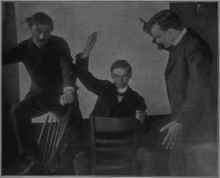
THE HORSE RACE.
Continue to:


My Books

