


Chapter IV. How Pyramid Energies Affect Living Cells
Description
This section is from the book "The Pyramid: How To Build It, How To Use It", by Les Brown. Also available from Amazon: The Pyramid.
Chapter IV. How Pyramid Energies Affect Living Cells
The main purpose of this small book, in addition to acquainting you with the basics of the pyramids, is to show you how you can grow bumper crops with the use of a pyramid. The magnetic field plays a very important part in plant life, animal life and of course human life. Nothing would thrive without it, in fact nothing could live without it. In our day-to-day lives we are used to seeing plants and animals of the same type or breed grow to normal size in addition to periodic occasions in which one or more of these varieties grows far and above the expected. There is a reason for these occasional episodes of supergrowth. It can be explained, or should I say, in various ways. It could be due to that particular piece of soil, well fertilized and watered, or a "supergrown" plant could be in the same kind of soil, with the same conditions, as those plants growing normally, but positioned perhaps near a metal fence. In nearly every instance, anything growing by an iron fence will be bigger and better than one nowhere near metal. The reason is that the iron fence picks up static or magnetic energy and feeds it to the plant.
I remember my mother and grandmother placing large nails in the soil of their potted house plants because plants thus treated always grew bigger and better. They had no idea why. In fact, if you asked them, the standard answer was that, as the nail rusted, the plant fed on it. This reasoning is fallible, however, because for one thing, plants can only absorb minerals in liquid form and for another, the rust would kill some plants. Rather, the nails picked up the magnetic energy and boosted the house plants' growth. I suppose you can see that what I am driving at is that when a plant receives an extra dose of energy to that already floating free in the atmosphere, that dose acts as a stimulant and causes better growth. What really happens is that the living cells are increased in size, and naturally when each cell is larger, since there are still the same number of cells, the final plant is a lot larger than normal. To illustrate, if I fill a basin half full of dried peas and fill it up with water, by the time the peas have completely soaked they fill the basin. There are still the same number of peas, but there appear to be many more.
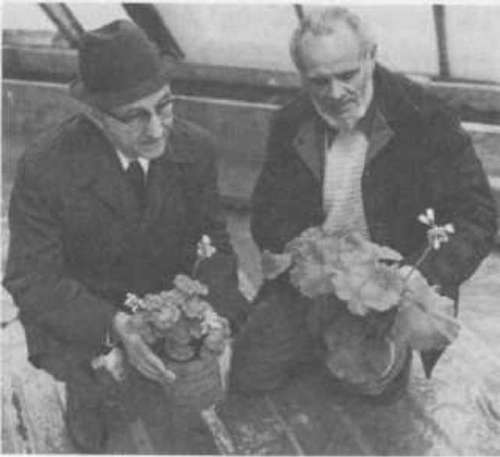
Similarly, if you plant a plant in a pyramid, the same sort of thing happens, but there is a difference. As detailed earlier, the pyramid collects magnetic energy and absorbs it to a higher intensity than the nails in the plant pots did, a much greater intensity or strength, and so the end result is, you can expect enormous growth, and when this is applied to vegetables and fruits, the plants, as well as their products, are immensely oversized. My own experiments have convinced me that this energy creates a special reaction in living cells of plants, resulting in larger blooms, leaves and fruits on whatever plants are propagated within the pyramidal shape.
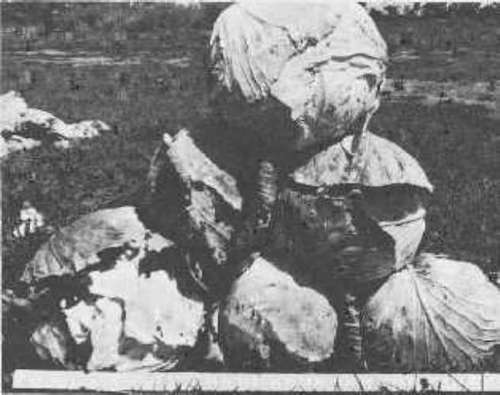
The normal life cycle of lettuce, for instance, from seed to maturity, is six to eight weeks. Grown under a pyramid the life cycle is still the same, but the plant is considerably larger. If one allows the vine type of tomato to mature to six or seven trusses under a pyramid while simultaneously allowing an identical plant to do the same outside the pyramid, giving both plants precisely the same feeding and watering, a startling difference in yield occurs. I should mention that if you put your outside plant too near the pyramid, it will reach for, and receive, some of the pyramid's energy, so keep it well away to get a fair test. The outside tomatoes would weigh out at approximately 10 to 14 pounds per plant, whereas the plant grown in the energy of the pyramid would produce between 50 and 60 pounds of tomatoes. Not every type of plant grown under a pyramid will produce this increase; this is the average that I have come to expect from tomatoes.
A few more averages I have obtained repeatedly were: lettuce two to three times larger than average; beans 25 inches long by 1-1/4 inches wide; cabbage--when controls were three pounds each, the pyramid-grown plants were 12 to 13 pounds per head; radishes that normally would be the size of a quarter were four inches in diameter; controlled cucumbers that averaged 14 inches in length and weighed up to one pound normally, were 21 inches long and weighed up to four pounds when grown in the pyramid.
A few more averages I have obtained repeatedly were: Lettuce two to three times larger than average; beans 25 inches long by 1-1/4 inches wide; cabbage-- when controls were three pounds each, the pyramid-grown plants were 12 to 13 pounds per head; radishes that normally would be the size of a quarter were four inches in diameter; controlled cucumbers that averaged 14 inches in length and weighed up to one pound normally, were 21 inches long and weighed up to four pounds when grown in the pyramid that warms your whole house and cleanses the air you breathe.
Energized air in the pyramid also appears inimical to small insects; though, there is no need for pesticides to be used within its glass walls. Pest-free plants grow to maturity inside, with none of the setbacks plants subject to normal attack from pests suffer in the garden outside. This also means that pyramid-grown vegetables need no washing upon harvesting. The mere appearance of such plants is more appetizing than that of those grown normally. Greens are more vivid, and many leaves have a sheen which is noticeably absent from plants in kitchen gardens. Artificial fertilizers will never be used in my pyramid. Since many fertilizers apparently are becoming short in supply themselves, the ability to grow plants without their use is a double blessing for all mankind. I will use natural farmyard manures, the best way to regain succulent taste and nutrition that are missing for too long in engineered and chemicalized food.
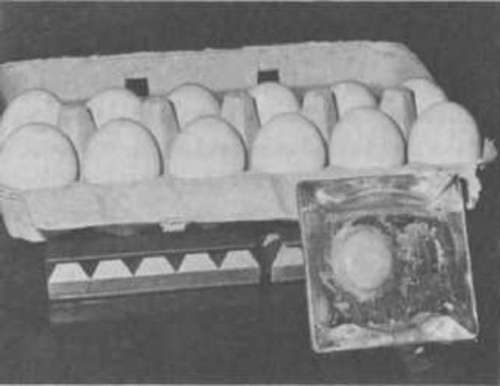
An egg broken out of its shell and left within the confines of the pyramid will gradually congeal and become like plastic, as the interior energy works on its cells—harmlessly. The cells do not die nor induce putrefaction. After a period of even weeks or months these congealed eggs can be reconstituted in water to the point where they can be eaten with complete safety—and taste even more delicious than eggs produced in the usual ways.
BTW, one peculiar phenomenon I have observed under my large pyramid is the formation of dew upon plants inside, early in the morning. During all my years of experience with greenhouses I never noticed dew forming on any plants in conventional greenhouses. This dew gently dissipates as the sun grows stronger, exactly as it would outside. Also, after a recent thunderstorm, my pyramid cucumbers grew two to two and a half inches in a matter of a few hours.
Continue to:


My Books

