


Chapter VI. Food Preservation With Pyramids
Description
This section is from the book "The Pyramid: How To Build It, How To Use It", by Les Brown. Also available from Amazon: The Pyramid.
Chapter VI. Food Preservation With Pyramids
In addition to food growth, the pyramid also has application in food preservation. I have read statistics stating that 40 percent of all food grown in my home country of Canada is lost to putrefaction, whether at the place of storage, in transport, in wholesale and retail, or finally in the home. If this happens all over the world, no wonder so many people are dying of starvation, and even closer to home, we find ourselves paying higher and higher prices for what does reach us.
These figures mean that either our methods of storage are highly inefficient or someone in authority couldn't care less. Regardless of how this spoilage occurs, however, the state of affairs can and must be remedied; it is both ridiculous and criminal to let it continue. Even though I have told how--as well as shown and proven how--to use the pyramids to solve the problem, on radio and television and in newspapers, no one in any governmental department has even picked up the phone to inquire about it. It seems that the words "govern" and "mental" don't work together.
Energy of the pyramid that grows plants so amazingly well can be used also for the purpose of mummification of food, which can be dehydrated and kept in storage for an indefinite period without losing any of its taste or nutritional properties. There are absolutely no ill effects on any food stored in a pyramid. In fact, in many instances it is far better when reconstituted than it was in the first place. It has the water taken out of it; but it also repels bacteria and as a result, nothing will rot in a pyramid. For instance, I cannot make a compost heap inside my pyramid; I have to do it outside; otherwise the ingredients in the compost all remain in good shape and will not break down. For further proof, the grain grown in Manitoba today is a direct descendant of the grain found in the Great Pyramid, grain that had been there for centuries an had kept perfectly. The government knows this but still bemoans the amount of grain lost to putrefaction in granaries. It makes me wonder at the mentality of the people we elect to look after our affairs. Naturally, since I am Canadian, I am referring to what is happening in Canada; it is probably happening elsewhere too.
Earlier I mentioned mummifying eggs. I conducted an experiment in mummifying an egg, using a pyramid energizer instead of a single wire pyramid. The energizer consisted of a small batch of one-inch-high pyramids, 20 in all, positioned in a group.
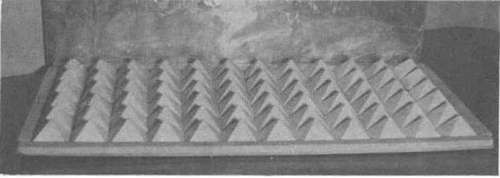
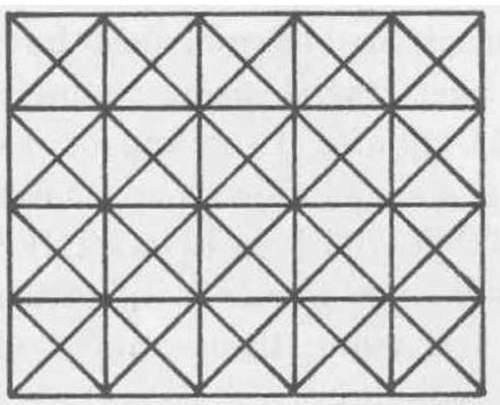
Using such a grid of pyramids provides quicker results than using just one pyramid. I broke an egg into a dish, placed the dish on top of the energizer and observed what happened in the ensuing days. In about six hours I noticed the lower perimeter of the yolk turning a pale yellow, and this continued through each day, the pale color gradually moving up to the top of the yolk. In the meantime, the white was becoming less fluid, thickening, so to speak. In two weeks the whole egg was just like glass; the yolk was hard and the white was now in crystal form. At no time would flies or any insect approach it, even though it was open to them. Flies were as prevalent as usually, but they would not go near the egg. There was never any smell present from start to finish.
I left the egg in this state for about three months and showed it to many of my visitors, but then it was time to reconstitute it and try it for taste. I added some water (an egg loses about 30 grams of water in such a period) and left it 24 hours. I then boiled some water with the intention of poaching the egg. When the water was ready, I tipped the egg in, and immediately the albumen turned snowy white and the yolk a perfectly natural yellow color. Had I dropped the egg before reconstituting it, it would have shattered, but now it was simmering away, looking just like an egg fresh from the pen. After cooking the egg I put it on a plate, salted and peppered it, then cut the yolk through with my knife, and it flooded across my plate. I admit I was not in too big a hurry to eat it, but if I was going to prove something, I had to taste it. I smelled the egg, and it was no different from normal, so I ate it. I can honestly say it was one of the nicest eggs I have ever tasted; it seemed to have more flavor than usual.
Had this method or one like it been used a few months back on a large scale the hungry world might have benefited from the saving of millions of eggs that went rotten in storage. We could have obviated the sorry spectacle which has come to be known as "Whalen's Waste." I know we cannot break all the eggs we produce for storage into dishes and preserve them in this manner; however, they may be preserved even in their shells, which is the way they could be preserved in the millions. I do not know of any food that cannot be treated in such a manner. I have tried preserving every food I can think of, and it all keeps indefinitely, with no refrigeration necessary.
Such a means of preservation by the use of the pyramid is better and cheaper, with no losses, so how can it be ignored? As I said before, nobody is listening, but the voices of my readers may help me in what I am doing. I firmly believe that food processing companies could save themselves billions of dollars by using pyramids such as mine, which in turn could mean at least a lowering of prices. Should they wish to cooperate, I am quite willing to place my knowledge at their disposal. [Les died before that happened.--ED]
Continue to:


My Books

