


Chapter III. Character Of The Lines - Defects And Repair - Individual Signs - Strengthening Lines
Description
This section is from the book "The Laws Of Scientific Hand Reading", by William G. Benham. Also available from Amazon: The Laws of Scientific Hand Reading.
Chapter III. Character Of The Lines - Defects And Repair - Individual Signs - Strengthening Lines
IN examining lines, note first the character of the lines themselves. By this I mean their clearness, depth, evenness, and whether they are perfect or defective. If the latter is the case, what is the defect, does it cover the entire line or only a part of it, is the line repaired after the defect, does it regain its original depth and clearness, or does it show diminishing strength until it gradually fades away? The first general principle governing lines is, that the more evenly they run, the clearer they are, the less they are crossed, broken, islanded, or chained, and the nearer pink in color, the better is the line, and the more vigorous and clear the operation of its attributes. These clear, even lines furnish better channels through which the Electric Current can flow, offering as they do less obstruction and fewer impediments to free circulation. Conceiving the Electric Current to be flowing in and out through the finger ends, you can readily see that all vertical lines facilitate its passage and all horizontal lines check and impede its progress. Thus vertical lines are favorable, and horizontal lines crossing them are defects.
This is why vertical lines on a Mount are good indications and increase the force of its type, and likewise the reason why grilles and cross-bars on the Mount are bad indications and obstructions, bringing out the bad side of the type or its health defects. The study of the lines makes clear the general law that lines operate best when the Current has the least obstruction to its free passage, and defects and bad effects are produced on a subject when it is impeded.
The slighter the defects and obstructions seen, the less marked are the bad results, and, conversely, the greater the obstruction the worse the effects. Clear, cleanly cut, even, pink lines show the best operation of any line; and every break, cross, island, or obstruction of any kind which may cause the Current to be impeded and to scatter or overflow its banks, will produce a defective operation of the qualities indicated by a line. Note whether any one line is deeper or shallower, is more defective, or has a different character in any way from other lines in the hand. If lines in general are of the same size and character, but some one line is much deeper, clearer, better colored than the others, the thing which this deep line indicates will be the strongest thing told by the lines in that subject's hands. If all the lines are deep, well colored, and clearly cut, and some one line is found much less clearly cut and deep than the rest, then the quality which that line indicates is the weakest point. Look for proportion constantly, and anything which disturbs it must be used for or against the chances of the subject.
If the lines in the hand are broad and shallow, instead of deep and clear, there is an imperfect channel for the Current to pass through, and instead of being a deep stream full of strength and power, it is a shallow brook, and the Current spreads over too wide a surface to make it strong. This broad and shallow line is a feeble and weak one, and is generally full of defects and obstructions. When you see that lines are clearly cut, deep, well colored, uncrossed, or unspoiled by other defects, these lines show vigor and strength in the operation of their several qualities, steadiness of purpose, evenness of temper, and these are the subjects who, while they may have many difficulties to encounter, overcome them. Broad, shallow, poorly colored lines show weakness, vacillation, and discouragement, and generally these subjects achieve few results, and those are gained only after great effort and with strong outside influences to spur them. All of the changes, obstructions, and defects that occur in the lines themselves have special names, and these we will consider separately.
One of the first defective lines to notice is the uneven line (1). This is a line which, to a superficial observer, may seem to be a good one, but, upon a close examination, it will be seen that it cuts much deeper in certain parts, becoming thin afterwards, sometimes becoming broad and shallow, and often fading away entirely. Sometimes this uneven line may start broad and shallow, become deep and clear, and then grow thin again. The uneven line is one which does not run the same in depth and clearness during its entire length, and yet does not break, island, or show other similar defects. It is its unevenness of character that distinguishes it. This line must be read from its beginning, and if the line starts thin it shows the Current flowing in a thin stream during the length covered by this thinness of the line. If it then grows deep, it shows that a great intensity of purpose has been expended during the time covered by this depth, and that the Current was flowing strong and cutting too deeply during this revival, and consequently producing a defect in the line.
If, after this depth, the line grows thin again, it shows that the great pressure of Current has been followed by a reaction, and the thin place following the deep one indicates a period when the Current was flowing in a weak manner. By following the course of an uneven line from its beginning, and by applying to it the measurements which indicate the ages of life upon the lines, you can locate the periods of strength, weakness, intensity, and all the consequent changes in the life of the subject. The uneven line shows the unequal, spasmodic operation of the qualities of the particular line which is found uneven. Please remember that, in this chapter, we are applying our statements to lines in general and not to particular lines', and the illustrations show in general different formations of uneven lines, all of which may be found on any line.
Next to the uneven lines we have those which split (2).
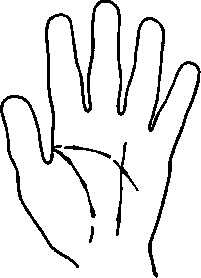
No. 1
These splits are splinters which have broken the lines and produced defects in any line by reducing its clearness and strength, also impairing its usefulness by crippling its ability to carry the Current within the boundaries of the line. These splits must not be mistaken for sister lines, nor for islands, as they do not join the line again after splitting away from it, but must be read as simply split lines, which show a weakened quality of the line during the period of life covered by its continuance on the line. Splits are sometimes very small and fine, and if any doubt exists as to whether a line is split or not, make a careful examination with your glass. The true split line leaves the Main line, and does not come back and attach itself to it again. This split line allows a portion of the Current to be diverted from the Main line and changed to some new direction. It is a leak in the line. This divides the strength of the Main line by taking away from it part of its ability to carry the Current in the original direction. These split lines are often the beginning of a new course in the life of the subject. They show that the natural life map may have been altered at the time they occur.
Continue to:


My Books

