


Chapter VI. Flexibility Of The Hands
Description
This section is from the book "The Laws Of Scientific Hand Reading", by William G. Benham. Also available from Amazon: The Laws of Scientific Hand Reading.
Chapter VI. Flexibility Of The Hands
1. Any object which is flexible can adapt itself to a greater variety of conditions than could the same object if it were stiff.
2. A flexible object bends underpressure; a stiff object under the same amount of pressure breaks or remains immovable.
3. As the hands reflect the condition and quality of the mind, flexible hands show a flexible mindt and stiff hands a stiff mind.
IN the present examination, which seeks to determine the degree of flexibility possessed by the hands, you are beginning to judge the mental powers of your client and will aid yourself materially by gaining a thorough understanding of the three statements introducing this chapter.
The flexibility of a hand is shown by the ease with which it bends itself backward, and to test this quality lay the hand of your client, with the palm upward, in the palm of your left hand, and with your right hand exert pressure downward on it until you have bent it as far backward as you can.
Having made a test of both your client's hands as above described, notice whether the whole hand is flexible, or whether the bending occurs only at the knuckle joints, for in the flexibility which means the most, you will find that the whole hand bends, fingers and all, and does not merely give way at the knuckles. In the examination for flexibility there will be great degrees of variation, running all the way from hands in which the fingers bend back at an angle of nearly forty-five degrees to others where the fingers cannot be even straightened. The extreme degrees of flexibility you will find in the hands of women, while pronounced flexibility in the hands of men is a rarity. The flexibility of the hand shows the degree of flexibility of the mind and nature, and the readiness with which this mind has power to onfold itself, and "see around the corner" of things.
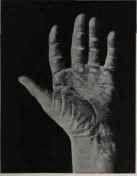
No. 20. A STIFF HAND.
In treating this matter, we shall speak first of the hand which is stiff and hard to open, where the fingers form a curve inward (20). This hand indicates the mind that is cautious, immobile, close, inclined to narrowness and stinginess, and which, in every way, lacks pliability or adaptability. Such a person is afraid of new ventures, afraid of new ideas; the method of dress and mode of living of his ancestors satisfy him; he has the political and religious faith of his fathers, and there is absolutely no use in trying to argue him out of it. When he views the methods and manners of the present generation, he longs for the open fireplace, the stage-coach, and, as he calls them, the "good old days." He is one whose narrowness makes him ungenerous. Appealed to for help, he replies, "I had to work for my money: let them do the same.** He thinks that failure comes because the old-time ways have been discarded, and that "new-fangled notions" are ruining everybody. He is the man who succeeds by hard work, deprivation, and saving, and he cannot conceive how success can be achieved in any other way. He is, in short, cramped and narrow in his ideas, stingy in his ways, unprogressive in his views, and lacks flexibility, or elasticity, in mind and manner, as well as flexibility of hands.
He is, however, exceedingly close-mouthed, and you can safely trust him with a secret, not from any desire on his part of doing you a favor, but nothing that he can keep gets away from him, so he holds your secret as avariciously as he clings to his own dollars. This is the stiff hand, and under the kaleidoscopic changes during the past age, he breaks on the wheel of time, because he does not bend, and adapt himself to the inevitable march of events. This hand is usually hard.
You will find hands which, when pressed backwards, open readily until the fingers straighten themselves naturally, so that the hand opens with ease to its full extent (21); there will be cases where it bends back Just a trifle. This hand is the medium or normal development, and its owner is balanced, even in action, up to date, and has control of himself. It is the hand of one who does not go to extremes, is self-contained, listens readily, and understands what he hears. He is not held back by old-fogyism, nor impelled into rashness or overenthusiasm. He can use money properly, will help those in need, but does not throw away either sympathy or charity. To him life is a problem, it is serious, and he thoughtfully uses his mind trying to understand it. He looks over the world from a bird's-eye point of view, can appreciate the difficulties that surround humanity, and will not try to find the remedy by crying that we are departing from old ways, neither will he want to turn everything upside down with the advancement of new ideas. He is thoughtful, broad, earnest, sympathetic, yet all within bounds. He is, in plain words, well balanced, and not an extremist.
This hand is generally elastic in consistency, and impresses you as possessing vital force.
There is another hand that is flexible in the extreme (22). The fingers bend back, without giving their owner any pain, until a graceful arch is formed. The fingers seem mobile, and the bones cartilaginous. This hand, as you bend it back and forth, impresses you with its great pliability, and shows readily what a fine machine it is, and how easily it can adapt and shape itself to circumstances. This flexible band shows an elastic mind, a brain susceptible of receiving keen impressions, and of understanding them quickly. It is the hand of the person who readily adapts himself to bis surroundings, is versatile, and does not require a diagram with every statement. Its elasticity is its danger, for it is a brilliant hand, directed by a brilliant inind. Its owner possesses in the highest degree versatility, and, being able to do many things, is liable to diversify his talents and lack concentration in any one direction, thus becoming a Jack-of-all-trades. The possessor of the flexible hand is extremely sympathetic, generous, and money to him is only the means of securing what he wants, not a thing to be hoarded for itself alone. The possession of riches gives pleasure to these persons only in that it allows them luxury, and extravagance is a prevailing tendency of the type.
They are emotional, easily moved by a pitiful story, and readily give to any one. Their minds work rapidly, they absorb ideas quickly, and their tendency is to go too fast. These brilliant hands are capable of the most wonderful achievements; they are not the hands of dreamers, but are full of life and action, though too versatile often for their own good. They can do too many things, turn their minds in too many directions, and unless restrained they come to naught from too much talent. They are as extreme in prodigality as the stiff hand is in economy, and yet they have this wonderful factor in their favor, viz.; they are so sensible that they can see their own failings when properly pointed out. and with good head lines, and good thumbs, they turn their brilliancy to fine account by applying determination and self-control to their natural versatility, which qualities give them the highest degree of success.
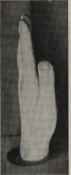
No. 21. A STRAIGHT HAND.

No. 22. A FLEXIBLE HAND.
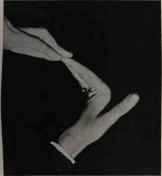
No. 23. EXTREME FLEXIBILITY.
Hands where only the first phalanges of the fingers are flexible, the rest of the hand normal, give one third of the degree of flexibility shown when the whole of the fingers are flexible, indicating flexibility in the mental qualities of the fingers on which this condition is found. Where the fingers bend back at the knuckles (23), you will find, in a musical hand, fine ability in execution. It also shows the extravagance of the extremely flexible type. It will not be hard to find good specimens of the hands dealt with in this chapter: the first you will find oftenest among middle-aged farmers; the latter types you will find everywhere. You should always carefully compare the two hands. If the left is stiff and the right flexible, your subject is improving mentally, the brain is becoming more elastic, the subject passing from stiff to flexible qualities. If the left hand is flexible and the right stiff, he has become more stingy, careful, less versatile, and is passing from the qualities of the elastic to those of the stiff hand. In this way you will often be able to do some excellent work by describing how a subject used to throw money away, and how stingy he has grown.
Having learned fully the qualities of the two hands, you can carry your simile as to the changing condition as far as you like, and in whatever direction the flexible or stiff hand may show it to be drifting.
Continue to:


My Books

