


Chapter XIII. Knotty Fingers
Description
This section is from the book "The Laws Of Scientific Hand Reading", by William G. Benham. Also available from Amazon: The Laws of Scientific Hand Reading.
Chapter XIII. Knotty Fingers
IN looking at your client's fingers, they will impress you either as being smooth, or as having knotty joints (55). These smooth and knotty developments indicate two exactly opposite kinds of people. The smooth fingers are more often found on young persons, while knotty joints belong to maturer years. This is not an invariable rule, however, for the philosophical qualities shown by knotty joints are often born in a subject,in which case the knots develop early; but as most persons become more analytical as they increase in years, knotty fingers are more often found on older subjects. On some fingers only the first joints are developed. This first joint is what we call the knot of mental order, and refers to the symmetrical qualities of the mind. On other hands the second joints are developed, and these are called the knots of material order\ indicating the love of order that manifests itself in neatness of the home, the office, or, in short, in all material things. A combination of the two knots shows both mental and material system, and consequently one who acts more slowly, thinks over things more carefully, and applies the gauge of mental and material neatness to whatever he does.
This way of gauging things by rule, of judging them from the standpoint of a systematic mind and body, leads to a habit of analyzing everything, of reasoning out all questions, of tracing back the thing as it stands, to the elements which compose it, and thus we find that analysis, reasoning, investigation, and thoughtfulness, are the ever-present qualities of knotty joints. For these people to accept anything as true means that they first hear it, think of it, and digest it. They examine every statement, refer it to their systematic minds,and gauge it from the additional standpoint of common sense and practical reasoning indicated by the second knots. They are not carried away by enthusiasm or impulse, but bring to bear on everything, the light of thorough investigation and thought. These knotty-fingered people are well named philosophical, as they are hunting for truth. They do not analyze from any frivolous motive, hut because they wish to arrive at the facts, so while they do not seem to respond as quickly as smooth-fingered subjects, always remember that they are honestly striving to get at the bottom of the matter, and will be guided by the result of their investigations as the facts may appear to them.
With this analytical tendency, it follows that the knotty fingers are seldom emotional, not easily led by sentiment, but that reason (head), not impulse (heart) is their guide. Knotty fingers cannot be suddenly rushed into anything. Give them time to think, something to think about, and abide the results of their investigations. If you have a hobby or a pet plan, do not expect them to adopt it, or at once to fall in with your ideas. Put the case as strongly as possible and give them time to think it over. Knotty-fingered persons are studious; they do not rely on impulse or inspiration to carry them through life, but depend upon a well-stored brain, in which information is classified and ready to be used when occasion demands. For this reason knotty joints belong to scientists and historians, rather than to romance writers. Knotty fingers always give an impression of energy and common sense. You realize the study and labor necessary to arrive at all their philosophical conclusions. Knotty fingers often make original deductions, but they never swerve, once convinced that they are right. In religion they are as likely to be atheists as Christians, for knotty fingers require much proof before they will believe anything.
They are the doubting Thomases, are naturally skeptics, ready to be convinced, but wishing to hold in their awn hands the evidence. If they cannot do this, they may conclude there is no evidence, and as it is often easier to prove that a thing is not than that it is, they become atheists. Whichever side they are on, however, they honestly believe it is right. Philosophical and analytical they are; reasoners, investigators, seachers for truth; honest, energetic, hard to change, thinkers, doubters, slow to arrive at conclusions, patient, and systematic. Knotty fingers thus hold the world in check, and prevent its going too fast. If you remember the life current bringing its flash of intelligence into the ends of the fingers, and think of it as stopped by the first, or knots of mental order, until these knots can digest it and let it pass; and then think of it as stopped by the second, or material knots, until these knots can digest it and let it go by, you will have a mental picture of how hard it is to get an idea through the philosophic knots. Smooth fingers may and do develop knots. I have seen many such cases in people who have developed reasoning faculties as they have grown older.
This is why I say, knots are oftener found on the hands of old than of young people, for these persons have passed from a way of acting by impulse to a habit of analyzing and reasoning. You will often have people tell you that the knots on their hands came from labor or baseball. This is not true. It is the habit of analysis that has produced them. Every analytical reasoner may not be a scientist of renown; don't get that into your head. You will find reasoners in the gas trenches, who analyze everything in their sphere of life just as carefully as the sage. I have seen the smoothest of fingers, whose owners have done hard manual labor for years. Labor does not produce knots (see 20); mental qualities do (see 55). I have made a thorough investigation of this matter, for it is one of the first questions one hears from those who wish to argue against the accuracy of hand-reading. If only the knot of mental order is found on the hand (56), it will indicate an intelligent mind, a systematic way of thinking, and mental processes that are careful and regular; this, of course, if this knot is of normal size. The good results of mental system can be largely overdone, however, as it is responsible for pronounced cranks and even insanity.
I once met a man who had a tremendous development of this knot. As it is my custom to investigate any pronounced formations I led him into conversation, and found him most intelligent and well educated. It was not long before he unfolded a plan by which he hoped to concentrate all the business in the world under one management. He had figured it all out on paper and was sure it could be done. Men called him crazy, but, in view of the organization of trusts during the past few years, he may not have been so insane after all. At any rate, he had immense knots of mental order. He had no sign of the second knot, however, and was careless to an extreme in his personal appearance. The mental development had entirely displaced the material. He was out of balance.
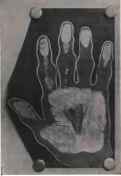
No. 55. KNOTTY JOINTS (Not produced by Rheumatlam).
If the second or knot of material order is found well developed (see 55), it will tell of the method in material affairs possessed by the subject. He will want his home neat and well kept, his place of business clean and orderly, and in all material matters will be careful and systematic. He will be neat in appearance, though his clothing may be old and worn, methodical in his daily life and habits, and with square tips he will be carried away by system. When knotty fingers are seen, look to the tips. If square tips are found, add square to knotty qualities. In this case you will have a severe disciplinarian and taskmaster, who, whether husband, wife, or employer, will be almost fanatical in red-tapism. Spatulate tips, with the first knot, will give you the most obstinate kind of a person, one cranky in the extreme. Remember that the vital spark has increased difficulty getting through the tips of these spatulate fingers with the added knot, and realism in the greatest degree will be indicated. Conic or pointed tips lighten the intensity of the knots, and give them the best possible complement. This is the ideal knotty hand, one which lightens the severity of the philosophical disposition by letting in a little idealism.
The conic tip and knotty fingers are the hands which are religious, for the conic tips allow the analytical doubting qualities a little idealism, and this formation is the only one willing to take anything for granted. Spatulate and square tips, and knotty joints are so bound down to materialism that they will not believe in what they cannot see and touch. Thus people with these formations are usually skeptics.
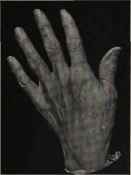
No. 56. FIRST KNOTS DEVELOPED.
Examine the consistency of the knotty hands before pronouncing fully upon them, for softness or flabbiness will make them only lazily analytical. Before you say they really expend time and effort in study and research, be sure that they have hard or elastic consistency. Flexibility is not often found. The knotty minds are not elastic, they achieve results from labor and study, not from elasticity of mind or brilliancy.
In speaking of knots on the fingers understand that these knots must be so pronounced as to be recognized at first glance. Unless they are thus plainly marked do not class fingers as knotty. If they are so bulging that they distort the fingers, consider the knotty qualities very pronounced. If they bulge out at the sides of the fingers, and in addition at the backs, so that it looks as if a ring were around the bone under the skin, it is an excess in development of the knots, which entirely spoils their good effect. In such developments the first phalanx of the fingers is bent inward, and the stiff qualities of the mind predominate. Flexibility is absent, the brain is hard, not elastic, does not take new ideas, but rides hobbies to death.
Continue to:


My Books

