


The Nails. Part 2
Description
This section is from the book "The Laws Of Scientific Hand Reading", by William G. Benham. Also available from Amazon: The Laws of Scientific Hand Reading.
The Nails. Part 2
As the fluting grows more pronounced, the nail grows brittle, begins to turn back from the end, loses its graceful shape, and becomes high on one side of the finger and low on the other, or is very short because the nail is bitten down into the quick. At this stage there is great delicacy of nerves or grave danger of paralysis. The nerves under the nail are thus reflecting by means of the nail the disorder which has occurred in the greatest of our nerve centres, the brain, and the vitality of the nail is being burned up, the oil dried out of it: the filaments, instead of binding themselves together in a homogeneous mass, are piling on top of each other, and the nervous confusion of the system is producing a confusion of the nail structure and life. Thus in this progression, from the mere warning conveyed by the white flecks, through the stage of fluting, to the brittle, turning-back nail, you can trace the degree of danger from nerve destruction or disorder in your subject. I have seen cases where smooth, even-textured nails, after a sudden attack of nervous prostration, grew out white and cloudy in color, and strongly fluted.
I have seen these same nails, as health returned, gradually resume their normal texture and lose the fluted appearance.
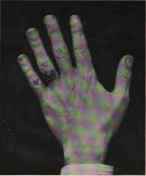
No. 24. FLUTED NAILS.
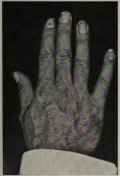
No. 25. CROSS RlDGES ON NAILS.
There is another indication which I have often verified, where the nail shows a ridge crosswise. Seemingly the nail has stopped growing, its vitality has been interrupted (25).
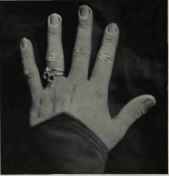
NO, 26. NARROW AND LONG NAILS.
It is as if one nail had died, and another had grown on to the finger to replace it. This cross-ridged nail shows that a serious illness has interrupted the health of the subject, and that the illness was attended with grave danger. When you encounter this nail, it will give splendid material with which to work, for you can almost always tell what the nature of the sickness was, and how long previously it occurred.
This nail always records a past event, and is not, as has been incorrectly stated, a source of information as to the future. It requires about six months to grow a new nail, so that in handling this indication you can tell how long since the illness occurred by noting how far the ridge has grown: if one quarter of the length of the nail, about one and one half months; one third, two months; one half, three months; and this can be continued until the nail has completely grown off the end of the finger. With this cross-ridge you will often see a firm-textured nail replaced by a fluted nail. In this case, it shows that nervous trouble has been the cause, and by judging how far out the new nail has grown, you can tell that at some time between one and six months past the subject has been dangerously ill from a nervous disorder. The exact date can be told by the distance the ridge has grown out. If the new nail is badly fluted, you can say, "This trouble has not entirely disappeared," and in this case you should advise rest and freedom from all excitement. In the progress of this chapter, we shall find other nail formations showing disease. If any of these show in the new nail, that will be the disease that has caused the trouble.
Whenever you find the cross-ridged nail, handle it as above outlined, and it will give you excellent results. Remember that it always shows a grave health indication.
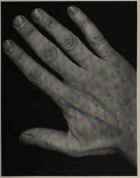
No. 27. Broad Nails.
No. 28. SHORT NAILS.
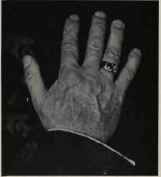
As an indicator of general health and robustness of constitution, the nails are also valuable. In this regard it has been my observation that a narrow nail shows a person who has not robust muscular strength, but is carried by nervous energy (26). It is a psychic nail, and the delicacy of the psychic character is present, rather than muscular strength as shown by a broad nail (27). The narrow nail will be either white, yellow, blue, or pink, never red, and it will be often found with the blue color at the base, denoting poor circulation. Neither the broad nor the narrow nails are indicative of special diseases, but, as I have said, of general health and strength. When you find the delicate, narrow nail, read a delicate constitution, with a broad nail a robust one, especially if the nail be, as it often is, red in color. Of course, if in the handling of these two nails you see abnormal developments, such as yellow or blue color, use these to indicate special trouble as is indicated by color, and if you also find changes of texture, such as fluting or brittleness, read it as showing nervous trouble.
Tbe general indications of robustness or delicacy are to be used only when found without complications of color or texture.
There is a nail which has many degrees of development, and which is to be read as indicating its peculiar qualities in proportion to the pronouncedness in which it is seen. This is the short nail (28). All short nails show a critical turn of mind, but if the nail is not very short, it will only be a quizzical or investigating disposition. This must be taken as the mildest type, while the extremely short, flat nail with the skin growing down on it, is its opposite, showing pugnacity and a person who does not argue with you because he believes he is always right, but because he loves contention. You will find this latter type, which is the one from which you start in grading the degree of shortness, often not a quarter of an inch long and very broad, covering the entire visible end of the finger, and giving the tip an exceedingly flat, blunt appearance (29). This nail gives almost a clubbed appearance to the fingers. The skin seems to cling to the nail, and loves to grow down on it until it can stretch no farther and breaks. This generally results in leaving a ragged appearance where the skin joins the nail. This nail goes with a vigorous constitution, an active mind, and a very critical, pugnacious, argumentative disposition. It shows a person who would rather argue than eat.
Continue to:


My Books

