


The Thumb. Part 7
Description
This section is from the book "The Laws Of Scientific Hand Reading", by William G. Benham. Also available from Amazon: The Laws of Scientific Hand Reading.
The Thumb. Part 7
This thumb undoubtedly possesses the brutal obstinacy, the violent temper, the low qualities characteristic of a murderer; but it is the balance of the hand that must tell you whether there are not refinements and good traits that will keep the clubbed thumb from doing harm. Always a danger, always showing terrific obstinacy if roused, a brutal temper and furious rage if kindled, the clubbed thumb requires careful study whenever seen; no hasty judgment should be passed on it, but every part of the hand estimated and cast in the scales before the balance is struck; and, above all, it should not be confounded with a spatulate thumb. Texture (for refinement), consistency (for energy), color, especially red, giving intensity and ardor, as well as everything that brutalizes or coarsens the nature, must be taken into account. Flexibility, to see if the elastic mind or the one-idea brain is present, the Mount of Venus to tell of love or sympathy which softens the nature, or of animal passions which may make it unmanageable, - all such things, and everything bearing on them, must be carefully looked at before you are in any position to say what a clubbed thumb means for your client.
With all these matters considered and understood, you can properly estimate this most difficult and dangerous indication.
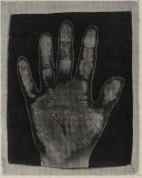
No. 81. KNOT BETWEEN WILL AND LOGIC.
The knot separating the phalanges of will and logic (81) is sometimes present, sometimes absent. It operates exactly as does a knot found anywhere else, - it creates an obstruction to the passage of the vital current, and consequently means deliberation of thought. It adds to the strength of the first phalanx, by making it more analytical and less guided by impulse. Thus it will greatly strengthen a conic tip and will add force to all the other tips. It increases the reasoning of the second phalanx, by reducing the intuition of the first, making a hasty operation of the will unlikely until thought and consideration have had a chance.
Having passed the knot, we reach the second phalanx, indicator of logic and reasoning qualities, perception, judgment, and prudence. In this list of qualities you will notice prudence, which is not generally ascribed to the second phalanx, but as prudent people are those who reason rather than act by impulse, it is evident that caution, or prudence, must belong to this phalanx. I have noted in my study of the second phalanx that this quality applies to it, and is strong in operation, especially if the thumb be carried close to the hand or is stiff. In the latter case the prudence comes from a stingy tendency. In examining the second phalanx, first consider its length. The second phalanx should be estimated as beginning with the joint which connects it to the palm, and as extending to the joint between the first and second phalanges. First look at the thumb held up naturally, and next bend the first phalanx toward the palm, to show the joints plainly and thus give you the exact length of this phalanx (82). This length, to be normal, depends on the length of the hand; a very long hand will have a long phalanx and vice versa, so accustom yourself to noting whether this phalanx is in proportion to the hand, and whether it is longer or shorter than the will phalanx.
Normally it should be a little longer, but it is still a good development when you find the first and second phalanges of the same length. The second phalanx shows the reasoning faculties, as well as logic, the science of reasoning. Being the seat of this most important function, it shows by its length and formation how much and what kind of reasoning are behind the will, so the second phalanx really occupies a position as director of the will. When the phalanx is found long and in good proportion as regards the will phalanx, it shows strong powers of logic, quick perception, and prudence. With these qualities its possessor will act from well-defined motives, will know what he is doing, be sure of his opinion, and will guide the forces of the first phalanx to expend themselves in beneficial ways. With this long second phalanx you will never find unreasoning obstinacy, but a will power guided by a reasoning brain. The direction, definiteness, and firmness of the will are largely augmented by this long second phalanx, but it is reasonable strength that is added, so even with an excessive first phalanx, and the second long also, you may be sure that, however obstinate your subject may be, he will still be amenable to reason.
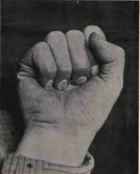
No. 82. SECOND PHALANX FROM JOINT TO JOINT.
In noting the tips of the thumbs, the long second phalanx will tell you that strong judgment is behind all of their separate qualities. Reasoning faculties added to conic tips will strengthen their impulsive ways and make them less impressionable; to square tips they will add sound practical judgment; with spatulate tips they will direct the spatulate energy into well-thought-out channels. From every point of view the second phalanx is the balance-wheel. Occupying the position it does between the first and third phalanges (determination and love), it will, if long, be the factor that will hold these strong forces in check, or, if short and deficient, will allow them to run riot. Reason, between will and love, must be the agent to guide them well or ill.
If the second phalanx is found shorter than the first, it will tell you that will is stronger than reason. In this case the subject will have excess of ill-directed will, modified in cases where the second phalanx is exceedingly waist-like. If the second phalanx is short and thick the subject will be stubborn, headstrong, acting without careful thought, and making many mistakes which he is too stubborn to correct even though it be to his advantage to do so. The short second phalanx is a sign of weakness that must not be overlooked. If with it the first phalanx be very strong, bad results are bound to follow, as obstinate will must have logic to direct it properly. If the tip of this thumb be conic, the short second phalanx will add to the weakness of the indication, for an impressionable will with lack of logic behind it produces deficiency of all good thumb qualities. With a square tip it makes the subject a martinet who makes a poor attempt to show strength when there is only weakness. It makes the spatulate qualities fussy without producing any tangible results. If the second phalanx be exceedingly deficient it pulls down the entire structure, and weakens it in every place.
Continue to:


My Books

