


Manipulating Salmon And Trout. Part 3
Description
This section is from the book "Fish Hatching, And Fish Catching", by R. Barnwell Roosevelt, Seth Green. Also available from Amazon: Fish Hatching, And Fish Catching.
Manipulating Salmon And Trout. Part 3
It must be remembered in this and all subsequent handling of the fish, that it the outer skin of a trout is broken or abraded by the hand or in contact with any hard substance, it will, in nineteen cases out of twenty, cause the fish to die. A white fungus appears on it first where the skin is broken; this fungus spreads over the fish until it is sometimes half covered with it before it dies. We speak of the covering of trout as "skin," because it feels like it and looks like it, although in reality trout are covered with minute scales. They will get over a deep and clear cut much more quickly than over a bruise where the cuticle or skin only is broken.
The fish being now in the tub must be taken to the hatching house as quickly as possible. There are probably in the tub some fifteen or twenty fish, and all the operations must be conducted as quickly as possible so that they will not die in the small quantity of water to which they are confined. So long as the fish lie quiet in the bottom of the tub there is sufficient air in the water to sustain them, but as soon as they begin to come to the surface and try to leap out, it is a sign that the air is nearly exhausted and the water should be renewed. They will also open their mouths wide, just as a person would when gasping for air. The question has sometimes been asked how long a trout would live out of water ; the answer is, about as long as a man would live under the water. Trout will die in a tub out of which the oxygen has been exhausted by their breathing, more quickly than they would die in a cloudy day if out of the water entirely.
A fire may be made in the hatching-house to warm your fingers, which will probably get cool while engaged in this operation. A six quart milk-pan is to be provided, if you have many fish, and also another tub of water, into which to put the fish after they are deprived of their spawn. Select a fish, and holding it over the milk pan, which has been dipped in water to wet it, rub it gently with the fore finger and thumb, from the pectoral fins to the vent. A little experience will show how this is to be done. If the fish is ripe, a few drops of pearly colored milt, or orange hued eggs, will be forcibly expressed into the pan. If the milt is not of this color, it shows that the milt is not good, and another male must be taken and treated in a similar manner. The female must be pressed more slowly and oftener than the male. If the eggs are not ripe, by passing the hand lightly over the belly, you will feel them beneath, hard, like shot. In that case put the fish back into the pond, for the eggs to ripen. When the eggs are ripe, the belly will be soft and flabby, and the eggs beneath the skin feel loose and change their position at the touch. So loose are they, that by holding the fish in a horizontal position, and then moving it up and down, the eggs will change, and fall downwards or upwards as if in a bottle. The operation must be continued until the fish are emptied of eggs and milt. The eggs in the pan may, at intervals, be gently stirred by moving the pan ; this is to change the position of the eggs, so as to be sure that all come in contact with the milt, and when the operation is completed a half-pint of water is poured on them and the pan set in one of the hatching troughs through which the water is running ; this will keep the eggs up to the proper temperature, and prevent a sudden change when they are transferred to the trough. The eggs will now agglutinate or stick to the pan, and to each other, for a little while.
In handling the fish, gentleness is essential. A trout, it is well known, may be tickled under the belly, and rather seems to like it, and will lie quiet in your hand while your are doing it. By putting the hand quietly in the water, moving it cautiously around the fish, and gently lifting him he may be raised high and dry, and will lie quietly without a struggle. There is a way of grasp ing a trout firmly, but gently, so that he cannot squirm, and yet not hard enough to break the skin.
We give a cut of handling a large fish which shows the proper position, except that the fish had to be held too high from the pan in order to get a good photograph of the operation, and that the operator is left handed.
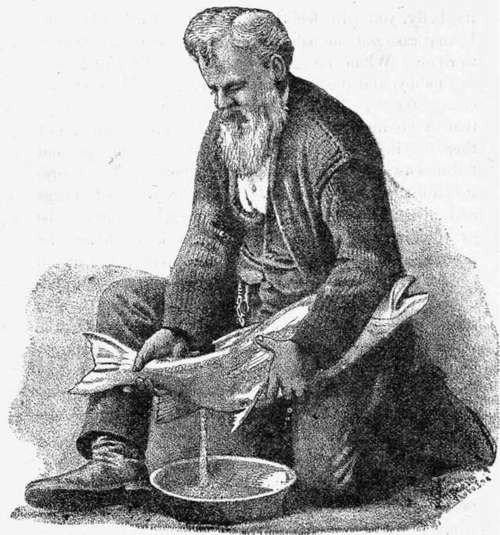
Seth Green Taking Spawn From A Salmon Trout. The Proper Position.
The fish must be grasped by the head, if you are right-handed, with the right hand, and by the tail, or rather the lower part of the body, with the other hand, and held over the pan with the belly near the bottom of the pan. As soon as the fish is quiet, the right hand may be gently slipped down from the head, and the fore finger and thumb used to press the belly. The fish still being held by the tail, and lower part in the left hand, and partly supported, perhaps, by the sleeve of the coat, or by the bare arm, and the remaining fingers of the right hand. Every one will have a way in which he can do this best, and will find it out after a few trials. If the fish is large and struggles violently, the usual direction given in the books, is to let an assistant hold the head. We counsel you, if the fish struggles violently, whether it be large or small, to drop it back into the tub, manipulate another, and after a few minutes try it again; it will lie quiet after a while. If you attempt to hold a fish, which struggles violently, you will be very apt to kill it. It, in addition to your own two hands, you get the two hands of an assistant on the struggling fish, there is not much chance of saving him alive. A better way is to file the barb off of a No. 4 hook, then tie it with three feet of line to a pliant switch three feet long. Hook your fish on this, through the jaw, and holding it in a tub of water, let it struggle until it is exhausted. Then the hook can be slipped out, no injury having been done to the trout, which can be handled without difficulty.
Continue to:


My Books

