


Camp Construction
Description
This section is from the book "Camping Manual For Troop Scouters", by Boy Scouts of America. Also available from Amazon: Camping Manual For Troop Scouters.
Camp Construction
The latrine being the first thing to be arranged, we will study a few types:
1. The Straddle Trench Latrine - Pick out a level spot, well screened from the camp and any places where people may pass. The dirt should be fairly easy to dig. Stake off a trench on basis of about six inches of length for each camper, dig one spade width (six inches), and twelve to eighteen inches deep and carefully pile the dirt in a ridge parallel to the trench. Pile this dirt about five inches back from the edge of the trench.

Make up a sign and put on stake at one end to indicate where to begin using the trench. When a camper has used the trench by squatting over it he scrapes the dirt from the ridge into the trench with his foot or with a wooden paddle until trench level full just for the length he has used it. The toilet paper may be placed on a stick and stuck in the ground, each camper moving it to be convenient for the next person.

2. Pit Latrine - For a Troop this trench should be six to ten feet in length, about two feet in depth and six to eight inches wide.
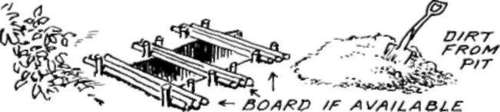
Cover with dirt each time after using. If strong one inch or thicker boards are available, use instead of round sticks. Another method of making a perch is shown below:

The pole upon which to sit should be centered about six inches from the front edge of the pit.
3. Garbage Incineration - Bum your garbage!. Burning garbage is the most satisfactory method for disposal. It should be done following each meal. It can be done on a steel grate whose bars are not more than one inch apart, or an improvised grate made of small sticks laid parallel or criss-cross.

4. Dishwater Pit - Here is where we must use some care for when the water soaks away the grease stays behind. It sticks on the bottom and sides of the pit and puts on the most effective waterproof coat you can want and then the ground won't soak up any more. Below is a diagram of how to arrest the grease:
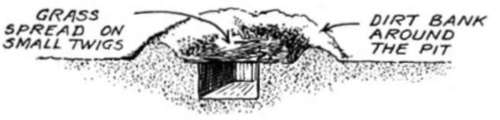
Dig the pit large enough to hold about sixteen gallons of water (two cubic feet) at one time, cover it with small sticks, then bank the air around and fill over the top with grass, straw or small weeds and strain the water through this. The grease will adhere to the fine stuff and almost clear water goes into the pit which will soak away and leave no coating to stop the next load. At least once each day the mat must be burned and replaced.
5. Tent pitching and ditching - Many an uncomfortable and sleepless night has resulted from failing to clear off the ground under the tent thoroughly before putting down the bed. It is strange how that little pebble or snag of a bush can grow during those first three or four hours of deep sleep after a long hike and wake you up about 3:00 A.M. with a feeling you certainly have a four ton boulder in the middle of your back or that you are gently reclining across a stump left over from the forest primeval.
Then when that thunder storm breaks about midnight and you wake up with a start when a cold wet stream sneaks under the small of your back, how you wish you'd have ditched the tent.
Over in Hungary the Scouts had a tricky way of ditching a tent that made a smooth job and was pretty long headed. They took a board about six inches wide and laid it down along the wall of the tent and cut the sod along this on both sides, then they moved the board out from the wall once its width, carefully took up the sod and laid it grass side down on the board. Then they dug the trench and piled the dirt on the upturned sod. The trench was as straight as a die. Here was the trick. When they broke camp they filled the dirt back in the trench, put a Scout at either end of the board, turned it over the trench and there was the sod laid in as nice as you please, all back in place. They cut a trench along each side of the tent under the eaves and cross connecting trenches and carried the water to the low side and dug a small round sump to catch the water and let it soak away in case the rain was heavy and lasted very long.
Tent Pegs are always a problem. Where the ground is firm they behave best driven "Army" style. That is leaning toward the tent as illustrated on page 9. A good tent peg for a water proof tent should be about 12 inches long with one notch. For a tent with a fly, a two notch peg is necessary, one for the tent proper and the other for the fly line. When you leave, always remove the pegs. Cache them if you plan to return.
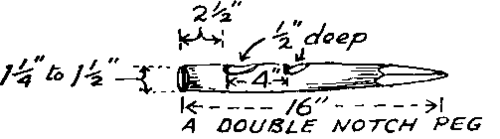
The above for use with a tent fly. Below is shown a tent set up with stakes set in firm soil and a method where the ground is sandy or loose.
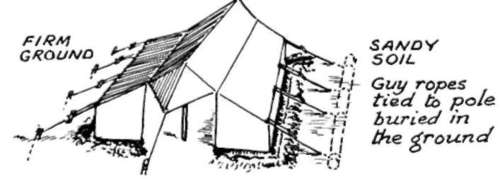
When tents are taken down always try to have them dry. Remember being wet with dew is just as bad as rain. Clean them thoroughly of all leaves, dead grass, etc. and fold neatly and roll tightly. Always keep a sharp eye out for your rope ends and keep them carefully whipped or back spliced. "Irish Pennants" flying are never good Scouting. And of course it gives a Sea Scout cold chills.
°* Bedding - Of course a sleeping bag is fine. Remember that inexpensive ones may prove to be bulky and heavy.
For a less expensive bed always have a ground cloth, just a plain piece of 10 or 12 ounce duck, heavily waterproofed, three feet wide by seven feet long. If dyed brown khaki or green it will be better. To waterproof, stretch it out over Mother's ironing board, take a cake of parafine and rub it all over until the shaved off parafine shows white all over it, then with a warm (not hot) smoothing iron run over it and melt the wax into the duck. Tents, bags, etc. can be treated this way.
If one wants to go further, it is possible to make up a very practical bed roll by following out the details of the plan below, the bottom of which is the ground cloth referred to above.
Next either buy or make up a bed sack or straw tick. This should be six feet six inches long and thirty to thirty-three inches wide, with the stuffing hole in the middle. If you want to be fancy you can put grommet holes on either side and have a lacing cord. Otherwise tie strings about six inches apart in pairs are satisfactory. This should be made of strong unbleached muslin or light drill cloth. Don't,stuff them too tight or you will roll off. Straw, hay, grass, weeds, leaves, balsam pine and such will make a comfortable bed.
Two four pound wool blankets make a good covering for most weather. Do not sleep in the clothes you have been wearing, as they will contain perspiration. Clean dry underwear and wool socks will help. On cold nights your poncho over the blankets has real merit and a ground cloth as well under your straw tick.
A small pillow sack will be appreciated by some of the Troop. This can be made of the same material as the bed sack.
Operation No. 1 - (Boxing in the ends and sides.)
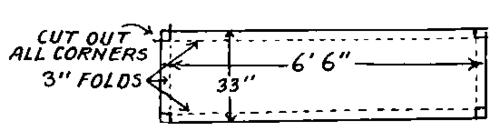
Operation la - Fold the cloth on dotted lines and stitch in this manner using No. 8 thread.
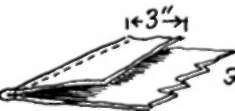
When this has been completed you will have the following:
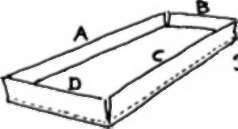
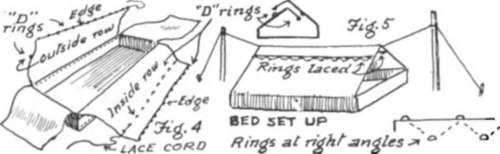
Operation No. 2 (side and flaps) - Cut two pieces for the ends and two for the sides 2'3" wide and sew on to sides and ends at edges, A, B, C, & D, Fig. 3. These pieces should go on the outside of the lower box in shingle fashion to shed off water. On the upper edge of the two sides, sew in a line of "D" rings 1/2 inch in size about 16 gauge weight, six inches apart and one foot back from the edge of one side piece and on the top side, sew another set of "D" at right angles to those on the edges - on the other side sew them on the bottom piece and you have the following:
7. Camp Kitchen and Dining Fly (Semi-permanent) - The following is a plan showing the use of two flies:

This requires one fly 16' x 20' for the dining fly and one 9' x 14' for the kitchen. The shelves for the kitchen are built of rustic material or sawed timber and the center and one end pole are spiked fast to these shelves, with a ridge pole and the hang over supported on a frame as shown in the perspective. This sort of arrangement is semi-permanent and can be left from one camp to another if the flies are stored with some nearby friendly neighbor. You have the fun and practice of putting the flies up at each camp.
7a - Camp Kitchen and Dining Fly for Patrols (Portable) - This is gear to take care of cooking by Patrols.
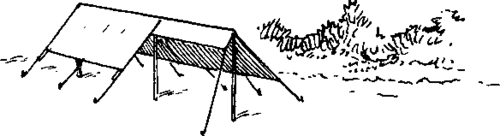
The dining fly is 9' x 10' and the kitchen fly is 7' x 12' . This makes them small enough so they may be transported to and from the camp to the Troop storage place at home. Detailed drawings for building may be secured from the National Engineering Service, Boy Scouts of America, 2 Park Avenue, New York 16, N. Y.
8. The following sketches show how many tables may be made for camp
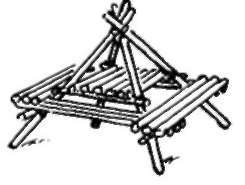
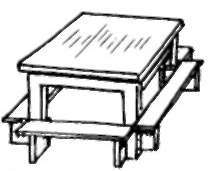
Detailed working drawings of these two eight-camper tables (2 on a side) are available from the National Engineering Service, and give a very much better social unit and occupy less ground space.
9. Cooking fireplaces are always necessary, and the type used depends to a great extent on the kind of country in which you are located. The sketches given below show some different kinds.
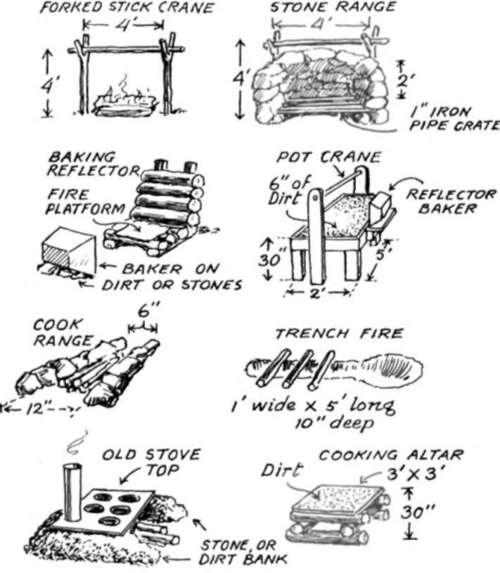
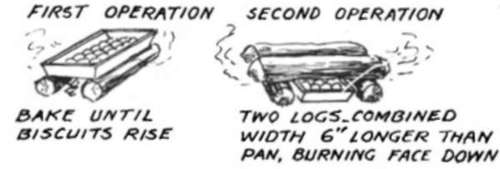
10. Trapper'a Biscuit Oven
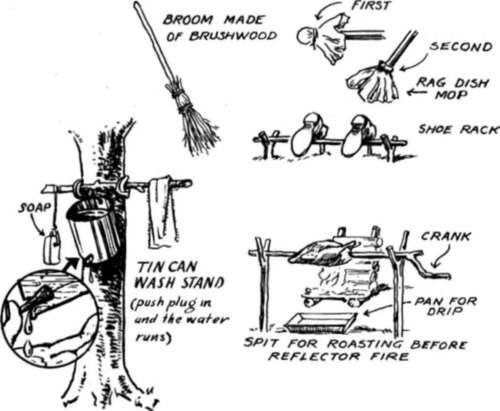
11. Gadgets for Around Camp
Continue to:


My Books

