


2. Troop Record Keeping
Description
This section is from the book "Handbook For Scoutmasters. Volume 1 & 2", by Boy Scouts of America. Also available from Amazon: Handbook For Scoutmasters.
2. Troop Record Keeping
What did we do last Columbus Day? How many Scouts were present at the Troop hike a month ago?

The rosters of your Scouts, Sea Scouts, Explorer Scouts, or Rovers go to the Local Council Office and become history.
Who were they? How far has Bobby Jones advanced? When did Jack Strong join the Troop?
These are some of the facts you must have at your finger tips to guide you in planning the activities of the Troop; to know the present standards of the Troop and to keep them up or raise them; to discover the Troop's weaknesses and overcome them; to aid Bobby Jones and Jack Strong and their brother Scouts in the Troop on their forward march in Scouting.
You are after Results. But results can be known only if you have Records of what has been going on in the Troop. And Troop records can be maintained only as Reports are gathered from those who are responsible for the activities of the Troop.
Reports-Records-Results. These are the "Three R's" of effectiveness.
The Troop Log
The Troop Log-or "Book of Traditions"-contains the permanent report of the Troop.
Keep It Vivid
The Troop Log is not a collection of dry facts, but a vivid report of the doings of the Troop, the Patrols and the individuals in it, reporting both creditable and "discreditable" (or incredible) acts with equal emphasis, with tact, humor, impartiality and judgment.
The Troop Log in itself may be a power for good in the Troop, if properly kept. A Scout likes to see his own deeds equal those of other Scouts whose accomplishments are being publicly recorded, and automatically the good Troop Log puts into operation that most potent force for a Scout's improvement-the spontaneous desire from within himself to do better.
But to be of value, the Log must be read. When you hear some quiet chuckles in the Troop room, you should be fairly certain that someone has casually picked up the Log Book to read the latest items.
The Keeper Of The Log
The Keeper of the Log should in all probability be the Troop Scribe. He became a Scribe because he possessed the very traits which will enable him to take care of the Log.
It is not his job to do all the work-on the contrary, his is the responsibility of getting everybody to help in creating a worthy history of the Troop.

The "Log" tells more or less romantically of the doings of the Troop. The Records tell statistically of those seme doings.
Securing Its Contents
Each Patrol will submit a report of its doings every week, with as much imagination expressed as the Patrol can muster, for the Keeper to include in the Log. The Keeper will get the Troop's "wit"'to write the doings of the Troop from a humorous angle, with plenty of good-natured jibes at his fellow members. He gets the journalist of the clan to write the news accounts, and the statistically-minded boy to write the statistics. The poet he encourages to write verses and jingles and epics of the heroic adventures of the Troop. He gets the artists to make cartoons and sketches-even if they be only of the "matchstick" variety-and will naturally have all who own cameras lined up to contribute their best "shots" to the Log.
After the material is gathered regularly-once every week or every two weeks-it becomes the Keeper's job to edit and put it in shape for posterity. He pastes small items on letter-head sized paper, copies what needs to be copied, pastes in sketches and photographs, adds his own personal contributions and inserts everything in the "Book of Traditions."
To hold the pages, a loose-leaf binder is most suited. This may be secured in any stationery or five-and-ten-cent store, and decorated to suit, in real "Scouty" style. Or the binder may be produced by the Troop's leathercraft expert by cutting leather to shape and punching holes in it through which a leather thong can be laced to hold the leaves together.
Records
While the Log tells more or less romantically of the doings of the Troop, the Records tell statistically of those same doings. They tell a story of great importance to those who know how to read them. To be effective, they should be simple, complete and up-to-date.
Suitable forms for Troop record keeping are available through the National Supply Service, or the Troop may develop and mimeograph its own.
An adequate record system should contain the following:
Book Records
1. Individual Scout Record (Form No. 503)-On this are kept the pertinent personal facts of the boy and his complete Scout history. The Requirements he meets are entered on this sheet. It also provides room for his record of attendance.
2. Attendance Record of the Troop (Form No. 506) -The attendance records of all the Scouts in the Troop are included on this form, preferably with members of the same Patrol listed together.
3. Advancement and Tenure Record of the Troop (Forms No. 528 and No. 528A)-On this may be seen at a glance the length of time each boy has been in the Troop and the advancement he has achieved.
4. Dues Record (included in Form No. 506)-Here a record is kept of dues paid and owed. The money is turned over to the Troop Treasurer, who keeps the Troop's Financial Records. (See Chat 19, Financing the Troop.)
Chart Records
5. Attendance Chart-On the wall of the Troop meeting room may be placed a chart showing the attendance of each boy, as a visual reminder.
6. Advancement Chart-An Advancement Wall Chart will aid in encouraging advancement, by making public to the Troop at all times the work of each member.
7. Patrol Contest Chart-to record the achievements of the Patrols (see Index).
Besides these, a graph may be developed to show the percentage of attendance at all Troop undertakings, and a chart showing the tenure of the members.
Who Keeps The Records?
In a Troop where the Troop Scribe is not a member of a Patrol, it should be possible for him to keep the Log Book and all the records, with the cooperation of an Assistant Scoutmaster for the advancement and of the Senior Patrol Leader for the attendance.
On the other hand, if he is in a Patrol, it would be unfair to place all the work in his hands. In this instance, it is advisable to arrange for two Troop Scribes, one as the Keeper of the Log and the other as the Keeper of the Records.
The Patrols And The Troop Records
Although the Scribe keeps the records, it should be definitely understood that it is up to the Patrols to provide him with the facts.
At the Troop meeting and on the Troop hike, for example, each Patrol Leader should present to the Scribe a list of those present and absent, with reasons for absences. Similarly, the Patrols should submit lists of the boys who have met Requirements or have paid dues, including the amounts.
Occasionally, attendance and dues are reported by the Patrols at the same time. For this purpose the Troop may use small manila envelopes, on the front of which the names of the boys of the Patrol are written and space provided to check attendance and dues, the dues being enclosed in the envelope when handed to the Scribe.
Forms And Blanks
In addition to the record keeping devices already mentioned, the Troop should have a supply of the following:
1. Application for Membership (Form No. 501B)- This is given to each candidate to be filled in by him and his parents and returned to the Troop. The information on this blank forms the basis for filling in the Individual Scout Record (Form No. 503) and the Additional Enrollment blank (see below).
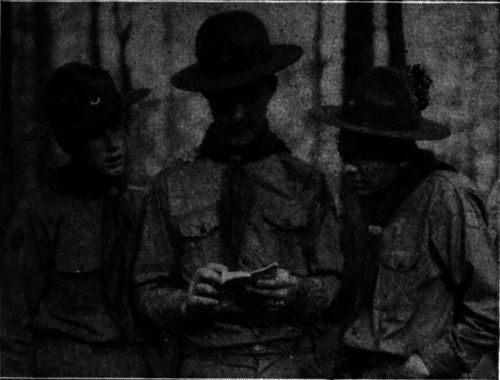
On Troop Hikes, as well as on Patrol Hikes, Patrol Leaders should keep a record of those who are there for the fun, and for advancement.
2. Additional Enrollment (Form. No. 515)-This blank is used for registering new boys with the National Office (through the Local Council).
3. Transfer Credit Certificate (Form No. 502A)- To be used in any case where a Scout is transferred to or from membership in another Troop.
4. Scouter Application (Form No. 716)-Used in registering Scouters.
Other forms, such as applications for Merit Badges, Star, Life and Eagle Ranks, are made available through the office of the Local Council whenever the Troop needs them.
Continue to:


My Books

