


8. Story Telling
Description
This section is from the book "Handbook For Scoutmasters. Volume 1 & 2", by Boy Scouts of America. Also available from Amazon: Handbook For Scoutmasters.
8. Story Telling
"Tell us a story" is consistently put to the Scoutmaster.
Story telling contains both an opportunity and a challenge as well as a compliment. Here is the Scoutmaster's opportunity of getting close to his fellows through capturing and holding their imaginations, of extending their horizons to other climes and times, of building their characters through holding before them deeds and exploits that have helped to create our civilization.
You Can Do It
You may say: "But I can't tell a story-just don't know how. I always get someone else who knows how to do it for me." Yet every man can become a story teller after a fashion if he will only keep certain fundamentals in mind and have a try at it. True, the first venture may be fumbling and halting, but after a few attempts all self-consciousness will disappear, the silent attention given by the listeners will constitute the greatest encouragement in the world and soon the man who said "I can't tell a story" will say "Gee, I didn't know I had it in me."
The Story Is The Thing
Many factors enter into successful story telling- seating of the audience, meeting the mood, drama in presentation. But first of all: THE STORY IS THE THING.
The questions most often asked by the aspiring story teller are: What kind of yarns do boys like? Where do I get them?
* Adapted from Harold Stein
Boys like all kinds of yarns, provided they contain action, have sustained suspense and end in a conclusive, definite manner.
Finding The Story
Every man who makes the slightest effort to keep up on his reading will stop time and again to say: ""That would make a fine story for the gang." If he is wise he makes a brief notation of the title, the author, where he ran across the story and a "sketch map" of the plot.
Another place to get stories is out of your own experience. Every man has, at some time in his experience, had a personal adventure which can be retold-a trip into the back country, an ocean voyage, a great fire witnessed-an experience which with the addition of the sauce of drama can be served up as a delectable dish.
The field of exploration offers another rich opportunity for the garnering of stories: Byrd's expedition to the South Pole, Lindbergh's flight across the Atlantic, Roy Chapman Andrew's explorations in the Gobi, Lawrence's adventures in Arabia.
The history of the United States is a treasure mine of stories to tell to boys: The exploits of George Washington, the story of the tragic Donner party in the West, The Jayhawkers in Death Valley, The Building of the Panama Canal. The life and death of Lincoln. These are but a few examples chosen at random, all containing the drama which is real life.
Preparing Yourself
When you find a story which you feel is well adapted for retelling, read it through until you have its sequence of events firmly fixed in your mind. Then tell it before a mirror to coordinate gestures, timing it at the same time.
General Directions
The story teller has a few general directions to keep in mind. First of all-the audience must be comfortable. Attention cannot be divided between concentration on a story and a cramped leg or an uncomfortable seat. Before starting your story, allow a couple of minutes during which everyone may find a comfortable position according to his concept. Start when the crowd is silent, not until then.
Deal with minor disturbances as they occur. If low talking is heard in the outskirts of the circle, pause until quiet is restored. Social discipline is never more evident than at the camp fire during the story hour, as the fellows realize that they are being deprived of their story by the actions of one or two noisy people.
If telling a story dealing with your own experiences guard against the too frequent use of "I"-"I did this," "I did that," "I said," "I acted," "It was due to MY." Tell the story in the second person or by generous use of the editorial "We."
Telling The Story
The start is important. The attention of the listeners must be caught in the very opening statement. Starting with a long description of the circumstances leading up to the predicament of the hero, of his attire, what he had for breakfast and the lovely afternoon sunlight on distant hills, dispels attention and you are likely to hear an impatient whisper: "Why doesn't he come to the point?" By saying: "Our boat was overloaded and we were quickly drifting into trouble. Behind us the bay was smooth as a millpond, ahead of us the tide was going out through the narrow inlet with high waves ripping every which way, and it seemed inevitable that we would be caught. 'Hold her off!' Jack shouted. 'Look out-watch that oar'-but before he had finished we were in the midst of what seemed a gigantic whirlpool. The boat was tossed from side to side. Then-a crack. One of our two oars had broken ..You get the idea? - Then there must be an ending and there must be no question about the ending. It must be as definite as the railroad terminal at the end of the line. All threads must be gathered together. All business disposed of. All obscure points made clear so that there is no doubt in the listeners' minds as to what happened to every character presented. And while the imagination has been stimulated throughout the telling of the story, no plot incident must be left to the imagination at the end of the story.
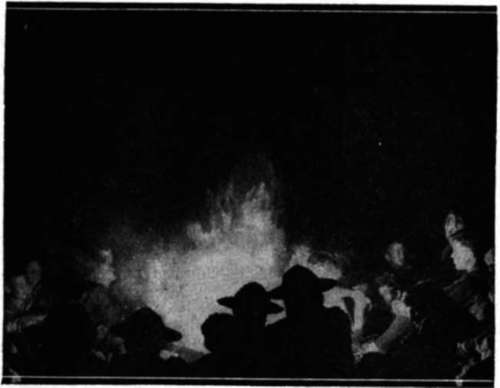
At the camp fire-a warm glow over everything-the smoke rising into the darkness, all make a perfect setting for a story.
"Tell us a story." Are you prepared for it?
Bibliography of Short Stories *
Mystery Stories
"Murder at Belly Butte"-Longstreth (Century).
"Around the Fire Stories"-Conan Doyle. See Chapter "The Brazilian Cat."
"Tales of a Traveler"-by Washington Irving (Mac-millan). See Chapter "The Devil and Tom Walker."
"In the Fog"-by Richard Harding Davis (Scrib-ner). Story a little long; must be cut.
"After Dark and Other Stories"-by Wilkie Collins. See Chapter "A Terribly Strange Bed."
"Great Ghost Stories"-edited by McSpadden (Crowell).
"The Lady of the Barge"-by W. W. Jacobs. See
"The Monkey's Paw." "Island Nights' Entertainment"-by Robert Louis
Stevenson (Scribner).
Indian Legends
"The Box of Daylight"-by William Hurd Hillyer (Knopf).
"The Red Man's Wonder Book"-Howard Augus
Kennedy (Dutton). "Rumbling Wings"-Arthur C. Parker (Doubleday).
* Compiled by F. K. Matbiews, Chief Scout Librarian.
Adventure Tales
"Adventure Days"-Carl Grabo (Rockwell). "How They Carried the Mail"-Joseph Walker (Sears).
"Full Fathom Five"-Frank H. Shaw (Macmillan).
"Short Rails"-by C. Warman. See chapter "Engineer's White Hair."
"The Man Who Was" -by Rudyard Kipling (Doubleday).
"Around the Camp Fire"-by Chas. G. D. Roberts (Macmillan).
"Dick in the Desert"-by James Otis.
"Ransom of Red Chief and Other Stories" for boys -by O. Henry (Grosset). Twenty-five O. Henry stories.
"Boy Scouts Book of Campfire Stories"-edited by Chief Scout Librarian F. K. Mathiews (Apple-ton),
Biographical Hero Stories
"American Book of Golden Deeds"-J. Baldwin.
"Pathfinders of the Trail"-by A. C. Laut.
"The Story of the Trapper"-by A. C. Laut.
"The Book of Bravery"-H. W. Lanier (Scribner). Forty-five short stories of heroic deeds.
"Adrift on an Ice-Pan"-by W. T. Grenfell (Houghton).
"The Wireless Man"-by Francis Arnold Collins. Contains a host of true stories of wireless adventure.
"Man Who Made Good"-by John T. Faris.
Stories Of Animals And Nature
"On the Edge of the Wilderness"-Walter Pritchard Eaton (Wilde).
"Wisdom of the Wilderness"-Charles G. D. Roberts (Macmillan).
"Those Who Walk in the Wilds"-Charles G. D. Roberts (Macmillan).
"The Sparrow of Ulm"-Grace Gilkison (Macmillan) .
"The Bald Face"-Hal G. Ewarts (Knopf).
"Best Bird Stories I Know"-edited by John Clair
Minot (Wilde). "Best Animal Stories I Know"-edited by John Clair
Minot (Wilde).
Continue to:


My Books

