


Chat 29. Short-Term Camping
Description
This section is from the book "Handbook For Scoutmasters. Volume 1 & 2", by Boy Scouts of America. Also available from Amazon: Handbook For Scoutmasters.
Chat 29. Short-Term Camping
THE next step is the short-term camp, the intermediate point between hiking and long-term camping.
Importance Of Short-Term Camping
The short-term camp is one of the cornerstones of Scouting. It is here that the Scoutmaster learns most about his Scouts and boy leaders. It is here also that the Scouts get their training for their great adventure —the long-term camp, which usually occurs in the summer.
To realize the importance of the short-term camp in the life of the Troop, you only have to do a little arithmetic: A summer camp may take in ten nights and ten days in a year, but during the rest of that same year you have the possibility of eleven monthly short-term camps. Some of them may extend from a Friday to a Sunday, besides several holiday camps, adding up in the neighborhood of fifteen nights and twenty days—at least. And then we haven't even counted the short-term camps undertaken by individual Patrols.
Preparing For The Short-Term Camp
The short-term camp is the logical evolution of the hike, and would be a very simple step for a hike-trained Troop to take, but for one obstacle: equipment. And even that is apt to simmer down to one item: tents. The Patrols in most instances will be able to secure most other things from the homes of their boys.
Tents
From the very beginning of the Troop you should have in mind that eventually tents will be needed. So start early to think of ways and means of getting them.
Broach the subject first to the Troop Committee as one of the items for which it has a responsibility: "Securing suitable opportunity for . . . camp, with adequate facilities. . . ." (By-Laws, Art. XI, Sect. 1, CI. 5, 9). Discuss it also thoroughly in the Troop Leaders' Council, and get the Patrol Leaders to take it up with their Scouts.
Depending on the decision of the parties involved, the job of securing tents may be considered (1) the Scout's own responsibility, (2) the Patrols' with the support of the Troop, or (3) the Troop's with the support of the Patrols. In the first instance, the Scouts make or buy their own, developing self-reliance, owner carefulness, and respect. Or, in the second instance, the Patrols might go about earning money as Patrols to buy tents, and the tents will become the property of the Patrols. In the third instance, the Troop Committee will decide upon ways of earning money, possibly in connection with the Parents' Auxiliary of the Troop, along the lines presented in the Chat on "Financing the Troop."
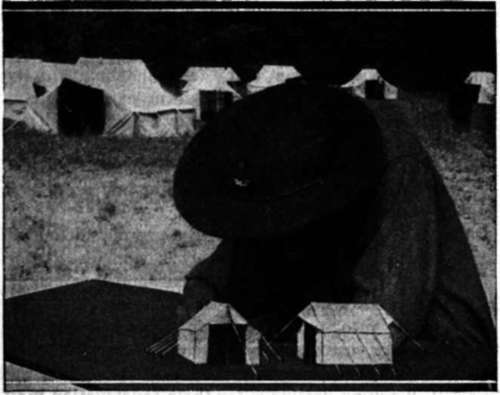
Tiny model tents become realities when the "Scouting" magazine program suggestions are followed by a Scoutmaster.
Money earned by Scouts, or by the Patrols or Troop, may be used to purchase the material for making tents, or it may be used to buy ready-made tents.
In considering your tent types, think ahead. You will want tents that may be easily transported for short-term camps. That means light-weight tents. In addition, you want them to be tents that are equally suited for short-term and long-term camps with a ground surface of not less than thirty square feet per camper, so constructed that the inside edge of each bed will be at least two feet from the inside edge of its mate. This automatically eliminates pup tents as a two-boy shelter.
The tent to look for is one with a ground surface of sixty square feet—approximately seven feet, three inches by eight feet, four inches—and preferably 6 feet high, to accommodate two campers. If it can be divided into two halves for easy transportation, and for use by the individual camper when desirable, so much the better. Such tents are on the market. Working drawings for their construction may be secured from the National Office, which has available the designs for several tents providing the prescribed number of square feet and ease of production.
Creating Your Own Type
If you desire to develop your own tent type, the procedure to follow contains the following steps: (1) Make a sketch of it, (2) make up a paper model, two inches representing one foot, (3) set up a full size "string model," i.e., outlining its shape with poles, pegs and string, (4) measure all dimensions, taking into consideration the necessary seams, (5) lay out the pattern and cut the material, (6) sew.
Making the pattern and cutting the material may be done by Scouts, but in most instances, the mothers in the Parents' Auxiliary should be called into action for sewing the tents. You will find the mothers willing and happy to do so. After all, it's their own Bill and Jack who will be sleeping in those very tents. There is even the case of an 80-year-old grandmother insisting upon sewing the tent her grandson was to use. The boys will make the tent poles and cut the pegs, supply the ropes and place the grommets where needed.
Continue to:


My Books

