


Chat 4. Giving The Boy Scouting
Description
This section is from the book "Handbook For Scoutmasters. Volume 1 & 2", by Boy Scouts of America. Also available from Amazon: Handbook For Scoutmasters.
Chat 4. Giving The Boy Scouting
WHO is this boy about whom we are talking? And what is he?*
To the little lad next door he is a hero. To his buddy, he is a "good guy"-to his mother, a lovable mystery- to his teacher, a problem-to his sister, maybe a pest -to the average man, a dimly remembered past-to you and me, a "complicated bundle of contradictions," needing our guidance.
Oh, that we all could remember back to our own 'teens, recalling what we liked and disliked, how we felt and acted. For it is only as we understand boy nature that we shall be able to lead boys. We have no excuse, no right to touch a boy's life-much less to attempt to guide him-unless we try our best to know him and the many desires and impulses which drive him on.
*Adapted from J. Harold Williams.
We Build On What We Find
It is upon what the boy brings to us, what he is and what he wants, that we must build what we hope him to be-what he in his heart of hearts wants to be.
He comes to us with certain tendencies, wants and desires all his own, part of his nature as a boy. They are there, surging within him, affecting his behavior and his outlooks and challenging us to make use of them.
He is a thing of action. He is busy; he is doing things. He craves movement, activity, fun.
He wants companionship and fellowship. He wants to "belong," to be of the gang and with the gang.
He seeks adventure. The venturesome, the hazardous, the mysterious appeal to him. For him, there is romance still left in the world.
He is anxious to get ahead-to achieve things he considers worth achieving, to assume responsibilities, to overcome obstacles and difficulties in the way of his achievement. He desires distinction among his fellows and he hopes to be a leader among them. He likes rivalry and competition.
He wants to "know." His thirst for knowledge is unquenchable and his "whys" and "hows" and "wherefores" interminable.
He practices hero-worship and is not ashamed to imitate the things he admires in those he looks up to.
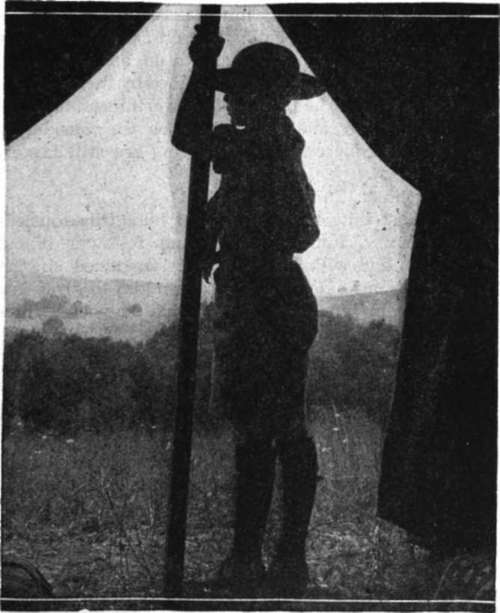
The misty dawn breaks. The Scout, trained and ready, steps into the wonder-filled nature world. Here he grows into manhood.
The Period Of Adolescence
But also he is with us usually during the period of adolescence, bringing with it rapid physical expansion and the growing discoveries that girls are attractive and that younger boys are just "kids."
He is altogether pretty much a creature of a multitude of impulses, conducting himself as they urge him. He wants to do what he wants to do, and the things he wants to do are largely determined by these natural boy tendencies. The traits of trustworthiness, helpfulness, team-play and the like which we consider so necessary to successful social living are still largely undeveloped.
There He Is: The Boy
We must take him as we find him, this tousled-haired, noisy, fun-loving, vigorous follower of our footsteps, and with his inborn and acquired characteristics as our aides and allies, help him to grow into a man, help him to build into his character those traits that are desirable for good citizenship.
Helping To Build Character
But character is an intangible thing. How then may we help to build it?
By concerning ourselves with the conduct of the boy and his attitude of mind in the hope that he may build for himself a character of the right kind.
As Kilpatrick, the famous educator, says: If a boy is to build anything into his character, he must practice that thing.
"If you wish this boy to build a sense of fairness, you can talk about it all day long and forever-his father may punish him-his teacher may scold him. But until that boy practices fairness, inside and out, he will never learn it. He cannot learn what he does not practice. You cannot learn to play baseball unless you practice baseball!"
To help the boy most we must in some way so get hold of him that he puts heart and soul into what he does-the secret of "Learning by Doing"-we must strive to bring out the finest and best there is in him, we must get him to practice those desirable traits that they may become traits of his conduct as a boy and so form his character as a man; we must constantly place him in life situations which will provide such practice.
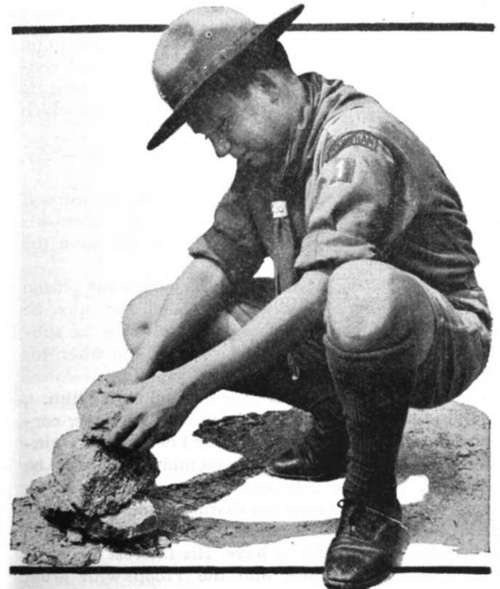
Stone on stone, Scouting builds character. Like trail marks, they remain to point the way to others who follow.
Holding The Boy
But we cannot fashion a boy's character overnight. To reach our aims we must attract the boy and continue his interest for a time sufficiently long to develop in him those traits and habits of conduct which make for character and citizenship.
To attract him isn't difficult. But to hold him-"Ay, there's the rub," as Shakespeare would say.
And yet on the day he enters Scouting he himself places in our hands the means of keeping him-his interest. In the very fact that he joins we have the key to holding him.
He wants to become a Scout because for some reason or other his interest has been awakened and must be satisfied. He advances because his interest in the subjects makes him want to master them. And when his interest dies-he drops out.
The Boy's Interest-That's The Key To Holding Him
Interest in what? Certainly not in our aims, certainly not in character building and citizenship training. He does not argue in his own mind-unless he be abnormal-that he is coming along to Troop meeting week after week to have his character developed or to learii how to become a good citizen. His first thought is the fun he is going to have. His interest is in the "goings-on." He comes into the Troop with great anticipations and big hopes, and only as we see eye to eye with him on Scouting, only as we get a personal vision of Scouting from HIS point of view, can we fulfill those hopes and thereby hold him.
Satisfying The Boy's Expectations
And for what does the boy hope? What does he expect?
He expects adventure-HIGH ADVENTURE-in
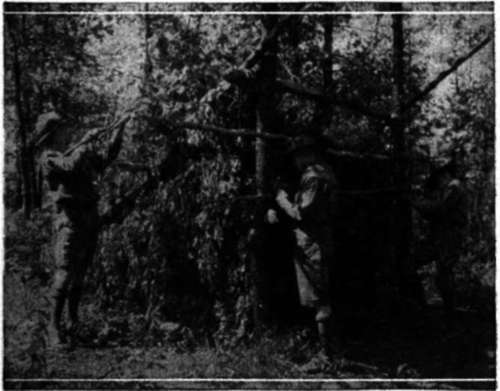
Activities-inventing and building. Learning by doing the very things they want to do. A temporary shelter for the night.
Scouting! That is what he comes for-that is his all-absorbing interest-and that is what we must give him.
"Did it ever occur to you," asks Dan Beard in one of his books, "that the charm, the magic, the fascination of the Boy Scout Movement itself is largely due to the name Scout and what it means to a boy?" And he answers his own question, "No wonder they are proud of the title, for even to see the word in print, or to hear it pronounced, opens one's mind to a land teeming with picturesqueness, crammed with real thrilling adventure and permeated with real chivalry and heroic valour."
The word opens up to a boy the vista of open spaces, woods, rivers, lakes, mountains, which are to be his habitat and where he may find his highest joy. He sees himself as a frontiersman, an explorer. He sees in Scouting the means of becoming one.
And so he joins with enthusiasm. Our responsibility is to see that his enthusiasm is kept burning. It is within our power and it is the only way in which we can keep him.
"Sometimes we are tempted to think," says Gilcraft, "that, because perhaps our Scouting has to be done in a big town, there can be little chance for romance. The truth is exactly the opposite. The duller the surroundings of ordinary life, the more romantic does the outside world appear. This applies with greater force to boys than to grown-ups. It is so easy to forget that a few yards off his accustomed beat lies an unknown land for every boy. Most boys know their immediate neighborhoods in a patchy way; all that is beyond is 'lost beyond the ranges,' and for them it is just as much an adventure to go outside their usual orbit and make discoveries for themselves as it is for a grown-up to explore foreign lands."
So let us not be fearful that we may not be able to provide the romance. Thousands of other busy men, serving also as Scoutmasters, are giving to their Scouts the experiences they want. Let us, then, make use of our imagination. Let us listen to the boys' own suggestions. Let us use the ideas of others (the following pages will provide many)-and by our efforts we shall see the boy as, in his own eyes, he grows into a young Daniel Boone, or Kit Carson, and, in ours, into a real Scout with a strong character-a true American citizen.
Continue to:


My Books

