


Closing Ceremony
Description
This section is from the book "Handbook For Scoutmasters. Volume 1 & 2", by Boy Scouts of America. Also available from Amazon: Handbook For Scoutmasters.
Closing Ceremony
Make the closing ceremony itself, brief, dignified and impressive. Plan for it and time it in such a way that it ends the meeting as close to the appointed hour as possible. For this purpose it is valuable for a Troop to have a few favorite ceremonies which may be used, the shortest if the meeting has been drawn out too long, the longer for occasions when the meeting has been timed correctly.
Any of the formations used for the opening ceremonies are feasible for the closing. However, do not use the same one for both periods at any one meeting.
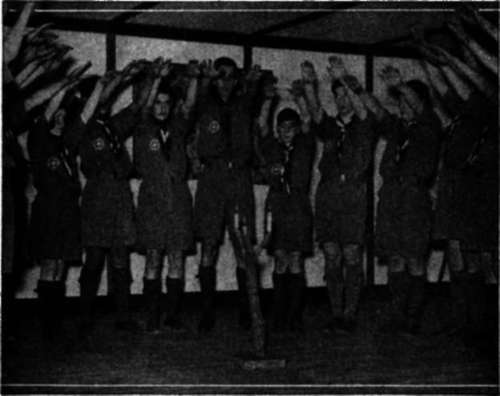
The Closing should be as impressive as the Opening, with a ceremony created to fill the needs of the Troop.
Any number of closing ceremonies are used throughout the country. Many Troops have developed their own through discussions in the Troop Leaders' Council. Others prefer to have their Patrols develop special ceremonies which are then put on in turn.
The Flag of the United States has a place in many-ceremonies, others include Taps, standing in circle with arms interlocked while singing softly a closing song ("Till we meet again," "Scout Vesper Song," "Auld Lang Syne" are favorites), reciting of the Scout Law or standing at attention for one minute of silent prayer.
Often the Scoutmaster brings the meeting to its close with the Scoutmaster's Benediction, whereupon the boys are dismissed by Troop, by Patrols, or, occasionally, by rank, the Eagle Scouts first, then Life, Star, First Class, and so on.
The important thing is that the closing ceremony leaves an impression with each individual which will carry through the interval between meetings.
Other Closing Suggestions
1. Line up Troop in Single Rank Formation. Then ask each Patrol in turn to step one pace forward. As each Patrol steps forward, the Scoutmaster repeats the three points of the Scout Oath, omitting "On my honor I will do my best," after which each Patrol salutes and says, "On my honor I will do my best." Dismissal.
2. Close meeting with Troop singing of "Taps" (words in Songs Scouts Sing), led by a muffled bugle or bugle in distance, the lights dimmed. Or use two bugles, one giving the call, the other the echo effect.
3. Troop formation. Scoutmaster's Benediction: "May the Great Scoutmaster (all make gesture toward heavens) of all good Scouts (inclusive gesture from right to left at height of shoulder) be with you till we meet again (right hands being brought to hearts and heads bowed)."
4. Form a ring of Scouts. Have each boy make the Scout Sign and with the left hand grasp the lifted wrist of his left neighbor. Scout Oath in unison.
5. Bring all Scouts to attention wherever they may be. Give the order, "Fall in alphabetically." Upon which Scouts scramble into line as nearly as they can make it in the alphabetical order of their surnames. This will merge the game period into the closing.
6. Finish with America yell (A-M-E-R-I-C-A, Boy SCOUTS, BOY Scouts, U-S-A), followed by Sky Rockets ("Ssss," the hiss of the rising rocket; "Boom," the bursting; and then the soft, very soft exclamation as it spreads, "Ah-h," and the terrific boy-satisfying yell, "Scout.")
7. Repeat Scout Law in unison, lower Flag with proper camp ceremony, using camp bugle, etc. If no bugle, whistle "To the Colors" and "Retreat." (When this closing ceremony is to be used, the Troop meeting should feature Opening Ceremony Suggestion No. 3 given earlier in this Chat.)
8. One round of Patrol calls. Troop call or yell. Scoutmaster: "Good night to you." Scouts: "Good night to you, sir."
9. Form circle, hands on shoulders. Song leader leads Troop in singing of Scout Vesper song, or similar good-night song. When the song is ended, Scouts leave room in silence.
10. Troop lines up in Patrol formation. Senior Patrol Leader in charge. Scoutmaster, Assistant Scoutmasters and other senior leaders take position facing Troop. Patrols successively are brought up in formation and halted in front of the senior leaders. Patrol gives Scout Sign, and recites Law. Then marches in formation to the door, where it is dismissed by the Patrol Leader.
11. Troop in line. The Scoutmaster says, "Be Prepared." To which all Scouts respond in unison, "We are prepared!"
12. Troop assembled in line. Colors are brought to front and center. Song leader leads Troop in singing "The Star-Spangled Banner." Colors returned to their place. Patrols dismissed.
After The Meeting
The Scouts are expected to leave immediately upon the conclusion of the meeting so that they may arrive home at the hour when they are expected by their parents. It will soon be found that unless this is insisted upon, a great number of them will "hang around."
Many Troops build up traditions of prompt dismissal and Scout-like conduct on the trip home—traditions that the Scouts defend zealously. Such traditions prevent unfortunate complaints from a Troop's neighbors about bugle calls, yelling, etc., disturbing them on Scout meeting nights.
The "closing" should mean exactly that and no Scout should be permitted to stay beyond a few minutes unless he has an extra duty to perform or an important personal problem to be solved. As far as possible, personal problems should be discussed with the Scoutmaster before rather than after the meeting —but, of course, the Scouts should feel at liberty to approach their leaders with problems at any time.
The Work Of The Service Patrol
As soon as the meeting is over, the Service Patrol for the evening gets to work cleaning up the room, putting away equipment used and finally turning off the lights. If anything has been damaged during the meeting arrangements should be made to repair or replace it.
Personal Interviews
For a short while after the meeting the Scoutmaster and other leaders are available for brief personal interviews, helping the boys to adjust possible difficulties, advising on advancement, answering questions and the like.
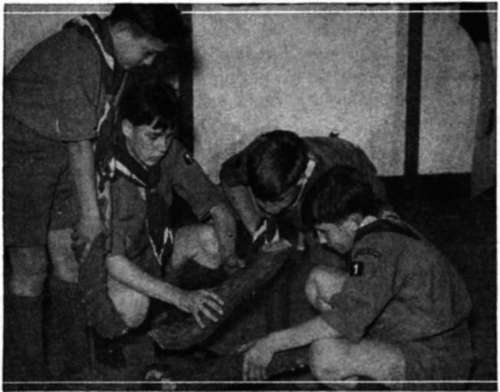
The Service Patrol for the evening is in charge of needed equipment and straightens up the room.
Continue to:


My Books

