


Dangers Of A Mass-Instruction Method
Description
This section is from the book "Handbook For Scoutmasters. Volume 1 & 2", by Boy Scouts of America. Also available from Amazon: Handbook For Scoutmasters.
Dangers Of A Mass-Instruction Method
The argument may be advanced that "instruction" of the whole Troop as a unit saves time and enables one expert to "get his stuff across." This argument would hold water if our aim were to have the entire Troop advance one degree at the time. Fortunately it isn't! Our aim is to give each Scout as an individual an opportunity to grow according to his own abilities and interests. Some boys take to Scouting more intelligently than others. Should we attempt to keep them in lockstep with those who because of various handicaps move more slowly? Most certainly not!
Also, we are more interested in having Scouts—and especially the Patrol Leaders—share in the leadership and responsibility of training other Scouts rather than depriving them of such opportunity. This is one factor which makes Scouting distinctive as an educational movement. It is the Scouting scheme.
Another point is that Troops which have been run a few months will be made up of candidates, Tenderfoot and Second Class Scouts; and Troops organized more than a year, of First Class and Merit Badge Scouts besides. Hence, if any instruction were attempted, it would be too advanced for some and too elementary for others.
"Very well then," some one will say, "what about splitting the Scouts up in groups according to rank and have an instructor in charge of each?" The best answer is a question: "Do you know of an easier way of destroying Patrol organization and breaking down the leadership of the Patrol Leader?" Our effort should be at all times to help the Patrol Leader, not to hinder him in his work, and it is very definitely the Patrol Leader's business to instruct his boys and help them to advance at Patrol meetings and on hikes, and not the business of the Troop meeting. Any other way is contrary to Scouting.
And lastly—how many subjects can be thoroughly taught and learned in weekly twenty-minute periods? None!
The Object Of Scoutcraft Presentations At Troop Meetings
Obviously, then, the Troop meeting is not the place for a formal instruction of the boys. Our object during a possible presentation period should not be to teach the details of the Scout Requirements, but rather to create and stimulate the interest of each boy in Scout advancement, to provide individuals and Patrols with the necessary incentive for study and experimentation, to orient the boys in the subject rather than give them its details.
This approach opens up an entirely different vista and provides for any number of exciting possibilities.
Instead of by dry demonstrations of bandages or blackboard talks on the skeleton, First Aid would be encouraged through spirited description of help rendered by Scouts in cyclones and floods. Interest in signaling would be inspired by a dramatic presentation of the feats of Marconi and Edison, campcraft advanced through master campers telling of their experiences.
Who Will Make The Presentation?
An outside expert—be he doctor, surveyor, farmer, curator, or forest ranger—brings a wealth of knowledge and the prestige of being a recognized authority. On the other hand, the Scoutmaster and his Assistants —often also members of the Troop Committee—have the advantage of a better understanding of the application of the Scout Requirements and of boy nature.
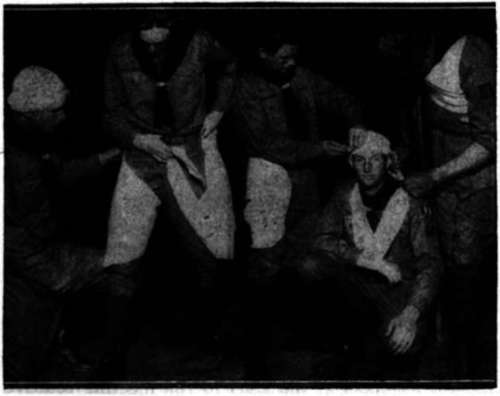
When a Patrol stages an "accident" all Scouts have a chance to increase their practical knowledge of First Aid.
Apparently, then, most items may be handled by the officers of the Troop, although the occasional introduction of an outside expert will lend variety and stimulate interest.
But do not stop here. Encourage boys with special abilities to prepare themselves in their specialties— and make use of them., Also Patrols specializing in certain subjects may be called upon for demonstrations, which, by the way, may serve two purposes: first, to get the subject presented, and second, to encourage a friendly rivalry between the Patrols by preparedness to put on creditable demonstrations for their fellow Scouts at suitable occasions.
Continue to:


My Books

