


Factors Which Contribute To Camp Health. Health Through Knowledge. Physical Examination And Medical Care
Description
This section is from the book "Handbook For Scoutmasters. Volume 1 & 2", by Boy Scouts of America. Also available from Amazon: Handbook For Scoutmasters.
Factors Which Contribute To Camp Health. Health Through Knowledge. Physical Examination And Medical Care
Every Scout and leader should be given a complete physical examination before coming to camp, based upon the Health History Form No. 952.
Parents of sleep walkers should advise the Scoutmaster so that precautions can be taken to safeguard the boys.
Scouts whose examinations indicate that they have bad hearts, fainting spells, or epileptic fits should be excluded from swimming and other vigorous activities. All camp leaders should know who these boys are.
Patrol Leaders should be held responsible for an immediate report of any boy who is ill.
If a Scout is quite ill, plans should be made for notifying the parents and removing him to a hospital or home. If there is the slightest reason to believe that the illness is infectious or contagious, the local health officer should be notified before removing the patient from camp.
Rest And Vitality
Boys cannot do a man's work without exhaustion. Overgrown boys should be watched with care to prevent overexertion.
Ten hours of comfortable, undisturbed sleep is necessary for boys. Some require more sleep than others and should be given an opportunity to obtain it.
Early in the morning bodily energy and temperature are low, heart action is slow, and the bodily forces are reluctant to respond to the demands of the day. Allow boys to wake up slowly, rather than with a startling howl. Morning dips, setting up exercises and other activities that require early muscular activity should be avoided. According to the best authorities, they are too strenuous for the low vitality of the body.
Sleep should be induced by healthy fatigue, never complete exhaustion.
The activities of the day should taper to such a point that when Taps is blown, the weary boy is mentally ready for sleep. The end of a camp fire should be quieting rather than exhilarating. Avoid ghost stories and mystery programs because they are sleep preventives and fear builders.

Plenty of fresh air. Long hours of relaxation and sleep after days of camp activity, and the Scouts return home refreshed.
During sleeping hours vitality is at its lowest ebb. At that time protection in the form of warm covers, fresh air and freedom from biting insects is essential to health. Have extra blankets on hand.
Sleeping places should be roomy enough so that there is at least two feet separating the side of one bed from that of the next one. And tent space should be allotted on the basis of thirty square feet per occupant.
Tent sides should be rolled up at night, except in the most inclement weather.
Loosely woven wool blankets are best. Covers that are waterproof are cold because they keep the moisture given off by the body inside the covers, where it condenses and cools off the sleeper. The best covers are those that are porous enough to permit ventilation.
Blankets should be aired each morning on lines rather than on the ground. Bed ticks should be exposed for two hours twice each week.
Scouts must not sleep together in the same bed because this endangers health and prevents the possibility of complete relaxation and rest.
A waterproof ground cloth should be provided when a Scout sleeps on the ground. Not even a thick bough or straw bed will remove the need of protection against rising ground dampness. The ground should be level, smooth, and a hip hole dug to accommodate hip bones. The ground should be cleared of every projecting stone and root.
New, clean straw in a clean tick should be provided each camper. In the Inter-Troop Camp, if straw ticks are used, they should be emptied, the straw destroyed, and tick laundered at the end of each camping period.
Water. Drinking Water
Drinking water should be analyzed and approved by State, City or County Board of Health, according to the U.S. Public Health Service standard. If the water does not meet the standard, it must be chemically treated or be boiled for five minutes before being used. Details are given in Chat 28.
Provide at least one quart of water per camper per day and encourage its consumption. Place a cup of water before each camper at each meal, to be drunk before other beverages are taken.
Make sure that common drinking cups are not used. Provide sanitary drinking cups at common drinking places. Do not rely on boys carrying their own cups. Have containers thoroughly cleansed each day.
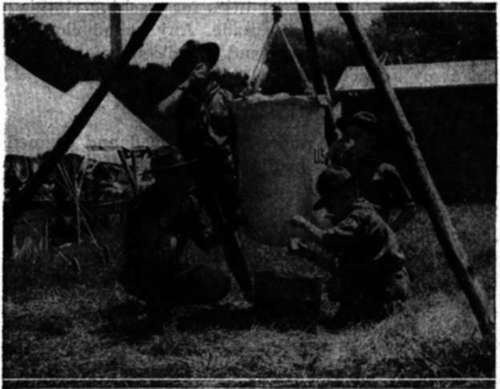
Safe, chemically treated water may be made available while in camp in special containers—Lister bags
Swimming Water
Swimming water should be analyzed and approved by health authorities. If you are using a swimming pool, be sure that it complies with the state law on water turnover and amount per bather.
Washing Water
Washing water for the cleaning of hands and face three times daily and for complete soap bath twice a week should be provided.
Be positive that wash water is provided at each latrine for washing immediately after elimination. This health measure should be taken on trips and hikes as well as in permanent camps.
An opportunity and facilities for washing clothing in hot water should be made. Any soiled clothing should be at least rinsed and sun dried before being put away as dirty clothes, to prevent "souring."
Dish Water
Dishes should be thoroughly scraped and cleaned of food, and then washed in soapy water at a temperature as high as the hands of the washer can endure. They should be rinsed in water at a temperature of at least 180 degrees Fahrenheit, by pouring the water over them on a rack.
If possible allow dishes to dry from their own heat. Avoid using dish towels.
Waste Water Disposal
Check carefully on your waste water disposal systems and be sure that they are working and not contaminating water or soil.
Do not permit water other than drinking water to be thrown on top of soil and then only if the soil is sandy. Even waste drinking water is better disposed of in proper drains, nearby.
If possible, do away with wash basins. If stationary basins are used they should be cleansed frequently.
Commissary
See special section on Commissary for milk and diet.
Refrigeration Coolers should be maintained at a temperature no higher than 45 degrees if they contain perishable food. If this is not possible, use them only for keeping non-perishable foods. Buy meat fresh each day and use it up. Keep thermometer in cooling places.

Proper care of milk is absolutely necessary. Note the damp burlap covered ice-box.
Cooked vegetables, particularly beans and peas, and potatoes are ideal for growth of deadly bacteria, and if held over even for one meal should be placed in small receptacles and kept at low temperatures (not over 45 degrees). It's much safer to throw such food away.
Refuse
Garbage should be burned as soon as it is made, or taken away. Dependence on others to remove garbage involves delay sometimes. That is undesirable, of course.
Food cans in which flies may feed should be burned out, crushed and buried. Open cans are not only unsightly but dangerous.
Continue to:


My Books

