


Ingredients Of A Short-Term Camp. Before The Troop Assembly
Description
This section is from the book "Handbook For Scoutmasters. Volume 1 & 2", by Boy Scouts of America. Also available from Amazon: Handbook For Scoutmasters.
Ingredients Of A Short-Term Camp. Before The Troop Assembly
The Patrols will meet in their own respective headquarters for packing. Here Patrol equipment and food is distributed and the Patrol Leader checks to see that each boy has brought what is required of him. When everything is in readiness, the Patrols proceed to the mutual gathering point of the Troop.
Troop Assembly
As each Patrol arrives an adult leader assigns a position to it and the Scouts establish their "duffelline" while waiting for the rest. At the exact hour previously announced, the signal is made for Troop assembly, and the Patrols line up, ready for the hike which will bring them to the camp site.
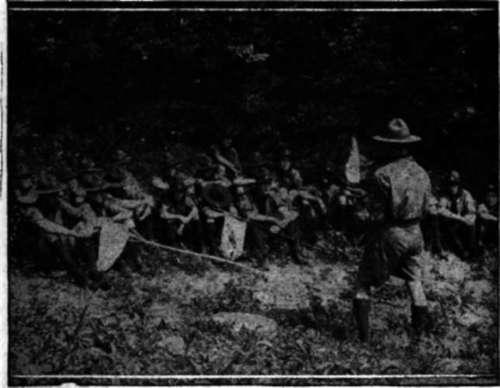
After a quick inspection the Patrols receive final instructions and are ready to set out.
The Patrol Leaders report and a quick inspection is made of the packs by the Scoutmaster, who then turns the Troop over to the leader in charge for final instructions.
On The Road
Three ways of getting the boys and their equipment to the camp present themselves, depending upon the distance.
If this is less than three miles and the boys are hike-trained, it should be easy enough for them to make it in good shape carrying their packs, provided these are well packed and the weight so distributed that the stronger Scouts have the heavier loads. If the distance is between three and five miles, the Scouts may hike it but it is advisable to have the packs thrown onto an automobile and transported to camp. A hike of more than five miles should not be attempted in connection with a short-term camping trip. If the distance is great, the Troop Committee should have been asked to furnish transportation to the camp site.
Activities along the route will naturally depend upon the method used. If the boys are hiking with packs, no special activity should be attempted, but if packs are sent ahead, any of those suggested for the outward journey in the "Hiking" Chat may be used. While hiking on a highway, the Scouts will of course observe the necessary safety rules previously described.
Arrival On Camp Site
Immediately upon arrival on the camp site, the Patrols establish their "duffel-lines." The Troop Leaders' Council gathers and makes a survey of the site for the purpose of giving the Patrol Leaders a chance to select camp sites for their Patrols. As soon as the selections are made, the Patrol Leaders are dismissed, each Patrol Leader leads his Scouts to their site, and they go to work—while the Scoutmaster and the other Troop Leaders keep hands off, possibly going into a huddle about special activities to take place later.
You—the Scoutmaster—and your assistants should be present to advise with any Patrol Leader who comes for advice, but you should not volunteer any. And most important of all, you should not go near the
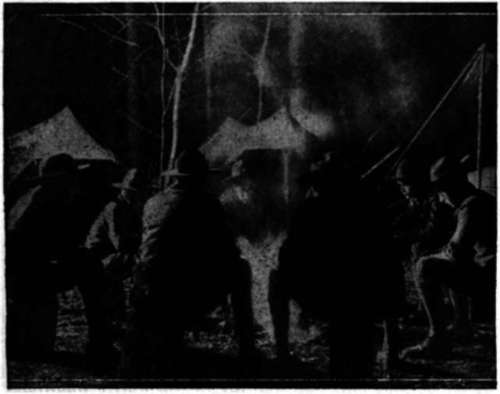
Around the camp fire, the reel boy appears. The afternoon twilight fades as a contented Patrol gathers where real friendships are made.
Patrol set-ups until after the Patrol Leaders come to you and announce: "Camp completed, sir!"
The Boys' Game
Your fingers may itch on the first few camping expeditions to help the various Patrols put up the tents properly, or to rearrange the stones of the primitive fireplaces produced by the Scouts. But, please, don't! This is the boys' game. Let them do their best. Then, after they have done the job, you may aid them with friendly advice and suggestions that will help them do even better the next time.
When tents are being put up for the leaders to sleep in, you will naturally give a hand. Otherwise be a free but exceedingly interested onlooker. You will have a chance as never before to study your Patrol Leaders at work, to find out how well they distribute the jobs, to see with what willingness the boys follow them and perform the duties assigned to them. Make written notes of points which may be bettered, and have friendly talks with the Patrol Leaders later suggesting how they may improve their leadership. That is where you prove your leadership—by not pitching in to do work which honestly is none of your business.
To make such smooth sailing possible, the Patrol Leaders must, of course, have received proper training in advance.
Checking Over The Set-Up
In checking over the Patrol set-ups, notice especially the following points: Has a suitable latrine been dug at an appropriate spot and do all the Patrol members know where it is? Has provision been made for garbage disposal? Is the food supply kept properly? Is the cooking arrangement adequate and is cleanliness evident? Are fireplaces well built for efficiency and safety? Are pieces of equipment lying around on the ground, or is everything in its right place? Are the tents faced properly? Have the Scouts' beds been well made with blankets properly arranged? And, finally (if rain seems probable) have tents been ditched where necessary?
Evening Activities
After the supper has been prepared by Patrols, and eaten by Patrols, and the clean-up has been done by Patrols, the Troop gathers for the evening's activities.
Games
It is still light, so an hour is spent playing a couple of favorite games. Choose vigorous games such as

Night finds them again at man's earliest gathering place: the glowing fire. Peace—and rest from the busy turmoil of modern life.
Capture the Flag or various kinds of tag. There are two purposes for these games: First, to provide recreation, and second, to tire the boys out. You know that there may not be much sleep for those Scouts who are experiencing their first night in camp. By sending them to bed healthily tired, but not overfatigued, you increase their chances of rest and sleep.
Camp Fire
While the games are being played, the junior leaders may collect wood and arrange for the evening's camp fire. When the fire has been lighted, the boys gather around it and an hour or so of fun and good fellowship is on.
For the first few occasions, the camp fire should be led by a junior leader according to a well-planned program, containing recreation in the form of songs, yells, stunts, and inspiration through serious songs, story-telling and the Scoutmaster's three minutes.
Later, the job of leadership will be assigned to one Patrol at a time, as "Program Patrols," or each Patrol may be given a certain length of time to fill with its own program of songs and stunts.
In all instances, you as the Scoutmaster should officially open the camp fire and should officially close it, with whatever short ceremony or statement you may want to make.
For camp fire suggestions, see Chat 30 on Long-Term Camping.
Sleeping in Camp
But before closing the camp fire, ask the Scouts earnestly whether you are to consider them "tender-feet," or real campers. Elaborate the point that the good camper is one who sleeps and permits others to sleep from Taps until the signal is given to get up in the morning, while the "tenderfoot" spoils the night for himself and others. Have them agree that if anyone has to get up during the night and go to the latrine, he will move quietly and return to bed again immediately. Appeal to their loyalty and good sense, and make the Patrol Leaders definitely responsible for upholding the standards of their Patrols. No Patrol will want to be considered the "poor campers" of the Troop.
Tent Inspection
As soon as the Patrols have turned in for the night, make a round of inspection to all tents. Have the Patrol Leaders check to see that the boys have changed into pajamas. Insist that no one is permitted to sleep in his day-clothes. (This point should have been made absolutely clear to the boys in advance).
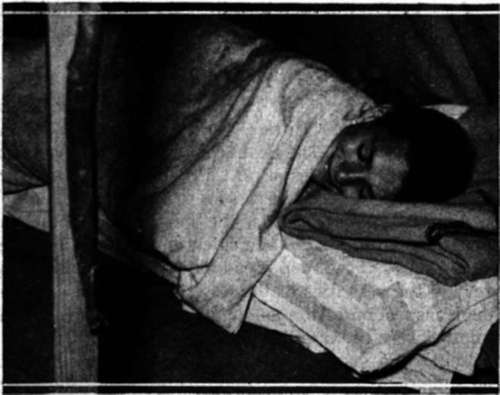
Sleep and such sleep. Smiles of contentment appear. Happily tired, completely resting in their tent homes, these are the joys of camping.
With a "Good night. We will all be quiet now!" you leave each tent. Insist upon quiet. Any talking should immediately be stopped on the spot by the Scoutmaster with a "Sh-h-h" or a whispered word to the "offender"—not with a loud "Pipe down" from the leader's bed. Eventually silence will reign.
In spite of all admonitions, some of the boys will probably be up before sunrise. "We haven't got a watch and it looked late . . ." If you are awakened, send them to bed again. There is no hope for their further sleep if they remain up. Once back in the blankets, they may get some more.
And, by the way, see that the rule about remaining in bed is kept by the Troop Leaders also.
Morning In Camp
As soon as the signal to rise is sounded, the boys should get up, wash, dress, and hang blankets out in sun or wind to air. The Scouts of each Patrol carry out their respective duties of putting the tents in shape or of preparing the breakfast.
After breakfast is over, the Patrols have half an hour to get their camp site spick and span. When the time is up, the Troop Leaders' Council gathers to review the activities of the day and to make a thorough inspection of the whole camp, not of the section immediately surrounding each tent only.
Make this inspection stiff. Each Patrol site should be gone over with a "fine-tooth comb"—not for your personal satisfaction, but because "That is the way we do it in Troop 3!" Draw attention to any chips, pieces of paper, scraps of food, carelessly made-up tents, and train the Patrol Leaders to be severe also. Don't pick up anything—that is the job of the boys of the Patrols—just make the fellows realize that you are "Eagle-eye" himself as far as cleanliness around camp is concerned.
Too harsh? Not at all! Your aim is to establish habits of good conduct, and habits formed in small things count toward forming the more important ones. And the neatness secured in the camp early in the morning is the starting point for continual neatness throughout the day. Your emphasis should be on this point.
Forenoon Activities
If it happens to be Sunday, much of the morning will be taken up by getting the boys to church and back. But by carefully budgeting your time, there will be occasion for several other activities. These will be along the same lines as those activities that might take place at the destination of a hike (see Chat 28). Have them definitely planned in advance so that every hour will be full of worth while doings.
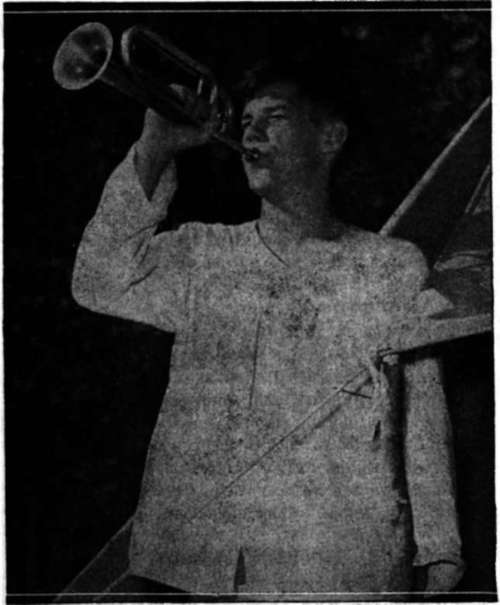
"I hate to get up in the morning"—but there's a new day ahead of fun and fellowship.
If swimming facilities are at hand and the weather is favorable, you will make use of them, provided you can keep the Minimum Standards for Swimming and Water Safety (described fully in the next Chat). Otherwise, make swimming absolutely TABOO. The same principle applies to boating and canoeing.
The Noon Meal
The noon meal should be simple. The making and eating of it should not take much more than an hour. When it is over, the pots and pans should immediately be cleaned and made ready to be packed.
The Afternoon
The activities of the afternoon depend upon whether an early or a late home-coming is contemplated. In the first case, there will not be much time between cleaning up after the noon meal and packing. In the other, games may be played or a couple of contests run off. Let it be a rule, that the afternoon activities be entirely different from those of the forenoon. If Scoutcraft games were featured in the morning, use recreational games in the afternoon, and vice versa.
Breaking Camp
The building of camp was begun by all the Patrols simultaneously. The breaking of camp should be started the same way, and a definite time should be set at which the packing is to be completed. It is advisable to start breaking camp a little earlier than you think is necessary.
Here, also, the Scoutmaster keeps "hands off," until the Patrol Leaders report that work is finished. When all Patrols have been heard from, the Troop Leaders' Council gathers to undertake the final inspection.
Even if time presses, do not permit a slip-shod clean-up job. The Scouts should pride themselves in always leaving a camp site cleaner than they found it, with a reserve fuel supply and possibly even a romantic food cache. The Patrols will readily respond to such tradition, and will admire the Scoutmaster more for being strict than for letting them "get off easy."
When everything is satisfactory, the Patrols line up, the Troop is formally dismissed and the boys return to town in the manner in which they arrived.
Continue to:


My Books

