


Intensive Training In The Green Bar Patrol. Part 2
Description
This section is from the book "Handbook For Scoutmasters. Volume 1 & 2", by Boy Scouts of America. Also available from Amazon: Handbook For Scoutmasters.
Intensive Training In The Green Bar Patrol. Part 2
Third Training Meeting
Theme: Patrol Hikes
Preliminary Reading Assignments:
For Scoutmaster and adult leaders: Handbook for Scoutmasters, Chats 14 and 28.
For Patrol Leaders: Handbook for Patrol Leaders, Chapter VII.
Needed Material:
Paper and Pencils.
Patrol Record Book.
Tin cans, shears, pieces of wire.
Map.
If possible: Hiking equipment for demonstration.
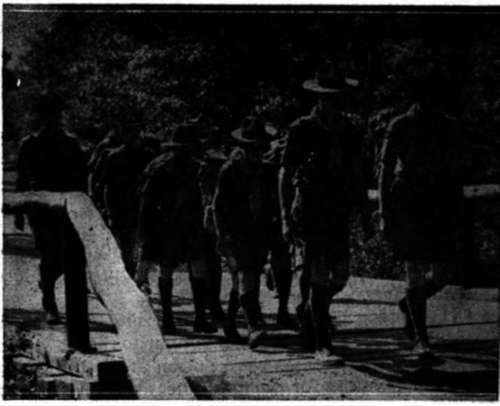
Wooden bridges clattering as you cross-bird songs in the skv-the smell of ploughed earth and new-mown hay--these are never-forgotten hiking memories.
Program:
(a) Opening Ceremony: Senior Patrol Leader stages ceremony which was chosen favorite at the Second Training Meeting.
(b) Business Period-short, but sweet (see Second Training Meeting).
(c) Hike Instruction. Short presentation by an adult leader on "Patrol Hikes, Their Place in the Troop's Life," necessary leadership requirements, hiking technique, based upon HPL, Chapter VIII. (Explaining difference between "Sandwich Hikes" and "Chop Hikes," and announce that forthcoming Leaders' Hike is to be a Chop Hike. If possible, demonstrate various pieces of hiking equipment.
(d) Hike Planning. Divide the Patrol up into four groups, and give each group the responsibility for developing the details of one of the following items in connection with the hike.
1. Route: (Hikemaster in charge). Planning an appropriate route on a map of the local territory, based upon previous experiences of the planners. 2. Equipment (Quartermaster in charge). Prepare list of essential equipment to make the Patrol prepared for its experience (Handbook for Patrol Leaders, Chapter VIII). 3. Commissary (Grubmaster in charge). Suggested menu and food list. 4. Activities (Assistant Patrol Leader in charge). Kind of hike, Patrol doings on out-trip, at the hike destination and on the return journey. After the plans have been completed, they are presented to the whole Patrol for discussion, possible amendments and additions, and final adoption. Distribute leadership for the hike and decide upon meeting place and time, and equipment and grub to be brought by each Scout.
(e) Instruction Game. "Uncle Quizzie." Have your Assistant Scoutmaster in charge of Scout Advancement develop a series of about thirty questions related to outdoor Scouting, such as fire-building, cooking, knife and axe, compass, mapping, signaling. Divide group into two teams, and run game similar to method used by Uncle Jim and Professor Quizz of radio fame, alternating boys of alternating teams to answer questions put to them. Each correct answer gains 100 for the team, partly correct answer a proportionate amount of points. Team with most points at end of game is declared the winner.
(f) Work Period. Making of simple cooking gear from tin cans, sufficient for the Patrol's hiking expedition. It is advisable to have a few items already developed by a Junior Assistant or an Assistant Scoutmaster for demonstration as samples of work expected.
(g) Recreation. 1. Games-one or two chosen from HPL, such as Hunt the Coon, Dry Repast, Who Nose Most? (If games planned for previous meetings have not all been used, make use of them now.) 2. Singing-Going through the Scout Song Book, "Songs Scouts Sing," pick out and rehearse songs suitable for the open road.
(h) Closing Ceremony. Stage closing ceremony voted most popular at Second Training Meeting.
After Meeting:
While at previous meetings, the material learned was to be taken home into the Patrols immediately, it is better to suggest that this be not done in this case until the hike planned for has been performed. Only in this way will the boy leader have the proper understanding of all the items involved.
Green Bar Training Hike
Needed Material:
As discussed and decided upon at Third Training Meeting.
Program:
(a) Assembly. Immediately upon gathering at spot decided upon, Quartermaster and Grubmaster make quick but thorough check of equipment and grub to insure that everything is in readiness.
(b) Outbound Journey. 1. Hiking Technique: Follow suggestions of HPL and HSM in regard to proper procedure, and correct Patrol hike formation on highways. 2. Activities. Start activities decided upon at training meeting as soon as is convenient. Give the different boy leaders a chance to lead the complete Patrol from time to time.
(c) At Destination.-Here, of course, the activities are entirely dependent upon the type of hike decided upon. A Scoutcraft hike (which, by the way, might be considered the most appropriate choice), would feature cooking and fire-building, knife and axe, mapping and signaling, or, in other words, the items that were the subject of the meeting quizz. For cooking, divide up into groups of approximately the size of a natural Patrol, and attempt the meal on a Patrol basis. For the other activities, a short demonstration by an Assistant Scoutmaster or a Junior Assistant may precede an experimentation period with the Scouts divided into buddy teams. Or a couple of Instruction Games may be featured such as Signal Relay, the Leading Packsack, String Burning, Height Judging, Leaf Matching (HSM, see Games Index). Rest Period. Recreation Games: One or two of the following: Capture the Flag, Skin the Snake, Antelope Race, Border Scouting (HSM), Clean-up.
(d) Return Journey-Do not attempt any specially planned activity during this, although a game such as Far and Near (HSM) may be tried. Make use of the hike songs rehearsed during training meeting. Dismiss at appropriate spot, after having announced time when hike report is submitted,
Fourth Training Meeting
Theme: Patrol Advancement
Preliminary Reading Assignments:
For Scoutmaster and adult leaders: Handbook for Scoutmasters, Chats 33, 34, 35, and 36.
For Patrol Leaders: Handbook for Patrol Leaders, Chapter VI.
Needed Material:
Paper and pencils.
Patrol Record Book.
Buzzers or flashlights.
Knives and sticks. Carborundum stone.
Game material as required.
Program:
(a) Opening Ceremony: Senior Patrol Leader stages ceremony which he considers his favorite of those tried at the Second Training Meeting.
(b) Business Period-as usual: short! (see Second Training Meeting).
(c) Discussion: "Scoutcraft Advancement in the Patrol, led by Assistant Patrol Leader based upon HPL, Chapter VI (specifically the opening pages), and HSM, Chat 33. Why advancement? What constitutes normal advancement? Why is it important that the Patrol Leader is ahead of the fellows in his Patrol? How does advancement relate to hiking and camping? Etc., placing emphasis on the fact that the activities of Troop and Patrol are based upon the Scout Requirements.
(d) Scoutcraft Instruction: Signaling. Divide Patrols into four teams. Situate one team in each corner of room. Teams diagonally opposed work together, each sending and receiving a complete message, using flashlights or buzzers. The messages should have been developed in advance by an Assistant or Junior Assistant Scoutmaster.
(e) Work Period. The making of a paper knife, as a Knife-craft project. Each Scout should have his own knife. (If the boys do not all own a knife, they should have been told to borrow one from someone else). Natural sticks (% to 1 inch in diameter, and 8-10 inches long) are distributed, and the project described. Time limit: 10 minutes. Follow it with a short demonstration of the proper way of sharpening a knife, staged by the Quartermaster, if possible.
(f) Instruction Games: Use a couple of games from HSM, Chat 31. For further training in signaling and knot-tying, try "Knot-Signals." For compass work, "Compass Facing;" for safety, "Safety First;" for observation, "Haunted House" or "Kim's Game." (See Games index).
(g) Planning: Make a quick review of the meeting up to this period, pointing out how many various Scout Requirements it has been possible to introduce in games and projects. Take a check of the advancement status of the leaders present, and discuss shortly an effective plan for advancement, using the buddy system.
(h) Recreations (1) Dramatics. In charge of Cheermaster. Cut out suitable jokes from Think and Grin, BOY's LIFE, and distribute them to buddy teams for snappy dramatization. Judge the performances for characterization and success in putting over the punch of each joke. (2) Singing. Each buddy team to introduce a solo and chorus song, the buddies to sing the solo part, then lead the whole Patrol in the chorus. For suggestions, study Songs Scouts Sing. (3) Story told by the leader of the Training Patrol, that is, the Scoutmaster.
(i) Closing Ceremony: Senior Patrol Leader puts on one of the ceremonies, already tried, or a new one especially developed for the occasion.
Continue to:


My Books

