


Part XV. Emergency Service Air Scouting. Chat 43. Emergency Service Training
Description
This section is from the book "Handbook For Scoutmasters. Volume 1 & 2", by Boy Scouts of America. Also available from Amazon: Handbook For Scoutmasters.
Part XV. Emergency Service Air Scouting. Chat 43. Emergency Service Training
OF the activities available for Scouts, possibly the most far-reaching, and certainly the one making most extensive use of previous training, is the development of the Emergency Service Corps Patrol and the service that the Patrol can give to its Troop in helping to make it an "Emergency Service Training Troop." It is important that every Troop be trained and equipped to carry on the tradition of willingness and preparedness to serve in any emergency.
The record of Scout service over the years in time of disaster shows that inherent in the Scout Program itself are the training in resourcefulness and the techniques which contribute to skillful service in the wide variety of demands that come in times of an emergency. The very organization of the Troop itself makes for easy mobilization. The activities in which the boys engage and the various Scout Requirements such as First Aid, Signaling, Pathfinding, Safety, Knife and Axe, and the handling of heavy ropes, naturally equip the Scout for his part in community mobilizations in time of disaster.
The Troop's Training Program
Scout Troops should give close attention to those particular phases of our Scout Program that contribute to training for service in an emergency. Here is a plan for every Scout to intensify his own training, for every Patrol to develop its program and for every Troop to complete its organization and prepare itself for service. This plan contains that which is basically good Scouting. It is designed with the following purposes of preparation in mind:
1. To condition individual Scouts to meet the need of the times and to fit them to meet that need when necessary as individual Scouts or as members of a Patrol or Troop.
2. To train Patrols in effective teamwork when needed through Patrol projects.
3. To train Patrols to coordinate smoothly and efficiently when working together as a Troop.
1. Training For The Individual Scout
2. Observation, Identification and Memory Knowledge of directions, roads, streets, lanes, landmarks, both natural and man-made, in his home community.
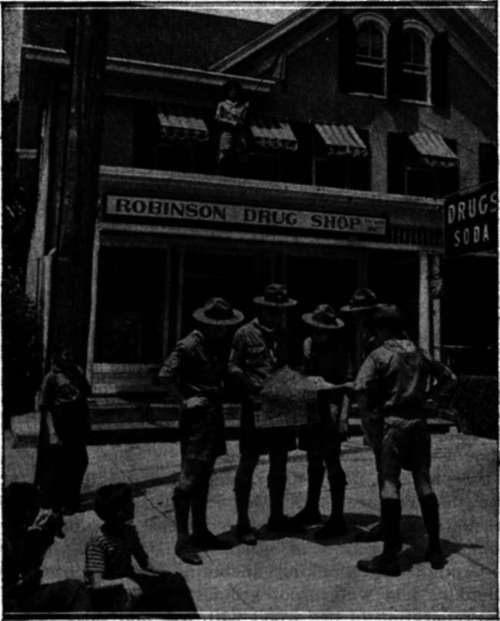
Telephone and telegraph wire may be broken. The reports must go through. Knowledge of highways, lanes, by-paths is essentiel.
Night, blindfolded and feeling tests.
2. Communication By Movement And Signal
By foot, walking, Scout pace, running, what to wear and how to pack, when necessary.
Bicycle—training, safety, signals, equipment.
Boats—rowboats, canoes; elements of rowing, paddling, and use of outboard motor when possible.
Swimming—renewed emphasis on every Scout (who is physically fitted to do so) becoming first a safe swimmer and then a long distance swimmer (one mile).
Horsemanship—new emphasis on this form of locomotion wherever it is possible to secure instruction.
Ski and snowshoe travel—A real promotional emphasis should be placed on these methods of winter travel. The skiing should be of the cross country and slalom type and not "down hill" work.
3. Outdoor Living
Greater emphasis on camping in tents and without tents. (Living in camp buildings should not be accepted as a satisfactory substitute.) Proper selection of camp site and ditching and setting up his own tent should be a part of this training.
Preparation of food by individuals should be a monthly requirement. Every Scout should be expected to know how to prepare at least three one-pot meals and two kinds of bread in the open.
Ground bed making including proper use of blankets and waterproof ground cloths.
Preparation of fire wood with axe and saw.
Forest fire prevention and suppression.
4. Safety
Safety will be a part of everything taught because skill is necessary to the successful accomplishment of each, but certain skills must be emphasized in addition to the normal attention that would be given to them.
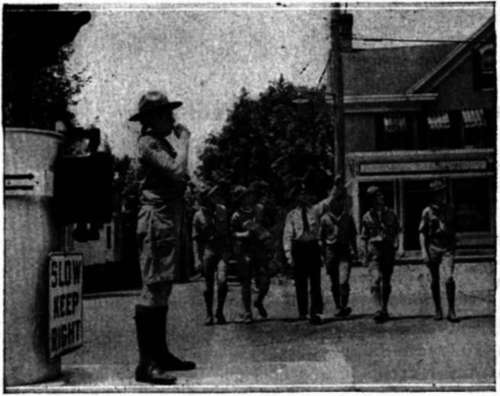
In an emergency, traffic becomes confused. Scouts are prepered to help. These are leerning the "How" of traffic regulating.
Safety with firearms. This will be increasingly important in view of the present stimulus on defense.
Use of belt hatchet and 3/4-size axe. Very little instruction now given in this skill and it must be majored as of great importance.
Fire prevention at home and in the woods.
Fire suppression at home and in the woods.
Making of fire suppression equipment. 5. Preservation of Human Life
Water rescue skills with boats, equipment and by swimming. First aid for arterial bleeding, suffocation, poison, freezing, starvation, burns. Comprehensive instruction on practical transportation of seriously injured persons IF AND WHEN IT IS TO BE DONE.
6. Physical Fitness
A strong body and good health to stand up well under hardships.
Training For The Patrol
In the Patrol, the individual Scout learns to adjust himself to the task of playing with the team. Here he has a voice in the program of the team and learns that he is but one of several who play together for the purpose of securing the most good for all.
Patrol games, afternoon hikes and overnight hikes with other Patrols, serve to contribute to the training of the individual Scout and the development of coordinated action. It is essential that each Patrol become a disciplined unit of an orderly and well disciplined Troop.
Training For The Troop
The Troop is a total of the Patrols, as the Patrol is the total of its individual Scouts. The Troop's strength is that of the Scouts and the Patrols, plus its adult leadership and Troop Committee and institutional backing. Its program should be one of training, opportunity for camping and other outdoor activities and their promotion. Discipline and orderly movement are vitally important to Troop progress and efficiency. Lack of discipline leads to accidents, unhappiness and breakdown of program. Discipline increases not only safety but the opportunity for more valuable use of the time available. Orderly movement must become an important part of the Troop plan. This does not necessarily mean movement in the strict military sense, but organization so that boys may be moved in Patrols or in full Troops safely and rapidly without confusion.
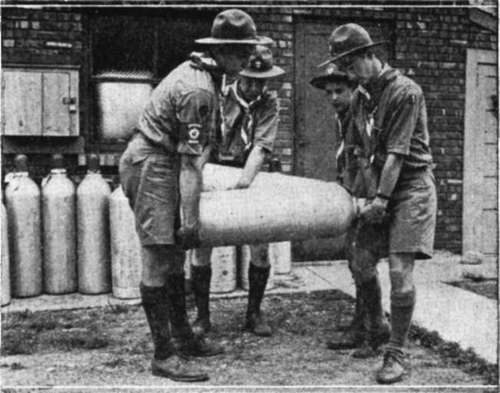
Scouts learn by doing. A collection of chlorine gas cylinders is used to purify the water in a large reservoir.
Troop Equipment
Troops can, with but little expense, be equipped or equip themselves with a number of valuable pieces of emergency gear. They can make and keep on hand very efficient stretchers, traction splints, triangular and roller bandages for first aid purposes, and such equipment for fighting grass and brush fires as beaters and pails.
They can gradually accumulate a small supply of axes, shovels, kerosene lanterns, rope, blankets, staves, etc. Such gear should serve two purposes— training for and use in emergencies.
The Emergency Service Training Plan
Together, the Emergency Service Corps and the
Emergency Service Training Troop are the organization underlying the Emergency Service Training plan.
Continue to:


My Books

