


Program Of Patrol Outings
Description
This section is from the book "Handbook For Scoutmasters. Volume 1 & 2", by Boy Scouts of America. Also available from Amazon: Handbook For Scoutmasters.
Program Of Patrol Outings
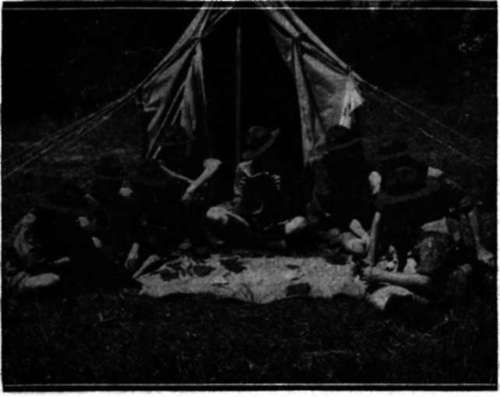
The program of these Patrol outings should include the activities of camping and Scoutcraft such as fire lighting, cooking, tracking, signaling, using knife and hatchet, exploring, mapping, judging, nature lore, pioneering, games.
Frequently it will be desirable to have the Patrols start out on separate hikes and to meet as a Troop at an agreed place later in the day. This method is particularly useful in Troops in which the all-day Saturday hikes are handicapped by the Scoutmaster's having to work in the morning.
Patrol Good Turns
A very fruitful means for stimulating the regular performance of individual Good Turns is the Patrol Good Turn. Patrol Leaders should be encouraged to guide the thoughts of their Scouts along this line and to welcome the suggestions of all Patrol members.
Patrols have strengthened themselves and their members' loyalty to the unselfish ideals of Scouting by the assumption of a definite and continuous job of helpfulness, caring for an elderly cripple, a blind person; directing traffic at a school corner; keeping vacant lots in a given section properly cleaned; helping to train a newly organized Troop. Many are the sorts of Good Turns that may be done by Patrols, either as a regular thing or as occasion arises. Patrols meeting in churches and schools can often give very practical help to their supporting institutions.
Patrol Specialization
Often Patrols may be stimulated by pursuing subjects in which the boys are especially interested.
Patrol specialization may take one of two forms: either all the members of the Patrol agree to concentrate on one particular activity or project, such as first aid, craftsmanship, or nature study; or the Patrol is organized as a team of experts, each boy specializing on a different activity or phase of the Patrol work. Each Patrol will decide for itself by common consent which method it will follow.
First aid and signaling are very popular subjects, but there are a number of other activities in which a Patrol may specialize. A group of good swimmers may practice and train themselves as a life saving corps. A Patrol interested in nature may work together to form a collection of leaves, of moths and butterflies, or rock specimens. Boys inclined toward craftsmanship may concentrate on the building of models. Or a Patrol may take pride in its record-of long hikes or in some other special achievement.
A Patrol works happily at Nature Study. Some one in the gang knows the answer, or can find it. Working together, progress is quickly made.
Patrol Spirit
One of the most significant characteristics of the common gang, its esprit-de-corps, its morale, evolves through its activities. In Scout Patrols, the spirit of loyalty in the boy, if properly guided, acts as a powerful reinforcement to the Scout Oath and Law. The development of Patrol spirit should be encouraged in every way possible. Patrol activities are the most effective means of intensifying Patrol vitality and permanency. The Scout Uniform gives the Patrol members a feeling of group consciousness and is an important factor in Patrol spirit.
Once a boy has qualified as a Scout and is admitted to a Patrol, he should be expected to remain a member of that Patrol until he severs his connection with the Troop or is promoted into Troop leadership, unless some compelling reason develops for a change. In a Troop in which the boys are shuffled together at frequent intervals and dealt out into new Patrols according to the whim of the Scoutmaster, there obviously can be little opportunity for the development of Patrol spirit and Patrol traditions.
When your Scouts begin to think and to say, "Our Patrol doesn't do that kind of thing," your job is more than half done. Group opinion among the Scouts in the Patrol is one of the most potent factors in determining conduct. A Scoutmaster at best sees his Scouts but a few hours each week. The Scouts, on the other hand, are meeting each other all through the week in school and at play, and are influencing each other for good or evil. It is for this reason that the Scout Ideals, developed in the Patrol, may be even as important as the personal influence of the Scoutmaster in shaping the character habits of the Scouts. This again shows how necessary it is that the Scoutmaster himself trains his boy leaders toward this ideal.
Developing Patrol Spirit
The Handbook for Patrol Leaders (Chapter II) gives numerous suggestions on how Patrol Spirit may be fostered.
The right Patrol Name is of importance. Instead of being merely a boy, the new Scout as he enters his
Patrol becomes a Buffalo, a Beaver, or an Eagle. He learns to make his Patrol Call and sets out to learn the habits of his Patrol animal or Patrol bird. He is shown how to use the Patrol Signature whenever he signs his name. He wears the Patrol's totem in the Patrol Medallion on his sleeve, and soon learns to take pride in his Patrol Flag and the traditions for which the Patrol Log Book stands.
All of these things-the name, the call, the signature, the flag-are for use, and the Scoutmaster can assist his Patrol in developing Patrol traditions by calling for their use.
Another valuable reinforcement of Patrol consciousness is a definite Patrol headquarters. Just as the boys' gang always has a special meeting place which it jealously defends against all comers, the Scout Patrol should have at least a corner of the Troop meeting place to call its own. The Patrol Corners should be individualized as much as possible by decorations with flags, pictures, knot-boards, trophies and the like, and by appropriate names, such as "The Panthers' Cave," "The Fox's Lair," "The Eagles' Aerie." Here also the Scoutmaster can aid his Scouts through his guidance and enthusiasm toward making these corners real homes to their respective Patrols. At the same time he should help and encourage them in their efforts to find real Patrol Dens for themselves away from the Troop's meeting place for their individual Patrol meetings, as well as suggest to them ways and means of making or purchasing Patrol Equipment for hiking and camping.
The cumulative effect of such items as these continuously emphasized will eventually build that all-desirable thing in every Patrol-Patrol Spirit.
Troop Work
The mistake has been made by many Scout Leaders of confusing the Patrol Method with Patrol Work, making the two synonymous. This notion, naturally, is entirely wrong. The Patrol Method does not imply that the Patrols be let loose and permitted to run each in its own direction independent of the others. On the contrary, unless it promotes the coordination and cooperation of the Patrols-for the good of the common denominator, the Troop-the Patrol Method fails. A Patrol is not a clique sufficient unto itself, but a gang living at one and the same time its own life and the life of a larger group, just as a family lives in its own life and in the life of the community.
As the Handbook for Patrol Leaders definitely makes clear (Chapter III), no Patrol exists for and by itself alone. It has another part to play aside from its important individual life.
Every Patrol has its obligations toward and its share in the larger life of the Troop. A Patrol could never have the truest kind of Patrol spirit unless it also had, in a very active way, genuine Troop spirit, pride in the Troop as a whole, eagerness to help the Troop make a good showing in whatever it undertakes, devotion to Troop traditions, Troop ideals and especially to the Troop's leaders.
Continue to:


My Books

