


Suggested Daily Schedule For Troop Camping
Description
This section is from the book "Handbook For Scoutmasters. Volume 1 & 2", by Boy Scouts of America. Also available from Amazon: Handbook For Scoutmasters.
Suggested Daily Schedule For Troop Camping
7:30 a.m. | Get up. Wash. Cooks prepare breakfast. (Cooks get up one-half hour or hour earlier.) Others straighten up around camp, clean tents, hang blankets up for airing. |
8:15 a.m. | Breakfast. Clean-up. |
8:45 a.m. | Sick call. |
9:00 a.m. | Meeting of Troop Leaders' Council. |
9:15 a.m. | Flag raised by Color Guard from the Seryice Patrol of the day. Inspection of Patrols and Patrol camp sites. |
9:30 a.m. | Scoutcraft period in camp fire circle. |
10:00 a.m. | Patrol training in Scoutcraft and advancement. |
11:00 a.m. | Waterfront period — Swimming and boating instruction. |
12:15 p.m. | Lunch. |
1:00 p.m. | Rest period. Diary writing. Letter writing. |
2:00 p.m. | Scout game or Inter-Patrol Contest. |
4:00 p.m. | Waterfront period—free swimming and boating. |
4:30 p.m. | Cooks start preparation for dinner. Head cooks call for provisions. |
6:15 p.m. | Flag ceremony. |
6:30 p.m. | Dinner. Clean-up. |
7:30 p.m. | Free time or game. |
8:30 p.m. | Camp fire. |
9:30 p.m. | Retire. Lights out. Silence in camp. |
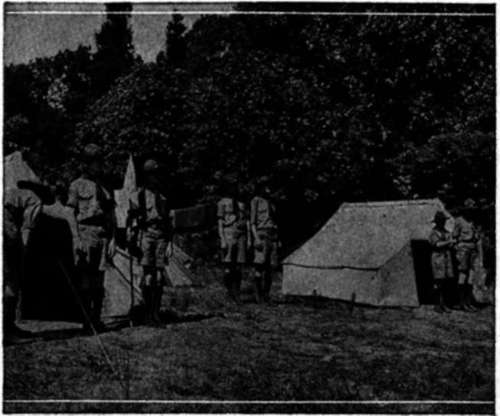
Make the Inspection thorough, yet friendly. A good camp is kept scrupulously clean.
Inspection
The Patrols are returned to their camp sites in charge of their Assistant Patrol Leaders, while the Patrol Leaders and the Troop Leaders set out on the morning inspection.
Be certain that this is thorough. It is the best opportunity you have for securing absolute cleanliness around camp. By making your inspections stiff and pitting the Patrols against each other for the cleanest camp, you may solve one of your major problems. By taking the Patrol Leaders around, you will make certain that not even a microscopic speck or scrap is overlooked. They will be severe with each other, knowing that they all have the same chance and the same responsibility.
Look over the tents: Are they properly straightened up? Are flaps tied up to provide for thorough ventilation? Do tents contain only what should be there of personal and Patrol equipment? (Do not insist upon having the beds made up for this inspection. The blankets and straw ticks should rather be out in the sun for airing.) Are the lanterns clean? Are clothes arranged neatly? Is the ground inside and outside the tents spotlessly clean?
The dining flies: Are tables and benches clean? Are plates, cups, etc., clean and protected against dust and insects? Are the dining flies put up properly? Are grounds clean?
Kitchen: Are fire places in good shape? Are pots and pans clean? Are wood piles in order, with axes in chopping blocks and chips removed? Are dish cloths washed and hung up for drying? Is food storage clean, tidy and free from flies? Have covers of grease traps been renewed? Are the refrigerators in shape? Has garbage been burned or removed?
After the Patrol spots have been inspected, the Patrol Leader of the Service Patrol goes with the Scoutmaster for an inspection of the latrines (Are seats clean? Are trenches properly covered? Is paper in place? Is screening in shape?), the washing place (Are the surroundings clean? Have basins been emptied, cleaned and turned up?), the Camp Fire Circle (Is wood piled up neatly? Are seats in position? Is ground clean?).
These details may seem rather formidable, but as a matter of fact, they are very quickly checked and taken care of when everyone knows what to look for. The important thing is to have high standards with which the Scouts are all familiar. If the Scouts are made to recognize the reasons for doing what is expected of them, they will give ready cooperation.
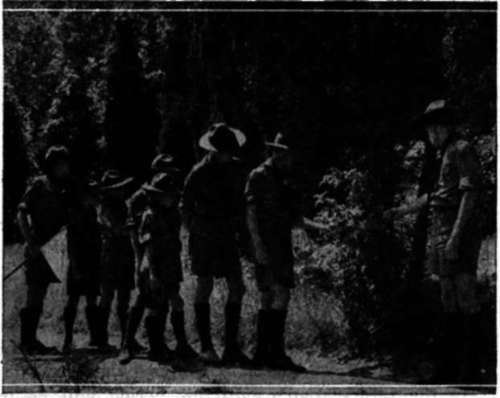
Naturecraft is a skill that may be encouraged and mastered during the forenoons' Scoutcraft periods.
Forenoon. Scoutcraft Period
The inspection may be followed by a Scoutcraft period, in charge of the Scoutmaster or an Assistant, or—in the Inter-Troop Camp—of an expert provided by the Local Council.
The subject should be very definitely tied in with the work of the camp. The first day it may thus treat axe safety and rope work, with special emphasis on the construction of camp gadgets. This may be followed on succeeding days by instruction in fire-making and cooking, in first aid, in woodcraft, etc.
The Scoutcraft period should be short and to the point, and should preferably take the form of a demonstration with the necessary explanations.
Patrol Period
The next hour or so should be left to the Patrols' own devices. There may be further gadgets to be put up. The Patrols may set out for training in special Scoutcraft subjects for which they may secure the aid of a leader, or they may go on exploration hikes of their own.
There is even the possibility that they may just sit and talk.
Let them feel that they are free to do whatever they please, as long as they stick together in the Patrol.
Waterfront Period
The forenoon waterfront period should preferably be an instruction period in elementary swimming for beginners; in life saving for advanced swimmers.
In the Inter-Troop Camp this period will be in charge of a complete expert waterfront staff, which will provide instruction, and supervision.
In the Independent Troop Camp, on the other hand, the following points (already briefly mentioned in the "Safety Through Skill" section) MUST be attended to so that the Minimum Requirements for Swimming and Water Safety may be satisfied:
1. Each bather MUST have received a physical examination before coming to camp.
2. The bathers MUST have been tested, classified as to ability and placed with a group in a special classification area.
3. The leader in charge of the waterfront MUST be at least twenty years of age and hold a Red Cross Life Saving Corps certificate. This is a minimum requirement.
4. Each classification group of bathers MUST be adequately supervised with one pair of eyes for every ten bathers the minimum.
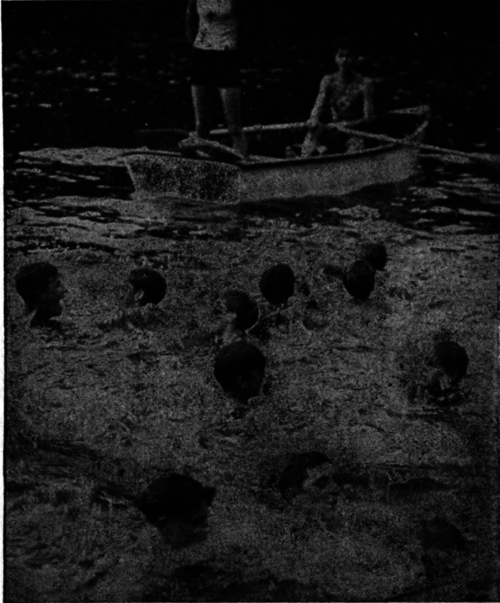
The Buddy System starts at the Buddy Board, carries on to the dock and into the water. This makes swimming safe.
5. The Buddy Plan Check System MUST be used and rigidly enforced. The Buddy Plan is based on the principle of placing together, as Buddies, two boys of equal ability who will, if need arises, assist each other.
This decreases the possibility of accidents to a great degree and gives Scouts a sense of responsibility which is of real value in their training. A "Buddy signal" is given at ten minute intervals at which time each Scout shall grasp and hold aloft the arm of his buddy. The lookout will then have an opportunity to see that each Scout is with his buddy. If the buddies are so far apart that they cannot reach each other while the leader counts to ten, they should immediately be called up and not permitted further swimming that day. If anyone is missing, the leader will immediately give the "all out" signal, and the lost bather's drill will be executed. The bathers are checked as they enter and leave the swimming area.
The waterfront is one place where it does not pay to be lenient. You do not want to be the person responsible for the loss of a human life. Therefore take full precautions.
For complete description of waterfront layout and safety, see the official manual, Swimming and Water Safety.
Noon
From the swim the Patrols return to a simple noon meal, followed by a compulsory rest period.
Rest Period
This noon rest should be a period without any organized activities whatever.
The boys should be encouraged to lie down in the shade somewhere (not in their tents). They may have a quiet talk together. Letter writing and bringing up-to-date the camp diary are in place. Or reading a book or a magazine. If anyone feels like indulging in a nap, by all means let him.
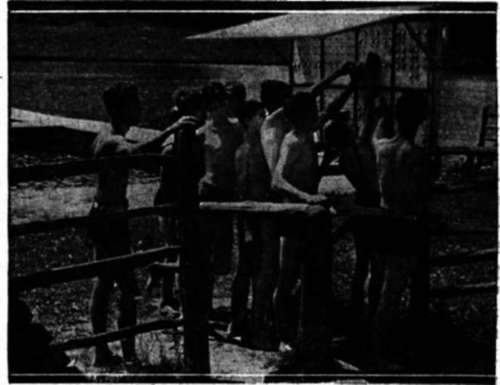
Each Scout hat had a swim with his Buddy. They're checking out. All swimmers "present and accounted for." So ends the swim period.
Continue to:


My Books

