


The Troop Committee. Continued
Description
This section is from the book "Handbook For Scoutmasters. Volume 1 & 2", by Boy Scouts of America. Also available from Amazon: Handbook For Scoutmasters.
The Troop Committee. Continued
The Duties In A Nut Shell
In a nut shell, the Troop Committee is expected to keep a good Scoutmaster at the head of the Troop and to maintain those conditions which are necessary for his success.
It should be clearly understood right at the outset that the Committeeman is not expected to give personal leadership to Scouts unless his help is particularly requested by the Scoutmaster for some specific project. On the contrary, his job is to handle all matters relating to the success of the Troop which do not require direct leadership of boys, so that the Scoutmaster may concentrate on the main job-working with Scouts. With this understanding the Troop Committee becomes a vital factor in the Troop's life.
Three Factors Of Success
There are three factors of success in the functioning of the Troop Committee:
(1) It must be composed of the right men.
(2) It must be properly informed of its duties.
(3) It must be given opportunities for definite service.
The Right Men for the Job
It naturally is of great importance that the right men are found for the Troop Committee, men of personality who are willing to see the job through.
The first requirement for a Troop Committeeman is, of course, a genuine interest in the Troop. The fact that he has a boy in the Troop or that he feels very keenly the need for a Scout Troop to round out the work of the Sponsoring Institution makes us fairly certain that he will give his best efforts to making the most out of his own responsibilities.
The next requirement is that he have some initiative of his own and be capable of going ahead with a job without having to be continually prodded. The type of Committeeman who is a joy to any Scoutmaster's heart is the one who regularly offers his aid without waiting for the Scoutmaster's call for help, who can see from his own observation that the Troop meeting place is inadequate, and who will then go up to the Scoutmaster and say to him, "Mr. Scoutmaster, wouldn't it be a good idea if I should try to get you the use of a good-sized room instead of this little basement you're meeting in now?"
Another requirement is a willingness to learn and a willingness to understand his relationship to the
Scoutmaster and the real purposes and methods of Scouting.
A last requirement of a Troop Committeeman is courage. Questions often come up and are pressed aggressively by commercial or political interests in a community to have a Troop take a certain course of action. Such situations call for the type of courage which will make the Committee refuse to swerve from the course which it believes to serve the best interests of the boys in Scouting. The Committeeman should not only be willing to take the responsibility for such decisions, but he will make it very clear to all concerned that the responsibility is being taken by the Committee and that the question was not one for the Scoutmaster to decide. However, in these cases the Scoutmaster should be given an opportunity to express his point of view to the Troop Committee.
The responsbility of getting the right men rests with the Sponsoring Institution or-in a community Troop -with the sponsoring group of citizens. If any members of the Committee become inactive or resign, the Sponsoring Institution appoints new Committeemen to take their places, and it is advisable in an established Troop that the Scoutmaster be consulted whenever an appointment is to be made. New or additional committeemen may be appointed at any time. Also, each year at the reregistration time it is quite in order for the institution to drop from the Troop Committee any "dead wood" and to add to it new men as it may see fit.
The Chairman
The Chairman of the Troop Committee may be appointed by the institution sponsoring the Troop or he may be elected by the other members of the Committee. He should, if possible, be a member of the governing board of the institution in order that he may be the representative of the Troop before the officials of the institution and make a report to them at regular intervals on the accomplishments of the Troop and the work of the Committee.
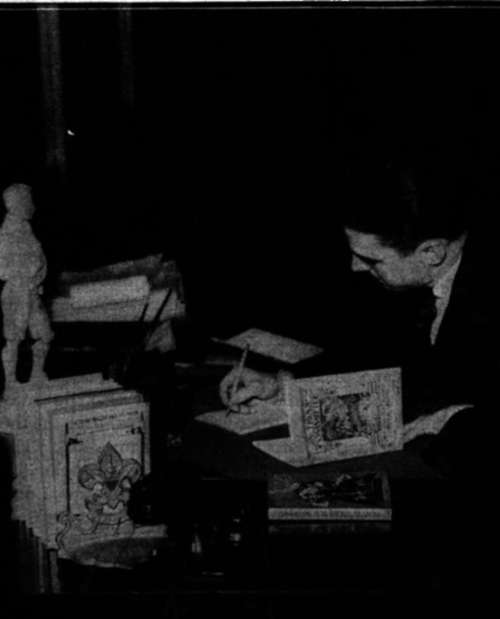
Troop Committeemen can find a great deal of inspiration in Scout books. The Service Library books show the short cuts.
He should be the representative of the Troop on the Local Council or District Committee unless the Committee decides upon another member for this position, and should hold office for the duration of the Troop year.
Informed Of Their Duties
With men of high calibre on the Troop Committee, the Scoutmaster has a tool which will greatly facilitate his work-that is, provided he makes use of it. As mentioned above, only as a Troop Committee actively commits is it a good committee. And it cannot "commit" intelligently unless its members clearly understand and wholeheartedly accept the responsibilities which they have agreed upon in becoming Committeemen.
The Scoutmaster, because of his training, is often in a position to give this information. Also he may refer the Committee to the available literature on the subject (such as the Service Library Pamphlet, "The Troop Committee") or have the Chairman make arrangements to have a representative of the Local Council office meet with the Committee and explain what other Troop Committees are doing. In addition, the Committeemen may attend training courses presented by the Local Council.
Opportunities For Service
No Scoutmaster should complain "My Troop Committee does nothing" when he has never asked them to render service at any particular time. These opportunities for service must be presented by the Scoutmaster. He cannot expect much help unless he indicates his needs, unless there is a cleancut understanding with the Committeemen as to what they are expected to do-and when. "Come down and help present Second Class Badges next Friday at 8:30," is better than "Drop in any time." We all know that "any time" is no time at all, or in other words, never.
It is equally important that the Scoutmaster call on boys in the Troop to do things whenever possible-and that he call on adults in cases only when the task to be done cannot be an occasion for letting a boy get the values of feeling that he is doing something. That is "learning by doing."
One of the reasons we have Scouting is that so much is being done for us in modern civilization that there is little left for boys to do. There are many opportunities for men to serve in Scouting, but they must not rob the boy of his chances to do things himself.
What The Troop Committee May Do
The opportunities for Troop Committee service which arise in the life of a Troop are many and varied. Several of them are directly related to the responsibilities of the Troop Committee, and here, of course, the Committee should take the initiative in getting them performed. In other instances, the initiative must come from the Scoutmaster.
At all times, the Troop Committee should keep in mind that the Scoutmaster and Assistants alone should have direct contact with the boy. Should any Committeeman have occasion to work with the Troop, or any individual directly, it should be done only at the request or with the approval of the Scoutmaster and under his supervision. The easiest way in which a Troop Committee may destroy a Troop is by going over the head of the leader in taking up things with the boys of the Troop.
Continue to:


My Books

