


The Troop Committee
Description
This section is from the book "Handbook For Scoutmasters. Volume 1 & 2", by Boy Scouts of America. Also available from Amazon: Handbook For Scoutmasters.
The Troop Committee
To carry out this obligation adequately, the institution or group appoints a Troop Committee - from influential, active members of the sponsoring group, preferably fathers of prospective Scouts and men especially interested in boys.
Before the Troop can start, there are certain responsibilities of the Troop Committee that must be carried out as a part of building the groundwork. During this period, with help from a Local Council representative, the Troop Committee selects and appoints a Scoutmaster and his Assistants, selects and secures a suitable meeting room, and establishes the Troop's finances on a firm foundation.
A Troop needs not only the intelligent and interested backing of an actively committed institution or group, but also the specific help of an able Troop Committee. (See Chat 10).
Cooperation Of Local Council
The Sponsoring Institution will, naturally, from the start have been in contact with the Local Council and will have received advice and help. As soon as the Troop Committee is formed, an even closer cooperation is necessary. The Committee should meet in conference with representatives of the Local Council, a member of the Council's Organization Committee and the District or Neighborhood Commissioner, at which its duties will be thoroughly explained and discussed, and all questions answered.
Selecting The Scoutmaster And His Assistants
Where a prospective Scoutmaster has himself set the ball rolling and is found fit for Scoutmastership, or where the Local Council itself or an old Troop is building a Troop around available leadership, this should present no problem.
Where no such predetermined leadership is at hand the Troop Committee must make a careful, personal investigation of the character and qualifications of possible candidates for these important posts and be convinced before appointments are made that they are men to whose leadership and influence they would be willing to commit their own sons without reservation.
The Scoutmaster's Training
The new Scoutmaster, especially if he is without previous Scout experience, should set out to secure a certain amount of training before undertaking to build a Scout Troop.
He should make a general study of the "Handbook for Boys" and a specific study of Parts I and II of this Handbook for Scoutmasters and of Chapters I, II and III of the "Handbook for Patrol Leaders."
He should, if possible, visit one or more Troops at their meetings and go on at least one of their hikes, to get a picture of the Scouting Program and to discuss with other leaders the running of a Troop.
He should, if possible, attend a Scoutmastership Training Course, and discuss his job with the Local Scout Executive and a representative of the Local Council, such as the District or Neighborhood Commissioner, who is specifically appointed to aid him.
He should familiarize himself with the duties of the Troop Committee and his Assistant Scoutmaster.
And-an important point-he should aim to secure a Scout Uniform for himself as soon as he has received his commission. That Scouting touch will be found of immense importance toward a flying start.
A Suitable Meeting Room
A suitable meeting room must be available before the Troop is started.
Where the Troop is connected with a church or a school, it usually has no difficulty in securing a headquarters because the institution considers it logical for a Troop sponsored by it to meet in its buildings.
If the Troop is sponsored by a community group, the Troop Committee must select a suitable place for the Troop's meetings.

The Church, the Home, the School. All three help Scouting and are helped by Scouting. The Church that sponsors a Troop is stronger.
A Troop Budget Plan
It is recommended that the Troop Committee make a thorough study of the Troop Budget Plan for the purpose of establishing, if at all possible, a revolving fund before the Troop is started. (See Chat 19).
The Actual Start
The ground work has been laid, the preparations are finished. The time has come to call in the boys and undertake the actual organization of the Troop. And you, as Scoutmaster, take the initiative and carry on.
There is one fundamental principle for organizing: START SMALL.
The "Chosen Few"
The right way to start is not by getting all the eligible boys in the town to join-but by getting a few of the right ones. Familiarize yourself with the boys of the institution or the neighborhood, and talk over the possibility of starting the Troop with a small number of the keenest, most "regular," most respected boys. Get them enthusiastic about the idea and have them round up a few more. Ten to twelve boys, preferably twelve-year-olds, would be the most appropriate number for a formative group, since eight is the national minimum for chartering a new Troop, and a couple of the first group may disappoint you. Only in the case that you have a nucleus of boys already Scouts, is it advisable that a larger number be invited. You will find that the most successful Troop is the one which achieves success with a small group first, and develops in size as success continues.
Planning Ahead
Arrange with these boys for a definite time and place for the first meeting-then settle down to PLAN AHEAD.
Two important factors enter into your planning:
1. To charter a Troop, each member must have met the Tenderfoot Requirements.
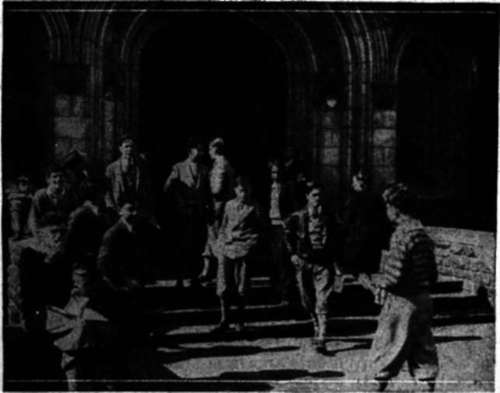
The School, the Home and the Church. Here character is strengthened. The center but never the circumference of e boy's life.
2. To run a successful Troop, the Patrol Method should be used from the start.
Which means that the main function of the first few meetings is to impart to the boys an elementary knowledge of Scoutcraft-Scout Oath, Law, Sign, Salute, Motto, Badge, Uniform, The Flag of our Country, and Knot-tying-and get the Patrol Method firmly established. But also-and equally important-to instill into the boys the spirit of Scouting, to build an esprit-de-corps, to give them the joy of anticipation of great-yes, glorious-things ahead in their lives as Scouts.
Correctly planned and prepared for, it is possible to accomplish most of these objects at about four meetings of the group, scheduled over a month's time, although it may be found necessary to extend this time to six weeks or even two months.
In the following pages are given two sets of such suggested meetings. It is obvious that either of them will have to be modified to suit your particular conditions.
Nevertheless, it is hoped that they may provide a worthy basis for your consideration.
Each meeting is planned to occupy an hour and a half.
Though it may be your first adventure in Scout leadership, approach it with at least the appearance of confidence. Have a trained Scout or an Assistant on hand, if you will, but conduct the meeting, explain the Scout Requirements and make the announcements yourself.
It is important for the boys to realize your interest, and to recognize your control of the gathering.
Continue to:


My Books

