


The Troop Leaders' Council As The Managing Body Of The Troop
Description
This section is from the book "Handbook For Scoutmasters. Volume 1 & 2", by Boy Scouts of America. Also available from Amazon: Handbook For Scoutmasters.
The Troop Leaders' Council As The Managing Body Of The Troop
In its capacity as the managing body of the Troop, the Troop Leaders' Council has three distinct functions in which it should be guided wisely by the Scoutmaster.
(1) It plans the activities of the Troop from ideas and suggestions submitted by all its members for meetings, hikes, camps, Troop Good Turns, entertainments, parents' nights, special projects.
The Troop Leaders' Council decides upon rules to be followed in Inter-Patrol contests and devises the Troop's special ceremonies for meetings, camp fires and investitures. It sets the Troop's standards in advancement procedures.
(2) It carries out the plans decided upon, receives and weighs reports of the Patrols, checks up regularly and critically to see if the work is advancing properly.
This last point is of great importance. Decisions must result in action. If a Troop sets up in January certain goals for advancement to be reached in June, for instance, these goals should be in sight by April. If they aren't, something stimulating should be done about it. Similarly, if the leaders have decided in January that there are to be one big adventure hike and one big Good Turn project during the spring, these decisions ought to be dusted off in April or May and marked "Done," or brought vigorously again to the attention of all hands.
Also the Troop Leaders' Council is what might be called the Reception or, maybe better, the Acceptance Committee of the Troop. One of its important duties is to interview candidates before they are formally admitted into the Troop. To bring a new boy who has already been informally accepted into and trained by a Patrol before the Troop leaders as a group will make an impression on him that will add to his realization of the importance of the step he is taking.
(3) It is the clearing house of the Troop on such individual problems of conduct or personality as the Scoutmaster may think the members capable of handling. The aim should be to bring about better adjustment within the Troop, such as transfer to another Patrol, a talk with the leader best able to deal with the case, different handling by all the leaders, and so on. Lads who are labelled as troublesome may often be led into a different attitude by skillful and friendly treatment applied by their fellows under the guidance of the Scoutmaster. The Troop Leaders' Council is the place where this treatment is discussed.
What The Troop Leaders' Council Does
The following gives ideas of items which may be handled in the Troop Leaders' Council:
Plans, promotes, organizes and operates all Troop (not Patrol) camping and hiking.
Determines what offices (other than those of senior leaders) are elective and what offices are appointive in the Troop, the terms of that office, qualifications and those eligible to vote.
Lays down basic rules with respect to recruiting of candidates, admission to Patrols and size of Patrols.
Operates Troop meeting programs. Lays down basic rules of Troop meeting program operation (e.g., minimum length of Patrol periods, excuses from meeting activities, etc.), and leaves details in hands of the meeting leader.
It fixes the dues rate and makes a complete budget of all anticipated income and expenses for the year; authorizes all Troop expenditures.
Plans, promotes, organizes and operates competitions.
Supervises the operation of Christmas toy shops by the Patrols, and other mass Good Turns.
Plans, promotes, organizes and operates the annual minstrel show, annual banquet and any similar large functions.
Determines the eligibility and qualifications of examiners in the administration of the Troop's advancement program.
Discusses current problems such as retarded advancement, poor Patrol organization, absences, delinquency in dues, etc., as such problems arise; proposes solutions.
Elects an executive committee from among its own membership to make decisions where immediate action is required.
Determines Troop participation in neighborhood, district and Local Council activities.
Types Of Troop Leaders' Council Meetings
Two types of meetings are the general practice of the Troop Leaders' Council in its capacity as the managing body of the Troop.
One, a short and snappy "half-meeting" right after the Troop is dismissed on its regular meeting night, for the purpose of discussing the strong and weak spots of the gathering while they are still fresh in the minds of everyone, of checking up on absentees, of introducing candidates, to the group, of discussing the meeting program of the following week and suggestions for the coming Troop hike.
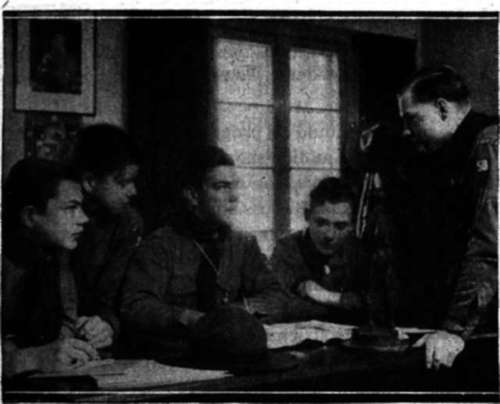
A fine group of young leaders. They know the boy angle of the Troop problems intimately. Useful suggestions bubble out.
The other, an unhurried, undisturbed "full-meeting" held monthly-or oftener if possible Or necessary -at entirely separate times, at the Scoutmaster's home, at the Troop headquarters, or at the Troop's camp, on a Sunday evening or spare week day evening, whenever it may be squeezed in. At this formal meeting the workings of the Troop and the Patrols are discussed in greater detail. Unfinished and new business are considered. The Patrol Leaders report on the advancement and problems of their Patrols, the future work of the Troop is scheduled and new ideas introduced.
A Few Suggestions
Every effort should be made to have the meetings of the Troop Leaders' Council as businesslike as possible.
The minutes should be properly read and submitted for corrections. A motion should be made and seconded to have them adopted as read or as corrected, and proper vote taken. Discussions should be carried on effectively, the chairman bringing possible "meanderers" back to their subject, and the meeting in general should follow proper parliamentary procedure. A warning may be in place here not to make the procedure too strict, impersonal, uncompromising, but rather to have it warm and personal.
The responsibility for running the Troop is a serious proposition and should be handled as such, although a somber seriousness would be out of place. The boy leaders should feel that they are doing a man-size job in a manly way. Thus they will respond more readily to their obligations, to the good of their Patrols and the strengthening of their Troop.
In addition to its value to the Troop, the value of the Troop Leaders' Council to the individual members should not be underestimated. It will provide them with a clearer vision of the job ahead and with a new inspiration for their work. And the formal procedure of conducting the Troop Leaders' Council in true grown-up fashion-with an agenda, definite minutes, orderly discussions, resolutions, rules of order, voting by secret ballot, each boy leader making his own decision instead of voting "with the crowd"-will teach the boys correct methods which will benefit them greatly in later life.
The Program for the Full-Meeting of the T. L. C.
The full-meeting of the Troop Leaders' Council may contain some or all of the following items:
Call to Order.
Minutes of the Preceding Meeting-Read by the recording secretary (the Troop Scribe). Corrections, acceptance.
Scoutmaster's Statement-On the general status of the Troop. Review of work accomplished. Criticisms and words of encouragement. Announcements as to Local Council and National Council developments, new policies, if any-as received from the Local Council Office or through the SCOUTING magazine.
Patrol Leaders' Report-Description of Patrol activities since last meeting. Report of advancement. Plans for future. Observations in regard to individual Scouts, including their wearing of correct Uniform and Insignia.
Treasurer's Report-The financial status of the Troop. Possibilities for earning money. Dues, registration of new Scouts, reregistration.
Next Month's Program-Troop meetings, hikes, camp. Advancement. Patrol objectives. Duties and leadership assignments.
The Season's Program-Check on accomplishments. Possible rearrangements of dates, addition of new or elimination of scheduled activities.
Troop Good Turns, Community Service-Report of achievements. Suggestions for future Good Turns. Establishment of a possible sub-committee to investigate ideas for service.
Discussion, Miscellany.
Scoutmaster's Minute-For inspiration, instruction or both.
Continue to:


My Books

