


The Ancient Ruins of Balbec
Description
This section is from the book "A Library Of Wonders And Curiosities Found In Nature And Art, Science And Literature", by I. Platt. Also available from Amazon: A library of wonders and curiosities.
The Ancient Ruins of Balbec
The Ancient Ruins of Balbec - To give a just idea of these ruins, we must suppose ourselves descending from the interior of the town. After having crossed the rubbish and huts with which it is filled, we arrive at a vacant place, which appears to have been a square; there, in front, towards the west, we perceive a grand ruin, which consists of two pavilions ornamented with pilasters, joined at their bottom angle by a wall one hundred and sixty feet in length. This front commands the open country from a terrace, on the edge of which we distinguish with difficulty the bases of twelve columns, which formerly extended from one pavilion to the other, and formed a portico. The principal gate is obstructed by heaps of stones; but, that obstacle surmounted, we enter an empty space, which is an hexagonal court of one hundred and eighty feet in diameter. This court is strewed with broken columns, mutilated capitals, and the remains of pilasters, entablatures, and cornices; around it is a row of ruined edifices, which display all the ornaments of the richest architecture.
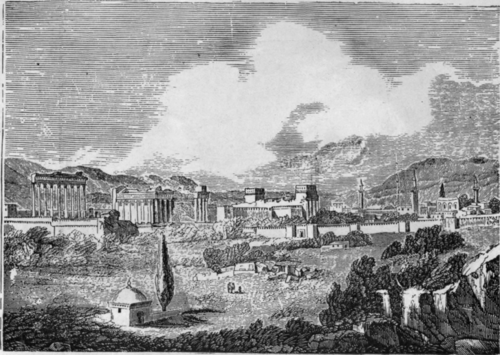
Ruins Of The Ancient City Of Balbec Or Baalgad. Built By King Solomon
At the end of this court, opposite the west, is an outlet, which formerly was a gate, through which we perceive a still more extensive range of ruins, whose magnificence strongly excites curiosity. To have a full prospect of these, we must ascend a slope, up which were the steps to this gate; and we then arrive at the entrance of a square court, much more spacious than the former, being three hundred and fifty feet wide, and three hundred and thirty-six in length. The eye is first attracted by the end of this court, where six enormous and majestic columns render the scene astonishingly grand and picturesque. Another object, not less interesting, is a second range of columns to the left, which appear to have been part of the peristyle of a temple; but before we pass thither, we cannot refuse particular attention to the edifices which inclose this court on each side. They form a sort of gallery, which contains various chambers, seven of which may be reckoned in each of the principal wings, viz. two in a semicircle, and five in an oblong square. The bottom of these apartments still retains pediments of niches and tabernacles, the supporters of which are destroyed. On the side of the court they are open, and present only five or six columns totally destroyed. The beauty of the pilasters, and the richness of the frieze of the entablature, are admirable. The singular effect which results from the mixture of the garlands, the large foliage of the capitals, and the sculpture of wild plants with which they are every where ornamented, is peculiarly pleasing. In traversing the length of the court, we find in the middle a little square esplanade, where was a pavilion, of which nothing remains but the foundation. On arriving at the foot of the six columns, we perceive all the boldness of their elevation, and the richness of their work manship. Their shafts are twenty-one feet eight inches in circumference, and fifty-eight high; so that the total height, including the entablature, is from seventy-one to seventy-two feet.

The Parthenon. At Athens.

Amphitheatre Of Vespasian.
The sight of this superb ruin, thus solitary and unaccompanied, at first strikes us with astonishment; but, on a more attentive examination, we discover a series of foundations, which mark an oblong square of two hundred and sixty-eight feet in length, and one hundred and forty-six wide, and which, it seems probable, was the peristyle of a grand temple, the primary purpose of the whole structure. It presented to the great court, on the east, a front of ten columns, with nineteen on each side, which, with the other six, made in all fifty-four. The ground on which it stood is an oblong square, on a level with this court, but narrower, so that there was only a terrace of twenty-seven feet wide round the colonnade; the esplanade this produces fronts the open country towards the west, by a sloping wall of about thirty feet. This descent, near the city, becomes less steep, so that the foundation of the pavilion is level with the foot of the hill; whence it is evident that the whole ground of the courts has been artificially raised.
Such was the former state of this edifice; but the southern side of the grand temple was afterwards blocked up to build a smaller one, the peristyle and walls of which are still remaining. This temple, situated somewhat lower than the other, presents a side of thirteen columns by eight in front, (in all thirty-four,) which are likewise of the Corinthian order* their shafts are fifteen feet eight inches in circumference, and forty-four in height. The building they surround is an oblong square, the front of which, turned towards the east, is out of the line of the left wing of the great court. To reach it, we must cross trunks of columns, heaps of stone, and a ruinous wall, by which it is now hid. After surmounting these obstacles, we arrive at the gate, where we may survey the inclosure, which was once the habitation of a god; but instead of the solemn scene of a prostrate people, and sacrifices offered by a multitude of priests, the sky, which is open, from the falling in of the roof, only lets in light to show a chaos of ruins covered with dust and weeds. The walls, formerly enriched with all the ornaments of the Corinthian order, now present nothing but pediments of niches and taberna-cles, of which almost all the supporters are fallen to the ground. Between these niches is a range of fluted pilasters, whose capitals support a broken entablature; but what remains of it displays a rich frieze of foliage, resting on the heads of satyrs, horses, bulls, etc. Over this entablature was the ancient roof, which was fifty-seven feet wide, and one hundred and ten in length. The walls which supported it are thirty-one feet high, and without a window. It is impossible to form any idea of the ornaments of this roof, except from the fragments lying on the ground; but it could not have been richer than the gallery of the peristyle: the principal remaining parts contain tablets in the form of tables, on which are represented Jupiter seated on his eagle, Leda caressed by the swan, Diana with her bow and crescent, and several busts which seem to be figures of emperors and empresses.
Continue to:


My Books

