


The Great Wall Of China
Description
This section is from the book "A Library Of Wonders And Curiosities Found In Nature And Art, Science And Literature", by I. Platt. Also available from Amazon: A library of wonders and curiosities.
The Great Wall Of China
The principal defence of the empire against a foreign enemy is the Great Wall, which separates China from Tartary, extending more than fifteen hundred miles in length, and of such thickness, that six horsemen may easily ride abreast upon it. It is flanked with towers, two bow-shots distant from one another: Walker says, there are forty-five thousand of these towers, (a number rather in-credible,) and that the wall extends two thousand miles. It is said, that a third of the able-bodied men in the empire were employed in constructing this wall. The workmen were ordered, under pain of death, to place the materials so closely, that not the least entrance might be afforded for any instrument of iron; and thus the work was constructed with such solidity, that it is still almost entire, though two thousand years have elapsed since it was constructed.

The Great Wall Of China. Erected To Protect The Empire From The Incursions Of The Tartar Cavalry.
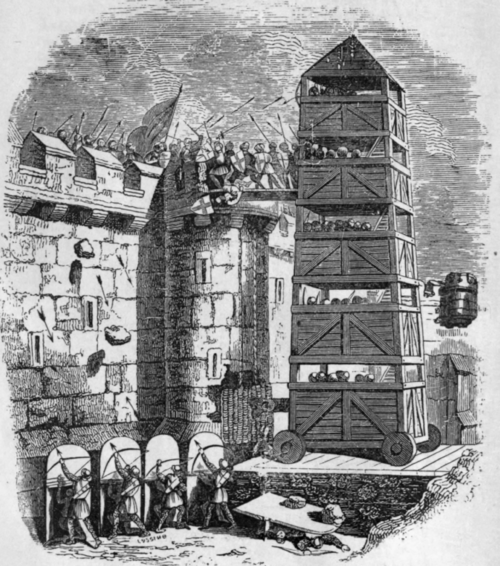
Ancient Method Of Storming A Fort.

The Emperor Of China.

A Chinese School.
This extraordinary work is carried, not only through the low lands and valleys, but over hills and mountains; the height of one of which was computed by F. Verbiest, at one thousand two hundred and thirty-six feet above the level of the spot where he stood. According to F Martini, it begins at the gulf of Leatong, and reaches to the mountains near the city of Kin, on the Yellow River; between which places it meets with no interruption except to the north of the city of Suen, in Peche-li, where it is interrupted by a ridge of inaccessible mountains, to which it is closely united. It is likewise interrupted by the river Hoang-ho; but for others of an inferior size, arches have been constructed, through which the water passes freely. Mr. Bell informs us, that it is carried across rivers, and over the tops of the highest hills, without the least interruption, keeping nearly along that circular range of barren rocks which incloses the country; and, after running about one thousand two hundred miles, ends in impassable mountains and sandy deserts. The foundation consists of large blocks of stone laid in mortar; but all the rest is of brick. The whole is so strong and well-built, that it scarcely needs any repairs; and in the dry climate in which it stands, may remain in the same condition for many ages. When carried over steep rocks, where no horse can pass, it is about fifteen or twenty feet high; but when running through a valley, or crossing a river, it is about thirty feet high, with square towers and embrasures at equal distances. The top is flat, and paved with cut stone; and where it rises over a rock or eminence, there is an ascent made by an easy stone stair.
This wall (our author adds) was begun and completely finished in the short space of five years; and it is reported, that the labourers stood so close for many miles, that they could hand the materials from one to another. This seems the more probable, as the rugged rocks among which it is built must have prevented all use of carriages; and neither clay for making bricks, nor any kind of cement, are to be found among them.
Continue to:


My Books

