


The Humming Bird
Description
This section is from the book "A Library Of Wonders And Curiosities Found In Nature And Art, Science And Literature", by I. Platt. Also available from Amazon: A library of wonders and curiosities.
The Humming Bird
Another subject of acknowledged curiosity is, The Humming Bird. - There are sixty species enumerated by Latham, and Gmelin has sixty-five. The birds of this genus are the smallest of all birds. These diminutive creatures subsist on the juices of flowers, which they extract, like bees, while on the wing, fluttering over their delicate repast, and making a considerable humming sound, from which they derive their designation. They are gregarious, and build their nests with great neatness and elegance, lining them with the softest materials they can possibly procure.
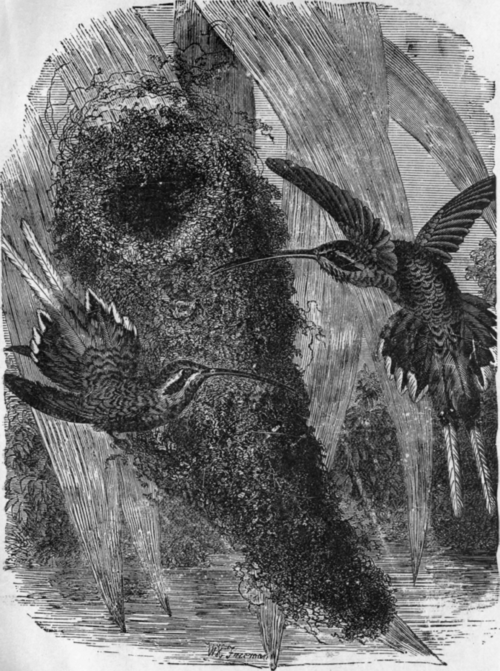
Humming Birds
The red-throated humming-bird is rather more than three inches long, and is frequent in various parts of North America. Its plumage is highly splendid and varying; it extracts the nectar of flowers, particularly those of a long tube, like the convolvulus or tulip. They will suffer themselves to be approached very near, but on observing an effort to seize them, dart off with the rapidity of an arrow. A flower is frequently the subject of bitter conflict between two of these birds; they will often enter an open window, and, after a short contest, retire. They sometimes soar perpendicularly to a considerable height, with a violent scream. If a flower which they enter furnishes them with no supply, they pluck it, as it were in punishment and revenge, from its stalk. They have been kept alive in cages for several weeks, but soon perish for want of the usual food, for which no adequate substitute has yet been found. Latham, however, mentions a curious circumstance of their being preserved alive by Captain Davies for four months, by the expedient of imitating tubular flowers with paper appropriately painted, and filling the bottom of the tubes with sugar and water as often as they were emptied. They then took their nourishment in the same manner as when unconfined, and soon appeared familiarized and happy. They build on the middle of the branch of a tree, and lay two eggs in an extremely small and admirably constructed nest.
The smallest of all the species is said, when just killed, to weigh no more than twenty grains. Its total length is an inch and a quarter. It is found in the West Indies and South America, and is exceeded both in weight and magnitude by several Species of bees.
Continue to:


My Books

