


Typhi (Gr. A Fen)
Description
This section is from "The American Cyclopaedia", by George Ripley And Charles A. Dana. Also available from Amazon: The New American Cyclopædia. 16 volumes complete..
Typhi (Gr. A Fen)
Typhi (Gr. A Fen), a genus of monocotyledonous plants, growing in fenny or marshy places, in this country popularly called cat-tail, and in England bulrush (a name here given exclusively to scirpus) and also reedmace. With one other genus (sparganium) this makes up the small family typhaceoe, which in a systematic arrangement is grouped with the aroids. Typhas are found in most parts of the globe. They have perennial creeping rootstocks, sessile, linear, and nerved leaves, and monoecious flowers, crowded in a spike at the end of the stem; the flowers have neither calyx nor corolla, their place being supplied by numerous long hairs; the upper part of the spike consists of stamens only, intermingled. with hairs, and the lower and more dense portion is made up of minute pistils, surrounded by and closely packed in numerous brown hairs; the ovary ripens into a small one-seeded nut, upon a stalk, surrounded by the copious down of the enlarged hairs. The best known species is the common or broad-leaved cat-tail (typha latifolia), found all over this and nearly all other countries; it is often 8 or 10 ft. high, and in some localities occupies the marsh to the exclusion of all other vegetation.
The leaves are flat, and the spike is a foot or more long,, with no interval between the staminate and pistillate portions; the stamens, when they have performed their office, fall away, leaving the upper portion of the stem bare. Our only other species is the small or narrow-leaved cat-tail (T. angustifolia), which is much smaller; the leaves are narrower, and channelled at the base; the spikes are more slender, with usually a space, often an inch long, between the pistillate and staminate portions; the two grow together, though this is much the less common, and all the characters which distinguish them are variable. In autumn the spikes disintegrate, and in localities where the plants abound the air is annoyingly filled with the copious down. The dried down has been used in beds as a substitute for feathers; but unless the ticking is very tight, or waxed on the inside, the hairs will work through and annoy the sleeper. At present it is largely manufactured into a nonconducting covering for steam pipes and boilers. The quantity of foliage produced by these plants in favorable localities is immense, and it now nearly all goes to waste; unsuccessful attempts have been made to utilize it as paper stock.
In France, where it is called massette, the leaves of cat-tail are used in the nurseries as a ligature in budding.
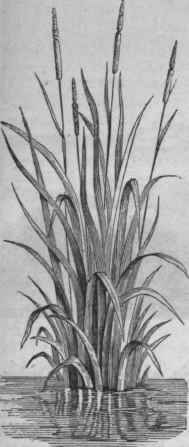
Cat-tail (Typha latifolia).
Continue to:


My Books

