


Anchovy
Description
This section is from "The American Cyclopaedia", by George Ripley And Charles A. Dana. Also available from Amazon: The New American Cyclopædia. 16 volumes complete..
Anchovy
Anchovy, a small fish of the genus engraulis of Cuvier, the peculiar features of which are the opening of the mouth extending behind the eyes, and the long sharp head and projecting upper jaw. It is distinguished from the sprat and other similar fishes by its very short anal fin, and the dorsal fin being immediately above the ventral. Anchovies enter the Mediterranean from the sea in enormous shoals in the spring, and deposit their ova along the shores in May, June, and July. They are caught like the herring with nets at night, with the use of lights. Gorgona, a small island west of Leghorn, is a famous place for the fisheries, and it gives its name to the best qualities of the commercial article. Other important fisheries are along the coasts of Provence and Catalonia. As the fish are taken, the bodies, separated from the heads and entrails, are salted and packed in small barrels, and in this state are ready for exportation. Sent to other countries, they are there repacked in bottles. The brine in which they are kept is reddened with ochre and Venetian red, which is supposed to be done for the purpose of concealing the other dirt.
Notwithstanding their impurities and the substitution of many inferior fish, anchovies are a favorite relish at the breakfast table with many, being taken out of the bottles and eaten raw. x\nchovy sauce has been a favorite condiment from the time of the Romans. They called it garum, and prepared it as it is now made, which is by bruising and boiling the fish over a slow fire with melted butter.
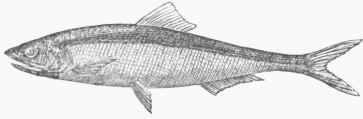
Anchovy (Engraulis encrasicholus).
Continue to:


My Books

