


Apteryx
Description
This section is from "The American Cyclopaedia", by George Ripley And Charles A. Dana. Also available from Amazon: The New American Cyclopædia. 16 volumes complete..
Apteryx
Apteryx, a struthious bird of New Zealand, called by the natives kiwi-kiwi from its peculiar cry. It belongs to the family which contains the living cassowary, emu, mooruk, and ostrich, and the extinct œpyornis, dinornis, and dodo. The beak resembles that of a long-billed wader, being slender, with the base covered with a bony cere, the upper mandible the longer and containing the openings of the nostrils near the tip; the base of the bill is furnished with long, slender black bristles, intermixed with the feathers, and projecting in all directions; the wings are 2 small crooked appendages, extending about 1 1/2 inches from the sides of the chest, and terminated by a curved, obtuse, horny claw 3 lines long, having 9 quill plumes differing but little from those of the body; the tail is not apparent; the tarsi are as long as the middle toe, covered with variously sized scales, and very robust as in gallinaceous birds; there are 3 anterior toes, free and covered with scales, and a very short hind toe, all armed with strong and rather sharp claws.
The plumage is loose as in other terrestrial birds which have no power of flight, resembling that of the emu in size, structure, and color, but wanting the accessory plumelet; the skin is very tough, a line thick along the back, and there is a large amount of fat between it and the muscles, especially on the back, abdomen, and root of neck; the head is broad and but slightly depressed. The genus apteryx was established by Shaw in 1812 from a stuffed skin, and was at that time supposed to have become extinct like the dodo; but in 1833-'8 other specimens arrived, which are described by Mr. Yarrell in vol. i. of the "Transactions of the Zoological Society of London," and by Prof. Owen in vols. ii. and iii. of the same work.
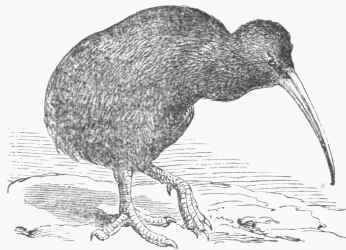
Apteryx australis.
Three species are described. A. australis (Shaw) is about 30 inches long from tip of bill to end of toes, 19 inches to end of coccyx, and weighs about 3 1/2- lbs.; the bill varies in length from 4 1/2 to 6 3/4 inches, the longest belonging to the females, another anomaly in this bird; the bill is 1 inch wide at the gape and 7 lines high; the color is grayish brown, darkest on the back. A. Mantelli (Bartlett), described in 1850, is about 23 inches long, with a bill of 4 inches; the color is dark rufous brown, darkest on the back. A. Oweni (Gould), described in 1847, is the largest species, and is said to be about 3 feet high; the upper parts are transversely barred with blackish brown and fulvous, and the plumage is exceedingly dense and hair-like, resembling more the covering of a mammal than a bird; the bill is an inch shorter, more slender, and curved; the wings are exceedingly rudimentary. The large size of the unhatched young, and the possession within the egg of the remarkable characters of feet, wings, and beak of the adult, show that the young apteryx must be able to provide for itself very soon if not immediately after leaving the egg.
The bill of the apteryx is moderately strong, as the bird is said to be in the habit of resting the head upon it against the ground, and to thrust it into the soil in search of food; it is struthious in structure, and grallatorial only in its length and slenderness. There is no trace of extension of air cells, as in birds of flight, into the interspaces of the abdominal viscera, and the diaphragm is well developed and pierced only for the oesophagus and vessels; the lungs are bird-like, and also the organs of circulation, except in the more membranous character of the right auriculo-ven-tricular valve; the larynx and trachea are struthious. The bones are not perforated for the admission of air. - These birds are found in New Zealand, particularly in regions covered with extensive and thick beds of ferns, in which they hide when alarmed. They are nocturnal in their habits, feeding upon snails, insects, worms, and the large soft-bodied lepi-dopterous larvœ; they run swiftly and defend themselves vigorously with the feet. The nest is made either at the base of a hollow tree or in deep holes which they excavate in the ground.
The natives pursue them for their skins, which from their strength are highly valued for making dresses. - Though a living specimen has been seen at the zoological gardens in London, the apteryx is probably nearly extinct; the Aepyornis is supposed to be extinct, though some believe that it may yet exist in Madagascar; the dodo has been lost within the memory of man; and the dinornis doubtless antedated the historic period.
Continue to:


My Books

