


Finch. Part 3
Description
This section is from "The American Cyclopaedia", by George Ripley And Charles A. Dana. Also available from Amazon: The New American Cyclopædia. 16 volumes complete..
Finch. Part 3
The length of the bird is 6 in., and the extent of the short wings only 8. The habits of this species render it difficult to observe; it runs in the grass more like a mouse than a bird, and is much oftener heard than seen; the notes are soft and sweet, justifying the remark that it is perhaps the finest songster of the sparrow family. The food consists of grass seeds, beetles, and berries. It is confined to the southern states.-In the genus spiza (Bo-nap.), or cyanospiza (Baird), the wings and tail are moderate, and the latter even. The nonpareil or painted finch (S. ciris, Bonap.) is 5 1/4 in. long and 7 1/2 in extent of wings; in the adult male, the head and neck are azure blue; the back and lesser wing coverts yellowish green; circle round the eye, lower back, and under parts carmine; quills and tail purplish brown; secondary coverts green. The female has a brown bill, the upper parts light olive green, and the under parts dull orange, paler behind; the male of the first year resembles the female, except in having the blue lower mandible of his sex; the adult male plumage is not obtained until the fourth year.
It is an inhabitant of the south Atlantic and gulf states, extending into Texas and Mexico; its flight is short and quick, and its movements on the ground like those of the sparrows; its song is very sonorous and pleasing, and is continued through the hottest part of the day; the nest is usually built in an orange tree, and the eggs, four or five, are of a fine bluish pearl color, speckled with blackish. It appears in the vicinity of New Orleans about the middle of April, when great numbers are taken in traps, set with a stuffed specimen of a male bird; all males which perceive this are led by their pugnacious disposition to attack it, and the trap springs upon them during the operation; they are easily kept in confinement, and will sing and breed in captivity if properly cared for. Great numbers of this beautiful finch were formerly carried to Europe, where they brought almost fabulous prices, a bird which cost eight cents in New Orleans selling in London or Paris for more than twice as many dollars. Their flocks sometimes occasion considerable damage to ripe tigs and grapes, of which they are exceedingly fond. The lazuli finch (S. amoena, Bonap.) is another handsome and allied species, belonging rather to the Pacific fauna.
The bill is brownish black; the head and neck, hind part of back and rump, are beautiful greenish blue; fore part of the back, scapulars, wings, and tail, brownish black, the feathers with blue margins; a conspicuous white band on the wings; on the fore part of the breast a broad band of brownish red; the sides, lower wing coverts, and tibial feathers, bluish gray; lower parts white. The female is far less brilliant, a grayish tint prevailing in most parts of the plumage. It is rather a shy bird, with a lively and pleasing song. Another beautiful species is the S. cyanea (Bonap.), which will be noticed under Indigo Bird.-The last finch which will be mentioned belongs to the subfamily of pyrrhulinae, and to the genus carpaducus (Kaup). The purple finch (C. purpurens, Gmel.) is 6 in. long, with an extent of wings of 9 in.; the bill is very robust, conical, bulging, and acute, deep brown above, bluish below; the head, neck, breast, back, and upper tail coverts are of a rich lake color, nearly crimson on the head and neck, and fading into rose color on the abdomen; the fore part of the back is streaked with brown; the quills, larger coverts, and tail are deep brown margined with red; a narrow cream-colored band across the forehead close to the bill.
The female and young are brownish olive above, with dark brown streaks; the under parts grayish white, the sides streaked with brown; quills and tail feathers dark brown with olive margins; a broad white line over the eye, and another from the gape backward. In the southern states their flocks are seen from November to April, feeding on the interior of buds, which they husk with great skill; they are usually seen in the morning and at night, darting after insects. Their song is sweet and continued. They are found from Labrador to Louisiana, being replaced on the Pacific coast by the C. Californicus (Baird) and the C. Cassinii (Baird); they breed in the north, where they are seen in midwinter in company with crossbills and other hardy birds, feeding on the berries of the evergreens. Their nest3 have been found in Massachusetts; the eggs are of an emerald-green color, with a few black dots and streaks near the point, and some purplish blotches. The farmers believe them to be injurious to fruit trees by destroying the blossoms, great numbers of which they pull off. Audubon considers their flesh equal to that of any small bird except the rice bunting.
They are sometimes kept in cages and in aviaries, but they do not sing; in confinement. -Other sparrows and buntings are called finches in different parts of the country, though not belonging to the subfamily of frangillinae, and may be found described among the frin-gillidae in works on ornithology.
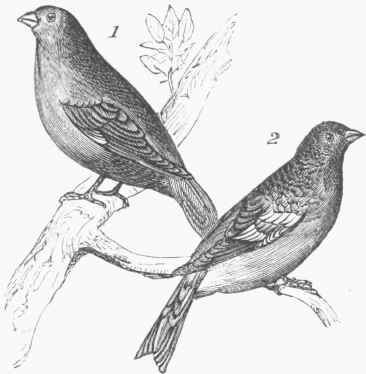
1. Mountain Finch (Fringilla montifringilla). 2. Green Finch (F. chloris).
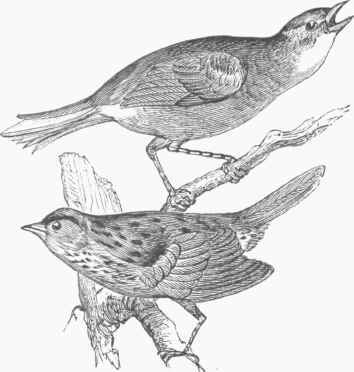
1. Lincoln's Finch (Zonotrichia Lincolnii). 2. Seaside Finch (Ammodromus rnaritimus).
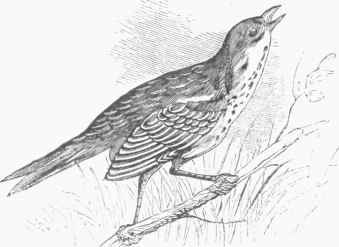
Sharp-tailed Finch (Ammodromus caudacutus).

Purple Finch (Carpaducus purpureus). 1. Female. 2. Male.
Continue to:


My Books

