


Galvanism, Or Voltaic Electricity. Part 5
Description
This section is from "The American Cyclopaedia", by George Ripley And Charles A. Dana. Also available from Amazon: The New American Cyclopædia. 16 volumes complete..
Galvanism, Or Voltaic Electricity. Part 5
Fig. 6.-Hare's Calorimotor.

Fig. 7.-Cell of Daniell's Battery-.
+ | Porous partition. | _ | |||||||
Copper plate | Zinc plate. | ||||||||
Cu2 | SO4 | CU2 | so4 | H2 | so4 | H2 | so4 | ||
- | + | - | + | - | + | - | + | - | + |
An interchange of particles follows this polarization, the terminal negative constituent, SO4, going to the positive or zinc plate and combining with it, and the terminal positive constituent (its electrical state heightened by induction) going to the negative or copper plate, and being deposited upon it. It will be observed that the action here is somewhat different from that which obtains in a simple cell containing dilute sulphuric acid as the exciting liquid. In that case hydrogen is liberated at the surface of the copper plate, while in the Daniell's cell it is substituted by metallic copper. The hydrogen constituent of sulphuric acid is separated from it at the porous cell, but is immediately reunited to the salt radical, oxysulphion, SO4, the electro-negative constituent of the sulphate of copper. An interchange of molecules is thus effected throughout the whole chain of particles of sulphate of copper and of sulphuric acid lying between the copper and zinc plates; a copper molecule, charged with positive electricity, being at one end deposited upon the copper plate, which within the fluid is charged with negative electricity, and a molecule of the salt radical, SO4, charged with negative electricity, uniting at the other end with the zinc plate, which within the fluid is charged with positive electricity.
If the molecules of copper after they are deposited could retain their electro-positive condition, a state of polarization of the plate would result similar to that which takes place from the deposition of a film of hydrogen in the ordinary sulphuric acid battery, and having the effect of a deposit of metallic zinc; but as soon as the deposition takes place the polarity of the deposited molecule changes from positive to negative, a necessary result of its becoming a part of the copper plate.When the solution of sulphate of copper becomes dilute, hydrogen is liberated upon the surface of the copper plate, from decomposition of water or of sulphuric acid, it has not been determined which. To preserve the constancy of the battery, it is therefore necessary to keep the solution of sulphate of copper saturated. The sulphuric acid resulting from the decomposition of the sulphate of copper tends to replenish the loss sustained by the formation of sulphate of zinc, but the accumulation of the latter salt weakens its action, so that it is necessary from time to time to add fresh quantities of acid.
Two ways have been devised to remedy this difficulty, one of which is using a siphon connected with the bottom of the cell, by which the strong solution of sulphate of zinc which settles may be discharged when fresh quantities of sulphuric acid are poured in. The other method, devised by Buff, consists in an arrangement by which the zinc plate is gradually made to sink in the fluid at a rate sufficient to counterbalance the loss sustained by diminished chemical action. Grove's battery is a modification of Daniell's, in which nitric acid takes the place of sulphate of copper, and a plate of platinum that of copper. Fig. 8 represents a cell of Grove's battery. A glass or earthen vessel, A, containing dilute sulphuric acid, receives a cylinder of zinc, within which is a porous earthenware cup, V, containing strong nitric acid, and in which there is immersed a platinum plate, P. A cover attached to it confines the fumes of hyponi-tric acid, N2O4, which are liberated by the decomposing nitric acid, N2O5. The chemical action is shown in the following diagram:
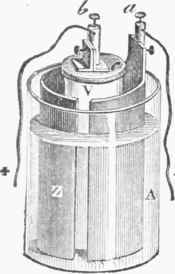
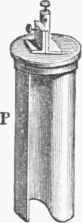
Fig. 8.-Cell of Grove's Battery.
+ | Porous partition. | __ | |||||||
Platinum plate. | N2O4 | O | N2O4 | O | H2 | So4 | H2 | So4 | Zinc plate. |
- 1 | + | - | + | - | + | - | - | - | + |
Bunsen's battery is a modification of Grove's, which was devised by Bunsen, then professor of chemistry at Marburg, in 1843. The platinum element is replaced, by carbon, which is an excellent conductor, and more electro-negative than platinum. The graphite carbon taken from the retorts of gas works is often used; or a cake may be formed by calcining in an iron mould a mixture of coke and bituminous coal. The electrolytic fluids may be the same as in Grove's; but others are often used, as bichromate of potash, sulphuric acid, and common salt. A battery may be charged with these fluids in the following manner: Two ounces of bichromate of potash are dissolved in 20 ounces of hot water, and when cold 10 ounces of sulphuric acid are added. "When the heat caused by the addition of the acid has subsided, the solution is placed within the porous cup, and a saturated solution of common salt poured into the outer compartment, which is occupied by the zinc plate. The chemical action when these solutions are used is rather more complex than that which has been given for other fluids. The action of the sulphuric acid on the bichromate of potash produces sulphate of potash and chromic acid.
Hydrogen is evolved, and acting upon the chromic acid reduces it to chromic oxide, water being at the same time formed, while the chromic oxide combines with sulphuric acid, forming sulphate of chromium. The electromotive force resulting from these reactions is very great, and the batteries in which these fluids are used are now generally preferred where compactness is desired. La-clanche's battery consists of a carbon electrode packed in a mixture of peroxide of manganese and carbon or coke in coarse powder in a porous cell, and outside of this a cup containing a zinc electrode immersed in a solution of sal ammoniac. Its electromotive force is about nine tenths of that of Daniell's. The comparative values of the electromotive forces of several forms of batteries are as follows: Bunsen's, 839; Grove's, 829; Daniell's, 470; Smee's, 210; Wollaston's, 208. - Electricity developed by the Action of Solutions upon one another. If two vessels, one containing a solution of potash and the other of nitric acid, are connected by a bundle of asbestus, as represented in fig. 9, and two platinum plates are connected with the wires of a galvanometer, a galvanic current will pass through the latter instrument from the acid to the alkali.
Continue to:


My Books

