


Bag-Pipe. Part 2
Description
This section is from "The Encyclopaedia Britannica". Also available from Amazon: Great Books of the Western World (60 Volumes).
Bag-Pipe. Part 2
The Old Irish Bag-Pipe
Very little is known about this instrument. It is mentioned in the ancient Brehon Laws, said to date from the 5th century (they are cited in compilations of the 10th century), in describing the order of precedence of the king's bodyguard and household in the Crith Gabhlach: "Poets, harpers, pipers, horn-blowers and jugglers have their place in the south-east part of the house."[12] The word used for (bag-) pipers is Cuislennaïgh, a word associated with reed instruments (cuiscrigh = reeds; O'Reilly's Irish-English Dictionary, Dublin, 1864). The old Irish bag-pipe, of which we possess an illustration dated 1581,[13] had a long conical chaunter with a bell and apparently seven holes in front and a thumb-hole behind; there were two drones of different lengths - one very long - both set in the same stock. It is exceedingly difficult to procure any accurate information concerning the development of the bag-pipe in Ireland until it assumed the present form, known as the union-pipes, which belong to Class II.
 The cornemuse and chalemie were the bag-pipes in use in France, Italy and the Netherlands before the advent of the musette, to which they bear the same relation as the old Irish bag-pipe does to the union-pipes, or the cornemusa or piva to the sampogna or surdelina in Italy. Two kinds of cornemuses were known in France during the 16th and 17th centuries, differing in one important structural detail, which affected the timbre of the instruments. Père Marin Mersenne[14] has given a detailed description of these varieties and of the musette, with very clear illustrations of the instruments and all their parts. The cornemuse or chalemie used by shepherds, and as a solo instrument (see fig. 1 (1)), was similar to the Highland bag-pipe; it consisted of a leather bag, inflated by means of a valved blow-pipe; a large drone (gros bourdon) 2½ ft. long included the beating-reed, which measured 2½ in., and was fixed in the stock; the small drone (petit bourdon), 1 ft. in length including a reed 2 in. long, also had a beating-reed and was fixed in the same stock as
 the chaunter. The two drones were tuned to C. The chaunter had a conical bore and a double reed like an oboe, but hidden within the stock; it could be taken out and played separately, when the compass given by the eight holes (seven in front and a thumb-hole) C to C′ could be increased by a third to E, by overblowing the D and E an octave by pressure of the breath and lips on the reed, now taken directly into the mouth. The second kind of cornemuse was played only in concert with a family of instruments known as Hautbois de Poitou, a hautbois having the reed enclosed in an air-chamber, just as is the case with the reeds of the bag-pipe. This cornemuse had but one drone which could, like the others, be lengthened for tuning by drawing out the joint; the reed was not a beating-reed but a double reed like that of the chaunter; this constitutes the main difference between the two cornemuses. The chaunter had eight holes, the lowest of which was covered by a key enclosed in a perforated box.
 Sackpfeife or Dudelsack.
 Bock.
Bock.
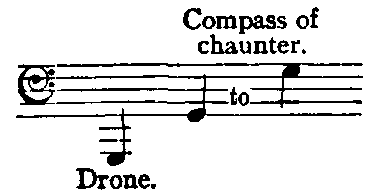
The Sackpfeife or Dudelsack of Germany was an instrument of some importance made in no less than five sizes, all described and illustrated by Michael Praetorius.[15] They consist of the Grosser Bock or double-bass bag-pipe, a formidable-looking instrument with a single cylindrical drone of a great length, terminating, as did the chaunter also, in a curved ram's horn (to which the name was due). The chaunter had seven finger-holes and a vent-hole in front, and a thumb-hole at the back. The drone was tuned to G, an octave below the chaunter.
The Bock, of similar construction, was pitched a fourth higher in C.
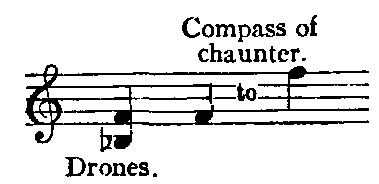 Schäferpfeife.
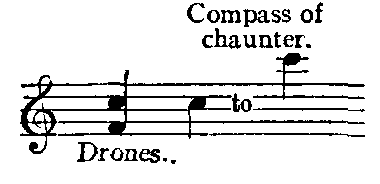 Hümmelchen.
The Schäferpfeife had two drones in B flat and F. Praetorius explains that the upper notes of the chaunter of this sackpfeife had a faulty intonation which could not be corrected owing to the absence of the thumb-hole, usual in all other varieties of the instrument.
The Hümmelchen had two drones tuned to F and C.
The Dudey or treble sackpfeife was the smallest of the family, and had three drones tuned to E flat, B flat and E flat, and a chaunter with a compass ranging from F or E flat to C or D.

Praetorius also mentions a different kind of sackpfeife he saw in Magdeburg (see op. cit. Theatrum, pl. v., No. 4), which was somewhat larger than the schäferpfeife and pitched a third lower. There were two chaunters
 mounted in one stock, each having three holes in front and one for the thumb at the back. The right-hand chaunter sounded the five notes D, E, F, G, A, and the left-hand chaunter, G, A, B, C, D. The performer was thus able to play simple two-part melodies on the Magdeburg bag-pipe. Praetorius mentions in addition the French bag-pipe (musette), similar in pitch to the hümmelchen, but inflated by means of the bellows.
Continue to:


My Books

