


Miscellaneous Receipts. Part 19
Description
This section is from the "Encyclopedia Of Practical Receipts And Processes" book, by William B. Dick. Also available from Amazon: Dick's encyclopedia of practical receipts and processes.
Miscellaneous Receipts. Part 19
6258. To Clean Files
6258. To Clean Files. The occasional cleaning of files in the machine shop by means of oil, heat, and the card (wire brush) will save dollars to the owner and annoyance to the worker.
6259. To Cut Good Steel Scrapers
6259. To Cut Good Steel Scrapers. Part of the blade of a broken saw makes the best scrapers; but, as it is hard, it is very difficult to cut it into the required form. The best and most expeditious way is to mark it out to the size wanted, and then to place the blade or steel plate in a vise which shuts very close, placing the mark even with the face of tho vise, and the part to bo cut to waste above the vise. Then with a cold-chisel, holding it close to the vise and rather inclined upwards, begin at one end of the steel plate, and with a sharp blow of the hammer it will cut it. Keep going on by degrees, and it will with ease be cut to the shape required ; then grind the edges of the scraper level, and finish by rubbing it on a Turkey-stone.
6260. Knots
6260. Knots. It is not a very difficult thing to tie a neat and secure knot, yet comparatively few persons know how to accom -plish it. Below we give all the knots necessary for ordinary purposes, with illustrations and directions for making them.
6261. The Sheet Bend or Weaver's Knot
6261. The Sheet Bend or Weaver's Knot. This knot is usually employed by netters, and is called by sailors " the sheet bend." It is readily made by bending one of the pieces of cord into a loop (a, b, Fig. 1), which is to be held between the finger and thumb of the left hand; the other cord, c, is passed through the loop from the further side, then round behind the two legs of the loop, and lastly under itself, the loose end coming out at d. In the smallness of its size, and the firmness with which the various parts grip together, this knot surpasses every other; it can, moreover, be tied readily when one of the pieces, viz., a, b, is exceedingly short; in common stout twine, less than an inch being sufficient to form tho loop. The above method of forming it is the simplest to describe, although not tho most rapid in practice; as it may bo made in much less time by crossing the two ends of cord (a, b, Fig. 2) on the tip of the forefinger of tho left hand, and holding them firmly by tho left thumb, which covers the crossing; then tho part c is to bo wound round tho thumb in a loop, as shown in tho figure, and passed between tho two ends, behind a and before b; the knot is completed by turning the end b downwards in front of d, passing it through the loop, securing it under tho left thumb,
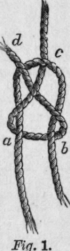
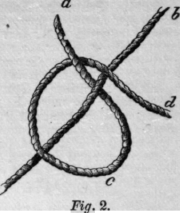
and tightening the whole by pulling d. As formed in this mode, it is more rapidly made than almost any other knot; and, as before stated, it excells all in security and compactness; so firmly do tho various turns grip each other, that, after having been tightly pulled, it is very difficult to un-tie; this is the only drawback to its usefulness, and in this respect it is inferior to the reef-knot, Fig. 3, which is made in precisely the same manner that a shoe-string is tied, only pulling out the ends instead of leaving them as bows.
Continue to:


My Books

