


Miscellaneous Receipts. Part 21
Description
This section is from the "Encyclopedia Of Practical Receipts And Processes" book, by William B. Dick. Also available from Amazon: Dick's encyclopedia of practical receipts and processes.
Miscellaneous Receipts. Part 21
6266. How to Tie a Parcel
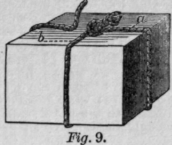
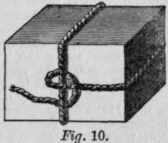
6266. How to Tie a Parcel. The tying up of parcels in paper is an operation which is seldom neatly performed by persons whose occupations have not given them great facilities for constant practice. Let a single knot be made in the end of tho cord, which is then passed around the box or parcel. This knotted end is now tied by a single hitch around the middle of the cord (Fig. 9) and tho whole pulled tight. The cord itself is then carried at right angles round tho end of the parcel, and where it crosses the transverse cord on the bottom of the box (Fig. 10) it should, if the parcel is heavy and requires to be firmly secured, be passed over the cross cord, then back underneath it, and pulled tightly, then over itself; lastly, under the cross cord, and on around tho other end of the box. When it reaches the top it must be secured by passing it under that part of the cord which runs lengthways (a, Fig. 9), pulling it very tight, and fastening it by two half hitches round itself. The great cause of parcels becoming loose is the fact of the cord being often fastened to one of the transverse parts (as 6, Fig. 9), instead of the piece running lengthways, and in this case it invariably becomes loose. The description may perhaps be rendered clearer by the aid of the figures, which exhibit tho top and bottom of a box corded as described. The cords, however, are shown in a loose state, to allow their arrangement to bo perceived more easily.
6267. Artificial Grindstones
6267. Artificial Grindstones. Washed silicious sand, 3 parts; shellac, 1 part; melt, and form it into the proper shape while warm. Tho fineness of tho sand must depend on the work tho stone is intended for. Powdered emery may be substituted for sand. Tho same composition is formed upon pieces of wood, for the purpose of sharpening knives, and cutting stones, shells, etc..
6268. To Make an Emery Wheel for Grinding Tools
6268. To Make an Emery Wheel for Grinding Tools. Provide a solid wheel, made of pine, or any other soft wood, and of the size required for the purpose. Turn the wheel true, and then turn rounds or hollows in its face, to suit tho tools you wish to grind, gouges, rounds, etc.. Then prepare some best glue, and, using it hot and thin, put it on the face of the wheel with a brush. The first coat of glue should bo a light one, and when it is dry a second one should be applied, and. as quickly as possible, as much emery should be sifted upon the wet surface as the glue will hold. When this is dry another coat of glue and emery should be applied in the same way. This will make a wheel that will last for months, and grind faster than anything else. No. 0 emery is best for this purpose. (See last receipt.)
Continue to:


My Books

