


Tables of Weights, Measures, etc. Part 9
Description
This section is from the "Encyclopedia Of Practical Receipts And Processes" book, by William B. Dick. Also available from Amazon: Dick's encyclopedia of practical receipts and processes.
Tables of Weights, Measures, etc. Part 9
5963. Miscellaneous Measures and their Equivalents
5963. Miscellaneous Measures and their Equivalents.
Dessert " ............. " 2 " |
Table " ............. " 4 " |
Tea-cupful............... " 4 " |
Breakfast-cupful.......... " 8 " |
Thimbleful................ " 3/4 fl.drachm. |
Pinch (of leaves and flowers) " 1 dr. (Troy). |
Handful " " 10 " |
5964. Signs and Abbreviations Used in Medical Prescriptions
5964. Signs and Abbreviations Used in Medical Prescriptions.
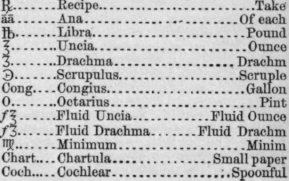
516 TABLES OF WEIGHTS, MEASURES, ETC.
Collyr... Collyrium................Eye-water
Decot .... Decoctum................Decoction
Ft.......Fiat.........................Make
Garg.....Gargarysma.................Gargle
Gr.......Granum.....................Grain
Gtt.....Gutta........................Drop
Haust... Haustus...................Draught
Infus .....Infusum..................Infusion
M........Misce.........................Mix
Mass .....Massa........................Mass
Mist.....Mistura....................Mixture
Pulv.....Pulvis.....................Powder
Q. S.....Quantum Sufficit. Sufficient Quantity
S.........Signa........................Write
S.S.....Semis........................Half
5965. Strength of Doses at Different Ages
5965. Strength of Doses at Different Ages. The following gradations for doses of medicines apportioned to the age of the patient were originally drawn up by Gaubius.
Under 1/2 year 1/16 of a full dose.
« 1 « 1/12 "
" 2 years 1/8 "
« 3 " 1/16 "
« 4 " 1/5 "
" 7 " 1/3 "
" 14 " 1/2 "
" 20 " 2/3 "
Above 21 " the full dose. "
" 63 " 11/12 "
" 77 " 5/6 "
« 100 " 2/4 "
Dr. Young gives the following simple formula: For children under 12 years, the doses of most medicines must be diminished in the proportion of the age to the age increased by 12. Thus, at 2 years, the dose will be 1/7 of that for an adult, viz:

Sex, temperament, constitutional strength, and the habits and idiosyncrasies of individuals, must be taken into account. Nor does the same rule apply to all medicines. Calomel, for instance, is generally borne better by children than by adults; while opium affects them more powerfully, and requires the dose to be diminished considerably below that indicated above.
Continue to:


My Books

