


Telescope
Description
This section is from the book "The Corner Cupboard; Or, Facts For Everybody", by Robert Kemp Philp. Also available from Amazon: The Corner Cupboard; or Facts for Everybody.
Telescope
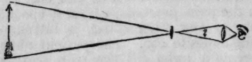
Telescope. An optical instrument, which enables us to dispose of the rays which proceed from distant objects, that we may see the image or spectrum formed in the focus of the object-glass, very near, or under an increased angle. The angle of the image is as the focal length, or the distance from the object-glass to the image, and the angle at the eye-glass is as its distance from the image; the magnifying power is, therefore, in the proportion of those angles. The glass nearest the object makes an image or picture by crossing and subsequently diverging rays, which a convex eye-glass of short focus renders parallel for vision; or which a concave eye-glass intercepts while converging, and the image then proceeds directly to the eye with parallel rays. In the figure annexed the arrow is the object, the rays of which cross at the object-glass, and form an image which is viewed through a convex glass by the eye.
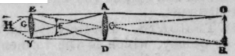
In the following figure 0 R is the object, rays from which cross at G, in the object-glass A D, forming an image, which is viewed by E Y, the eye-glass, by the eye at H.
D object-glass, E concave eye-glass, carrying parallel rays to the eye.
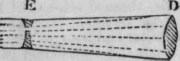
The first and second are the common telescope and microscope, the eye-glass being usually compounded of three eyeglasses to set the object erect; and the third is the Galilean or primitive telescope, and also the opera-glass.
The following represents a mounted telescope with rack-work for vertical and horizontal motions.

The following is a section of the tubes with the position of the object and eyeglasses.

Continue to:


My Books

