


ARTEVELDE 114 ARTHUR
Description
This page of the book is from "The New Student's Reference Work: Volume 1" by Chandler B. Beach, Frank Morton McMurry and others.
ARTEVELDE
114
ARTHUR
the most prominent man on the side of the citizens in their struggles against Count Louis of Flanders. The people of Ghent made him commander of their forces, and he banished from the town all the nobles and friends of the count. His power was secure for ten years, but in 1335 he made a treaty with Edward III of England, persuading him to assume the title of king of France. To strengthen this alliance, he tried to make Edward the Black Prince count of Flanders, when the people rose in rebellion and Artevelde was slain July,
24, 1345-
Artevelde, Philip Van, son of the above; born in 1340. In 1381 the people of Ghent, who had driven away the Count of Flanders and plundered his house, were closely blockaded by the count. At this juncture, Philip, as the son of the great Artevelde, was asked to become their leader. The count's army was badly defeated and Bruges, which had sided with the count, was plundered and submitted to Artevelde. His power only lasted a year; a French army invading Flanders routed the forces of Ghent, and many thousands were killed, including Artevelde. His death occurred in Belgium, November 27, 1382.
Arthrop'oda. The largest sub-kingdom of animals, containing an immense number of species. They are known by having an articulated body and jointed legs. The group embraces four great divisions or classes: 1. Crustacea, including the lobsters, crabs, crayfish, shrimps and others They usually live in the water and breathe by gills. The common pill-bug is an exception. 2. Arachnida, the spiders, daddy-long-legs, scorpions, mites and others. In this class the head and thorax are united. They have four walking legs and no antennas. The representatives are air-breathers. 3. Myriapoda, the centipedes and thousand-legged worms. They are air-breathers, with the head bearing antennœ and distinct from the thorax. The latter forms with the other joint of the body a continuous line of segments fiom six to two hundred in number. Each of these segments bears a pair of legs. 4. Insecta, the largest class, including all insects. These breathe by air tubes distributed through the body. They show great variety of form and structure. The king crabs, the fossil trilo-bites and the interesting peripatus (see Insecta) are sometimes separated from the other Arthropoda into distinct classes.
Ar' thur, a prince of the Britons, who is supposed to have lived about the 6th century. He is pictured in legend as the champion of the British tribes against the Saxon invaders and as the ideal of a knightly hero. The son of King Uther, he became leader of the Britons after his fatner's death. He married Guenevere, the fairest princess m the land, and with her lived
in splendid state at Caerleon in Wales, surrounded by hundreds of knights and beautiful ladies, patterns of valor, breeding and grace to all the world. Twelve knights, the bravest of the throng, formed the center of the retinue, and sat with the king at a round table, known as the famous Knights of the Round Table. From Arthur's court knights went forth to all countries in search of adventure, to protect women, chastise oppressors, liberate the enchanted and to enchain giants and malevolent dwarfs. Among the most renowned of these heroes of legend were Percival, Tristram, Gal-lahad, Lancelot and the enchanter, Merlin. Arthur was killed in battle by his nephew, Modred, who had revolted against him. His body was carried by fairies to the Isle of Avalon to be cured, whence he was expected to return some day again to lead the Britons against the Saxons. Many critics doubt the existence of Arthur, and, of course, the stories that have gathered about his name- are, many of them, only beautiful legends. His fancied adventures have been sung in many languages, but for English readers they are told most beautifully in Tennyson's Idylls of the King. At Innsbruck, in the Franciscan church, is a magnificent ideal, life-sized, bronze figure of Arthur.
Arthur, Chester Alan, the twenty-first president of the United States, was born at Fairfield, Vermont, October 5, 1830. His father was the Rev. W. Arthur, D. D., a Baptist minister and a native of the north of Ireland. He was graduated at Union College, New York, and was admitted to the bar in 1853. At the outbreak of the Civil War he held the post of inspector-general, and during the war was quartermaster -general for the New York forces. When he returned to the law, he was head of an eminent law firm. He took a prominent share in politics on the Republican side. In 1871 President Grant appointed him collector of customs at the port of New York. He was elected vice - president of the United States when Garfield was made president. The death of Garfield called Arthur to the chief magistracy, and he was installed as president on September 22, 1881, and held the office till March, 1885, when he was succeeded by Grover Cleveland. During Arthur's term of office two important measures were passed by congress: a bill dealing with the Mormon question and one for the exclusion of the Chinese. His administration was
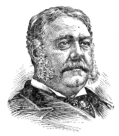
CHESTER A. ARTHUR


My Books

