


AUK 138 AURELIAN
Description
This page of the book is from "The New Student's Reference Work: Volume 1" by Chandler B. Beach, Frank Morton McMurry and others.
AUK 138 AURELIAN
and fraud, the Roman world was divided between Augustus and Antony. While Antony was lost in luxurious dissipation at the court of Cleopatra, Augustus was striving to damage his rival in public estimation. At length war was declared against the queen of Egypt, and at the naval battle of Actium, B. C. 31, Augustus was victorious and became sole ruler of the Roman world. Soon after, Antony and Cleopatra ended their lives by suicide. The subsequent measures of Augustus were mild and prudent. He abolished the laws of the triumvirate, adorned the city of Rome and reformed many abuses. The title of Augustus, meaning consecrated, was conferred upon him as consul. In 12 B. C, on the death of Lepidus, he had the title of Pontifex Maximus or high priest conferred upon him. He died August 19, A. D. 14. He so beautified Rome that it was said: 'Augustus found the city built of brick, and left it built of marble." He encouraged agriculture and patronized the arts and literature. Horace, Vergil and all the most celebrated con-cemporary Latin scholars and poets were his friends. His was the famous Augustan Age of Latin literature.
Auk, the name applied to a family of webfooted sea-birds. They have a thickset, heavy body with short wings and tail. They are seldom more than a foot long, dark colored above and white beneath. They live almost exclusively in the water
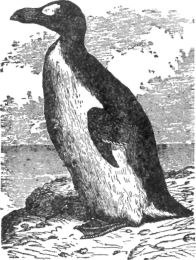
GREAT AUK
and visit the land only to lay eggs and breed. Their movements on land are very awkward, which is caused because their legs are set far back. They are fine swimmers and divers, using their wings
as well as their legs when under water. The razor-bill and the so-called little auk are common in high northern latitudes, and are used by the Esquimaux for food, while the skins are used in making clothing.
The most noted as well as the largest member of the family, is the great auk, which has become extinct by the hand of man within the last fifty years. This bird, about the size of a goose, was formerly abundant on both shores of the Atlantic in north temperate parts, not, as is commonly supposed, in the Arctic Ocean. The wings were so short as to be useless for flight, and the birds stupidly allowed themselves to be knocked over by seamen armed with short clubs and to be driven in large flocks on board vessels. They were used as food from the time of the discovery of Newfoundland, and later they were killed for their feathers. While once wonderfully abundant, they have become extinct, because they were ruthlessly slaughtered. Now their skins, bones and eggs bring high prices from museums and collectors.
Auld Lang Syne, a well-known popular song; words by Robert Burns; music derived from a book of Scottish tunes printed in the latter half of the eighteenth century.
Auld Robin Oray, a popular Scottish ballad, written about the year 1772, by Lady Anne Barnard, daughter of the Earl of Balcarras, whose family name was Lindsay. It was originally sung to an old Scotch tune, known as The Bridegroom Grat, but has been superseded by a modern air. A second part of the ballad, it is said, was written by Lady Anne, in which Robin Gray dies and Jeanie happily marries Jamie, who "lo'ed her weel," as the song portrays.
Aumale (do'mal') (Henri Eugène Philippe Louis d'Orléans), Duc d', fourth son of Louis Philippe of France and a general of note in the French army, was born in Paris, January 16, 1822, and died in Sicily, May 7, 1897. When a youth he took part in campaigns in Algeria, of which he became governor-general. When the Revolution of 1848 broke out, he resigned his post and joined his exiled father and the Orleanist princes in England, until the law banishing royalty was repealed in 1871. The duke then returned to France, was made a general, and president of the council of war in which capacity he tried and condemned Marshal Bazaine. Later on, a new expulsion bill passed the French legislature in 1886, and he was banished until the revocation of the measure in 1889. Meanwhile, and in spite of the decree of banishment, the Due d' Aumale bequeathed his beautiful chateau of Chantilly, with its fine art treasures, to the French nation.
Aure'Iian, Lucius Domitius Aure-lianus, emperor of Rome, was born in


My Books

