


BRIDGE, CANTILEVER 267 BRIDGMAN
Description
This page of the book is from "The New Student's Reference Work: Volume 1" by Chandler B. Beach, Frank Morton McMurry and others.
BRIDGE, CANTILEVER
267
BRIDGMAN
tance of 135 feet from high water under the center of the bridge. The bridge has a width of 85 feet, and carries two roadways, two railways and a footway. It was opened in 1883 and cost over $15,000,000. The traffic has increased so that a second East River bridge has since been constructed. A bridge to Brooklyn Navy Yard is now being built. It was also proposed to bridge the Hudson River from New York to the New Jersey shore, but the plan has been abandoned, and a tunnel under the Hudson and extending under the East River has been built by the Pennsylvania Railroad.
Bridge, Cantilever. The first modern cantilever bridge was built in 1882 across Niagara, although its principle had been approached in one or two earlier bridges. The advantage of the cantilever bridge is partly in its erection and partly in its long spans. It is the only bridge that can compete with the suspension for long spans. The principle of the cantilever can be understood from the drawing. A and B are two towers, C and D is a truss anchored at C, resting on tower A and projecting over the river. EBF is a similar truss on opposite-side. DE is a simple truss supported at D and E, so as to transmit only vertical loads. A load on D tends to lift C, but does not effect EBF. A load on DE is divided between C and D and EBF.
The Forth Bridge in Scotland, one of the most notable bridges in the world, is a cantilever bridge. It has a total length of 8,295
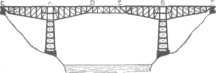
CANTILEVER BRIDGE
feet, and has two main spans each 1,710 feet long. The largest cantilever structure in the world is the bridge over East River, at New York, known «as Blackwell's Island Bridge, built at a cost of nearly $25,000,000. It is double decked, 8,449 feet in length. The length of the main span is 1,182 feet between the towers. On the lower deck, projecting beyond the trusses, is a roadway wide enough for four three-horse teams to pass abreast. On each side of and apart from this roadway are two trolley tracks. In the middle of the upper deck, between the trusses, there are two elevated railroad tracks and two promenades, each eleven feet wide.
Bridge of Sighs, The, leads 'from the palace of the Doge of Venice to the prisons, whence comes its name. The bridge dates as far back as the close of the sixteenth century. Byron refers to it in Childe Harold. The bridge is covered above and at the sides, is handsomely built, and divided into two passages for going and returning. The
name has been transferred to a bridge in New York City which connects the Tombs jail with the court of justice.
Bridge'port, a railroad and steamboat center and a manufacturing city of Connecticut, lies on Long Island Sound, about fifty-seven miles northeast of New York. It is a fine looking city, has many pleasant environs, and a magnificent esplanade looking out over the sound. It is noted for its manufactures of sewing machines and firearms, automobiles, type-writers, grapho-phones, silverware and corsets, and it has the largest cartridge factory in the world. Population, 102,054.
Bridge'ton, N. J., a port of entry, and capital of Cumberland County, New Jersey, on the Cohansey Creek, thirty-eight miles south of Philadelphia. A railway connects it with Vineland, eleven miles northeast, and also with towns on the Delaware River and Bay. It is well equipped with schools, among the higher institutions being Ivy Hall Seminary, South Jersey Institute, West Jersey Academy, Seven Gables Seminary and a high school in connection with a good public school system. It has a number of woolen and rolling mills, nail works, glass and carriage factories, is also engaged in fruit and vegetable canning, and manufactures gas-pipe, oilcloth, etc. Population, 14,209.
Bridg'man, Laura, famous as a blind mute, was born at Hanover, New Hampshire, Dec. 21, 1829. A bright, intelligent child, at the age of two she had a severe attack of fever which utterly destroyed sight, hearing and the sense of smell, and injured the sense of taste. She learned, however, to make her way about, and even to sew and knit a little. When eight years old, she went to the Perkins Institute for the Blind, at Boston, where Dr. Samuel G. Howe became interested in her, and undertook to educate her. He first tried to give her some signs by which she could interchange thoughts with others. Then she learned to read raised letters by the touch, and when a raised word was joined to the object it represented, she learned to connect the two. It now seemed to flash through her mind that in this way she could tell others what was passing in her mind, and her progress thereafter was rapid. A set of metal types with letters cast at the ends, and a board with holes in which they could be fitted, so as to be read by the fingers, was the next step. In three months she could write the names of the most common objects. Her touch became wonderfully keen and accurate, and she learned to know people almost instantly by the touch alone. Later she studied geography, history and algebra, and learned to play the piano and to sew and to do many other things. She received and answered letters from all parts of the world, having learned to write a good hand. Once she asked her teacher: "Man has made houses and vessels, but who made


My Books

