


CARSON 342 CARTHAGE
Description
This page of the book is from "The New Student's Reference Work: Volume 1" by Chandler B. Beach, Frank Morton McMurry and others.
CARSON
342
CARTHAGE
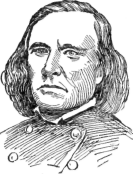
KIT CARSON
country and join those to the south of the line in seeking independence. Failing in his mission, he became a member of the Maryland constitutional convention and later one of its senate. From 1789 to 1791 he was a member of the federal senate and also served on the Maryland and Virginia boundary commission. In 1828 he laid the cornerstone of the Baltimore and Onio Railway, and four years later died at Baltimore in his 95th year. His life and journals have been published.
Carson, Christopher, popularly known as Kit Carson, a famous American trapper and guide, was born in Kentucky in 1809. While yet a youth his family moved to Missouri, and he early engaged in trapping. He spent eight years as hunter to Bent's fort, and then acted as guide in the explorations of 1 General Fremont. One of his most difficult feats was the driving ef 6,500 sheep to California. He became Indian agent in New Mexico, and helped to bring about many treaties with the Indians. During the Civil War he did good service, and at its close was breveted brigadier-general. He died at Fort Lynn, Col., in 1868.
Carson City, Nev., the seat of Ormsby County and the capital of the state, is on the Virginia & Truckee Railway, 12 miles east of Lake Tahoe at the foot of the Sierra Nevada and 30 miles south of Reno. It lies in a fertile region, its chief industries being mining, lumbering and agricultural operations. Besides its gold and silver mines (and here is the noted Comstock Lode), there are hot springs in the region. Settled in 1858, the town became the capital three years later, while in 1875 it received its charter as a city. Within the city are the state and federal buildings, including a branch mint, and in the neighborhood are a U. S. government Indian School and the state prison. Its population, which has declined of recent years, was in 1910 but 2,466.
Cartagena (kär'iä-jē'na), Spain, an important historic town and fine seaport on the Mediterranean, in the province of Murcia, is situated in the southeast of the kingdom, south of Alicante and east of Almeria in Andalusia. Its population in 1901'was 103,-373. Its harbor, which is defended by strong fortifications, is one of the best on the coast and was formerly the chief naval arsenal of Spain. In early days it was the great
commercial emporium of the Carthaginians, and was founded in 242 B. C. by Hasdrubal, Thirty-two years later, it was captured by Scipio Africanus and in A. D. 550 it was destroyed by the Goths; it has otherwise suffered from invasion and capture at different eras. Today the city, which is an episcopal see, has many interesting ruins, among them the Castillo de la Concepcion, situated on a fine promontory, while notable are many of its churches (especially the cathedral, a Gothic structure which dates from the 13 th century). The arsenal, docks, dockyards, barracks and hospitals, besides its foundries, machine shops, glass and smelting works and other industrial establishments, are worthy of a visit. Its exports consist of minerals, including lead, zinc, copper, silver ore, coke and coal ; besides machinery, lumber, esparto grass, oranges, lemons.
Carteret (kār'íěr-ěí), Sir Qeorge, an English vice-admiral, royal lieutenant-governor of the island of Jersey in the English Channel and one of the original proprietors of the land lying between the Hudson and the Delaware, afterward named in his honor New Jersey, was born on Jersey about 1612 and died in 1680. With Lord Berkeley, a favorite of Charles the Second's court, Carteret was granted by the Duke of Yprk(after-ward James II), portions of New Amsterdam and what is now New Jersey. On the latter Carteret settled a colony, which should enjoy religious freedom and a liberal government resembling that of Maryland. The. relations between the colonists and Carteret were, nevertheless, not harmonious; and portions of the lands were made over to the Quakers, ultimately, however, to revert again to the crown until the War of the Revolution.
Car'thage (kar'thaj), a city on the northern coast of Africa, the capital of one of the great empires of the ancient world. It stood on a peninsula of the region that is now Tunis, and was founded, probably, about the middle of the 9th century B. C. by Phoenicians from Tyre or from the Tyrian colony of Utica. The Carthaginians belonged to the Semitic race, and were an offshoot from the Canaanites. Vergil in his Æneid relates a mythical story of the unfortunate Queen Dido and the young city, but little is really known of the city's rise to power and wealth. About the 6th century it appears as the center of a great commerce and the capital of wide dominions in Africa, Sardinia, Sicily, Corsica and probably Malta. In 525 B. C. Carthage narrowly escaped destruction at the hands of Cambyses, the Persian king, and in 509 B. C. occurred her first treaty with the rising power of Rome. About this time began the contest between the Carthaginians and the Greeks for the possession of Sicily. Greece had settled a large part of that island with her colonies, and while she was engaged in her struggle with Persia, Carthage resolved to wrest Sicily from her


My Books

