


CONIDI A 443 CONNECTICUT
Description
This page of the book is from "The New Student's Reference Work: Volume 1" by Chandler B. Beach, Frank Morton McMurry and others.
CONIDI A
443
CONNECTICUT
representing all the colonies but Georgia, set forth the well-known Declaration of Rights. This body became known as the Continental Congress, and on July 4, 1776, adopted the Declaration of Independence. The first congress of the United States met in New York in 1789 with 26 senators and 65 representatives. The next year it moved to Philadelphia, and in 1800 to Washington. See Woodrow Wilson's Congressional Government; Cooley's Constitutional Limitations; Von Hoist's Constitutional Law of the U. S.; and Bryce's American Commonwealth.
Conid'ia (in plants), asexual spores of cer-tain fungi, which are formed by cutting off a series of cells from special branches of the mycelium, resulting in more or less extensive chains of spores which separate easily. Such spores are well displayed by the mildews and the æcidium forms of rusts. They are often called conidiospores. The singular of the name is conidium. Co'nifers, the greatest group of living gymnosperms, containing such plants as the pines, spruces, hemlocks, firs, redwoods, cedars, cypresses, junipers, yews. The species are characteristic of the temperate regions of the northern and southern hemispheres, and are almost entirely absent from the tropics. Among them are some of the most valuable timber-trees, and the yearly inroads upon them for lumber, unless properly controlled, will result presently in their extinction. Their most characteristic features are the central shaft which never breaks up into branches the evergreen needle-leaves, the cones
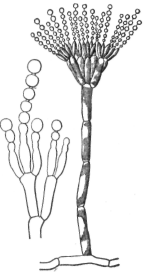
conidia
and the soft and very evenly-grained wood. They are a very ancient group, their remains occurring in great abundance in the earlier rocks. See Gymnosperms.
Conjugate Plants, a group of the green algæ, in which different plants become united together by connecting tubes, through which fertilization is effected. The common pond-scum or Spirogyra is an example. See Chlorophyceæ.
Conjuga'tion. A process of fertilization occurring in certain of the lower plants (Thallophytes), in which the sexual cells (gametes) which unite to form the spore are alike in appearance, there being no distinction of male and female.
Conk'ling, Roscoe, American politician, was born at Albany, N. Y., Oct. 30, 1829; and died at New York, April 18, 1888. In 184Ó he removed to Utica, N.Y., where he became district attorney, and was mayor in 1858. In the latter year he was elected to Congress, and in 1879 became a member of the United States senate. In the practical business of. both houses he took an active and prom-' inent part, serving on important committees, and was instrumental in the passing of many useful legislative measures. After the war he took an active part in the reconstruction of the southern states, and advocated the resumption of specie-payments. He was an opponent of President Johnson's policy and a zealous champion of Grant's administration; and in June, 1880, nominated Grant for a third term. In the following year he resigned his seat in the senate, owing to Garfield's exercise of the control over appointments in his native state. In i88<2 he was appointed associate-justice of the supreme court; but declined the office. See his Life and Letters.
Connecticut (kŏn-nĕfï-kŭt) (name derived from Indian word meaning land on the long tidal river occupies the southwestern corner of the New England states. Its northern boundary is Massachusetts, 88 miles, its eastern, Rhode Island, 45 miles, western, New York, 72 miles. On the south 100 miles of irregular coast afford numerous good harbors, the best of which are New Haven and New London. The area of the state is 5,004 square miles. The census of 1900 gave a population of 908,420. A school census in 1907 showed a population of 1,037.614, and the census of 1910 gave a population of 1,114,756.
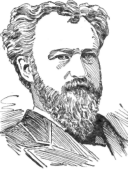
ROSCOE C0NKLING
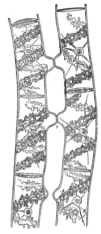
conjugation of two filaments of spirogyra


My Books

