


INSTITUTE OF FRANCE 930 INSURANCE
Description
This page of the book is from "The New Student's Reference Work: Volume 2" by Chandler B. Beach, Frank Morton McMurry and others.
INSTITUTE OF FRANCE 930 INSURANCE
tera, all true bugs, plant-lice, seventeen-year locusts and others. Insects with four wings, constructed on two typiõ—some with outer wings, thickened at the b£,ses and thinner tips, which overlap on the back ; others with wings of the same thickness throughout. Mouth-parts formed for sucking. The metamorphosis is incomplete. (See Chinch-Bug, Cicada, Electric-light Bug etc.) Ill: Orthoptera, grasshoppers, crickets and others. Insects with four wings, the outer pair being straight and not used for flying ; the innerpair or flying wings are folded like the plaits of a fan. Mouth-parts formed for biting. Metamorphosis incomplete (See Cricket, Grasshopper, Katydid etc.) II: Cdonata, dragon-flies and others. Insects with four membranou s wings finely netted with veins. Mouth-parts formed for biting. Metamorphosis incomplete. (See Dragon-Fly.) I: Thysanura, spring-tails, bristle-tails and others. Insects without wings which undergo no metamorphosis. The larval form is retained by the adult. In some cases, in addition to the six legs belonging to all insects, there are rudimentary legs on the abdomen. They form a sort of connecting-link between the other inst"ts and the myriapods. Besides the insects mentioned above, the mayflies, stone flies, white ants, book lice, bird lice, thrips, scorpion flies and caddice flies each separately represent an order in the modern classification of insects.
Insects and Flowers. Insects are of the greatest value in that they practically create by cross-pollination our beautiful and fragrant blossoms and our most valuable varieties of fruit. In destroying injurious insects, however, little hesitation need be felt, for the honeybee alone is "practically sufficient for the work of cross-pollination of fruits and flowers." (Hodge.) While a few feed upon flower-petals, by far the greater number are attracted by the pollen or nectar, the nectaries being so placed that the insect will have to touch anthers and stigma in getting to its feast. Pollen clinging to the insect is brushed against the stigma of a flower of the same kind visited by the carrier, clings to the stigma and is conveyed to the seed-cup, and the flower is fertilized. Insects that, in addition to the bees, are agents in cross-fertilization include wasps,
most butterflies and moths, certain bugs, flies and beetles.
See H<»dge : Nature Study and Life; Corn-stock: A Manual for the Study of Insects and Insect Life; Belle S. Cragin: Our Insect Friends and Foes; Weed: Life Histories of American Insects; French: Butterflies and Moths of the Eastern United States; Holland : The Butterfly Book; Packard: Guide to the Study of Insects and Textbook of Entomology ; Scudder: Everyday Butterflies; and Smith: Economic Entomology.
In'stitute of France, The. The principal philosophical and literary society of France, originally proposed by Richelieu, for which letters patent were issued in 1635 under the name of the Académie Française. Later many new bureaus or departments were added, as the Academy of Inscriptions and Belles-Lettres; the Academy of Sciences; and those of sculpture and pamting, music and architecture, the later name of which is the Académie des Beaux Arts. At present the Institute is made up of five distinct academies, each having its own officers, meetings and publications. The Académie Française, whose origin has been stated, is the first. Its department is the French language and literature, and its ordinary members number 40. The Académie des Inscriptions et Belles-Lettres comes next, having 40 ordinary, 10 honorary and 100 corresponding members. The A cadémie des Sciences, which has 65 ordinary, 10 honorary, 8 foreign and 100 corresponding members, is third; and the Académie des Beaux Arts is fourth. This has 40 ordinary, 10 honorary, 10 foreign associate and 40 corresponding members. It distributes prizes. The Académie des Sciences Morales et Politiques is the last. This has 40 ordinary, 6 honorary, 6 foreign associate and 40 corresponding members. Salaries are attached to memberships. There is a fine library.
Insur'ance is of the nature of a contract, in which one party, in return for a certain sum of money, undertakes to recoup the other party in case of loss. On the whole, there are two chief kinds of insurance, one including fire and marine insurance; the other life and accident insurance. Insurance of the former kind generally only undertakes to make good the actual loss, and not to pay a given fixed sum; while insurance of the second kind involves the payment of a fixed sum when the occasion may arise. The danger incurred is termed the risk; the payment which is made for the sake of protection is the premium; and the formal agreement is a policy. In general, the benefits of insurance are very great. The revenues which the great insurance companies make out of premiums are embarked in great industrial enterprises; but the chief gain is the security which is given to the owner of property against sudden poverty, together with the immense advantage to his peace of mind. It
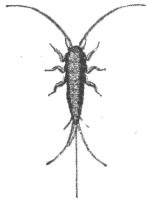
LEPISMA, A SPRING-TAIL


My Books

