


952
Description
This page of the book is from "The New Student's Reference Work: Volume 2" by Chandler B. Beach, Frank Morton McMurry and others.
/
952
JACKSON
J (jay), the tenth letter, is a compound Vocal consonant nearly equal to dzh, as in jar. It is a variation, originating about iŏoo, of I used as y in yet. It is classified as a diphthongal palatal, because compounded of d and zh and made by the point of the tongue on the back of the hard palate.
Jack'al, a dog-like animal, smaller than the wolf, inhabiting southern Europe, Asia
and northern Africa. It has a pointed muzzle, like a fox, and a bushy t a il about one third the length of the body. The common jackal of southern Asia is the best known. It is grayish yellow in color, darker above and lighter below. During the day jackals remain concealed in burrows, caves and sheltered places, but at night they hunt, frequently in packs. They utter a piercing unearthly cry, and the howling of a pack at night is familiar in oriental villages. They feed on smaller mammals, poultry and especially carrion, quarrelling over the latter with the vultures. They shadow wounded animals and haunt battlefields and burying-grounds. When running in packs, they often attack sheep and antelopes. They are easily tamed, and probably represent or.e of the breeds from which the domestic clog is descended. They are harmless if lore unmolested, but when cornered fight desperately.
Jack'daw, a common Old World bird of the crow family, found- in Europe, Asia and North Africa. It is smaller than its closest relations, the crow, raven and rook, being about 14 inches in length. Its color is black, with gray at.the sides of the neck, and it has a straighter bill than other crows. It builds nests in holes, cavities in rocks, church-towers, chimneys and uninhabited buildings. It feeds chiefly on insects. The jackdaw is easily tamed, and, besides making an interesting pet, can be taught to imitate the human voice.
Jack'son, Andrew. One of the most original and forceful characters that ever ap-
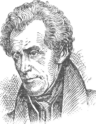
ANDREW JACKSON
peared in American public life is this seventh president of the United States. He died in 1845; the issues of his day have long since become ancient history; but Jackson's is still a name for the Democratic party to conjure with. He expressed a definite, vital idea stamped with a picturesque personality. He was worshipped and vilified but could never be ignored. Tradition still votes for him, for his party's candidates for office must measure up to certain standards laid down by Jefferson and Jackson.
Jackson was the product of a peculiar period of transition in American life and ideals. Born in the Waxhaw Settlement, South Carolina, in 1767, two years before Daniel Boone penetrated Kentucky, he was a generation later than Boone, a generation earlier than Lincoln. As a boy of 13 he saw service in the last years of the Revolution. As a youth of 20 who had, although early orphaned and in spite of poverty and impatience of restraint, made of himself a lawyer, he was in Tennessee as prosecuting attorney. He prosecuted lawbreakers, carved a plantation out of the wilderness, fought Indians and had duels, raced horses, organized the machinery of civic life and loved his whe — all with equal facility and ardor. In 1813 he organized a volunteer force of 3,000 men and marched against the Creek Indians. Until the battle of Horseshoe Bend, March 27, 1814, which broke the power of the red man in the south, Jackson had had only local fame. Four days later, with the sobriquet of Old Hickory, won by his endurance of hardships in the campaign, he was appointed a major-general in the regular army, with orders to defeat the British forces in the south. Although Pensacola, Florida, was in Spanish territory, the British were using it as a base of operations. Jackson stormed and captured the seaport. He then, with 4,000 troops and 12 guns behind breastworks, defended New Orleans against 12,000 British veterans. The victory was so great that its anniversary, January 8, is still celebrated as Jackson Day. He added
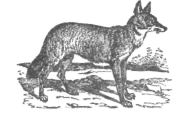
JACKAL


My Books

