


JAIPUR 956 JAMES I
Description
This page of the book is from "The New Student's Reference Work: Volume 2" by Chandler B. Beach, Frank Morton McMurry and others.
JAIPUR 956 JAMES I
that there are three species of jaguars — a large and a small spotted form and a large, black variety which attacks the tapir.
Jaipur (jī-pìfor) or Jeypur, one of the Rajputana states, feudatory to the British crown; and also a walled city 850 miles northwest of Calcutta, India, and the capital of the native state of the same name. It is a handsome, well-built city, and was founded in 1728, In it are the maharajah's palace and college, a school of art, an observatory, a mint and many mosques and temples. The beautiful Ram Newas gardens, covering 70 acres, are a fine park. Its business is chiefly banking. Population 160,000. The state has an area, including feudatories, of 15,579 square miles, with a population of about 3,000,000.
Jamaica (jä-mă'-kā), first called Xaymaca, "land of springs," one of the largest of the West India Islands and the most important of the Antilles belonging to Great Britain. It lies some 90 miles south of Cuba, and its area is about 4,200 square miles. Its greatest length is 144 miles, and its greatest width is 50 miles.
Surface and Cities. It is crossed from east to west by a heavily timbered ridge called the Blue Mountains, which rise 7,400 feet. Excellent harbors are everywhere found. The best is in the southeast, in the deep basin which washes the most spacious and fertile of the plains between the hill-country and the coast. Around this mlet and within a few miles of each other are the largest towns: Kingston (population 50,000) and Spanish Town, the old capital (population 5,500). Here also is Port Royal, one of the chief cities of the West Indies before the great earthquake of 1692.
Climate and Products. The climate varies from the torrid belt of the coast to the temperate region of the Blue Mountains, which have become favorably known as a resort for invalids. Vegetation is luxuriant. The primeval woods are fast disappearing, but there still are many valuable trees, as balata, mahogany, logwood, ebony, cocoa-nut and other palms. The exports are chiefly dyewoods, fruits (oranges, lemons, bananas and pineapples), sugar and coffee, allspice and cocoa. Jamaica has 817,211 acres under cultivation — 246,373 under tillage and 570,838 under pasture.
Education and Defence. In addition to government training-colleges for both sexes and to high-schools, Jamaica supports nearly 700 government elementary schools and industrial institutions. Port Royal is strongly fortified, and, besides the garrison of regulars (English), there are a local artillery militia and a rifle corps.
Jamaica was discovered by Columbus in 1494, and was settled by the Spaniards in 1509. It was conquered by an expedition sent out by Oliver Cromwell in 1655, and
was ceded to the English in 1Ŏ70. In 1661 a representative council was established: but this was abolished in 18Ŏ6, and in 1884 a partially elective legislative council was instituted. There is no established church; all the chief religious denominations, however, have their places of worship. There are numbers of East India immigrants, besides Negroes and Chinese on the island. In 1906 the population was estimated at 820,437. Jamaica now has a railway nearly 200 miles in extent, open and running. Under the government of Jamaica are the Cayman, Turks and Caicos Islands, part of the Bahaman group. See the Jamaica Handbook, published by the government printing-house, Kingston
James, Edmund J., a writer on political economy and an American educator was born at Jacksonville 111., in 1855. He attended Northwestern University; and afterwards studied at Harvard, Halle. Leipzig and Berlin. He has in succession been principal of Evanston (111.) High School and of the State High School at Normal (111.), professor of administration and finance in the University of Pennsylvania, professor of administration in Chicago University, and (1902) president of Northwestern University (111.). He now is president of the University of. Illinois at Urbana. He has written An Outline of a Proposed School of Political and Social Science, Chairs of Pedagogics in our Universities, The Relation of the Modern Municipality to the Gas-Supply, Our Legal Tender Decisions, The Education of Business Men in Europe, The Growth of Great Cities, etc.
James the Great, held to be the oldest of the brothers of Jesus, was stoned to death by command of the high priest Ananias in 62 A. D. He is the James mentioned in Acts xii., xv., xxi. and Cal. i. 19, who was the head of the Christians at Jerusalem and, according to one authority, was called the Jus<\ He is held to be the author of the epistle which bears his name. His epistle n the first of what are known as the catholic epistles, that is, those addressed to no one person or church but "to the twelve tribes scattered abroad." It was written not later than 50 A. D., certainly before the destruction of Jerusalem in 70 A. D.
James I of England and VI of Scotland, the only son of Mary, Queen of Scots, and
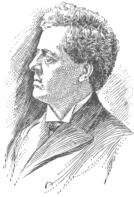
EDMUND J. JAMES


My Books

