


JULY 982 JUNIUS
Description
This page of the book is from "The New Student's Reference Work: Volume 2" by Chandler B. Beach, Frank Morton McMurry and others.
JULY 982 JUNIUS
ing foreign rule out of Italy. To force Venice to give up the old papal provinces on the Adriatic, Julius entered the League of Cambrai with Germany, Spain and Louis XII of France. On the submission of Venice, he at once, fearing Louis's designs, entered the Holy League with England and Spain against France. Ranke describes him as "a noble soul, full of lofty plans for the glory and weal of Italy." He died on Feb.
21, 1513-
July, the seventh month in the year in our calendar, the fifth in the Roman calendar, where it was called Quintilis (the fifth). At first it had 36 days, then 31, then 30, and was restored to 31 by Julius Cæsar, in honor of whom it was named July. The July revolution is that of France m July, 1830, by which Charles X was set aside and Louis Philippe became king.
Jump'ing Mouse, a small field and forest-mouse of North America, having very long hind legs and capable of jumping eight to fifteen feet at a single bound. The body and head together are about three inches long, and the tail, while variable, is often five inches in length. The hind-legs and manner of using them always remind one of a kangaroo. In color it is reddish-brown above and white below. It feeds on seeds and grain, is nocturnal in its habits, and is only rarely seen in the daytime.
Jun'co a member of the finch family and a hardy little bird unafraid of winter's cold, is sometimes known as the slate-colored snowbird. It belongs to the woods of the north. Naturally shy, it is not infrequently emboldened to join the chickadees and sparrows in accepting man's hospitality, offered when deep snow makes lean pickings for feathered folks. In winter it feeds chiefly on weed-seeds and grain. It is about the size of the English sparrow, a small, trim bird robed in neatest Quaker uniform; its coat dark slate-color, a blackish hood fitted snugly about the head, then a slate colored breastplate; under part dull white, and white on the outer tail feathers. When disturbed, juncoes twitter and fly away, sometimes uttering what Chapman describes as a "sharp, kissing call." During the nesting-season a simple trill or low, sweet warble is heard.
June, the sixth month of the year in our calendar and the fourth among the Romans.

white-winged junco
It first had 26 days, to which four were added by Romulus, one was taken away by Numa, and the month again lengthened to 30 days by Julius Cæsar.
Juneau (jū' nō), the capital of Alaska, is a town of 2,000 to 3,000 people, situated in the southern district, near Douglas Island. It is the center of a large import and export trade. Besides gold, furs are the chief article of export. A submarine cable now connects Juneau with the United States. The town has a few manufactures, the most important being its ironworks.
Jungfrau (yoong'frou), meaning the maiden, a magnificent peak of the Bernese Alps, reaches a height of 13,671 feet. It obtains its name probably from the purity and dazzling brightness of the snow which covers it. Its summit was first reached by two Swiss, named Meyer, in 1811. A railroad is built from Lauterbrunnen to its summit. Ju'niper, species of Juniperus, a genus of conifers, containing about thirty species widely distributed throughout the northern hemisphere. The junipers are characterized by their opposite or whorled leaves, and are peculiar among conifers in that the cone ripens into a berry-like fruit. The most common species of the northeastern states are the common juniper (/. communis), which occurs either as a small tree or shrub or as a prostrate form; the savin (J. Sabina), which is a prostrate or sometimes creeping shrub throughout the northern regions; and the cedar (/. Vir-giniana), which is common on dry hills or in deep swamps and has a shreddy bark and a red, aromatic, hard wood.
Junius, Letters of, seventy letters of political character, which appeared in the Public Advertiser of London between January, 1769, and January, 1772. For publishing the letter to the king, Woodfall, the proprietor of the Public Advertiser, was prosecuted, but was acquitted on a legal point; but a bookseller was punished for selling a reprint. These letters attracted the widest attention, because of their unknown author's boldness and his seeming familiarity with politics and well-known persons. It certainly was bold in that day to say, as Junius said to George III: "Remember that while the crown was acquired by one revolution, it may be lost by another." A dozen or more leading writers and politicians were suspected of hiding under the name of Junius. But the man most commonly held to be the writer is Sir Philip Francis, and this theory was adopted by De Quincey, Macaulay, Stan-
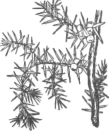
JUNIPER


My Books

