


KEENE 995 KELLY
Description
This page of the book is from "The New Student's Reference Work: Volume 2" by Chandler B. Beach, Frank Morton McMurry and others.
KEENE
995
KELLY
the Christian Year, which attained a very large circulation and an influence that can hardly be overestimated. Keble was one of the leading spirits in what was known as the tractariari movement in the Anglican church, and for several years was actively engaged with Pusey, Newman and others in issuing Tracts for the Times. He died at Bournemouth, March 27, 1866. See Memoir by J. T. Coleridge and Studies in Poetry and Philosophy by J. C. Shairp.
Keene, N. H., a city, county-seat of Cheshire County, is about 43 miles from Manchester. Its leading industries are the repairshops of the Boston and Maine Railroad, shoe, glue, blind, tub, furniture and pail factories, a pottery and a woolen mill. The city, then known as Upper Ashuelot, was settled in 1734, and in 1753 became incorporated as Keene. It is on Ashuelot River, and has the service of two railroads. Population 10,068.
Keewatin (kē-wa'tîn), District of (Canada), lies north of Manitoba and Ontario, along the southern and western shores of Hudson Bay, extending northerly to the Arctic. The region adjoining Manitoba and Ontario has some timber of value and some agricultural land, but its northern portion is called the Barren Grounds. This portion has been very little explored, except along the old trade-route from York Factory near the mouth of Nelson River to Lake Winnipeg. It has many lakes and valuable fisheries, but its future lies in possibilities of mineral development. Its chief present interest is that Churchill, the only practicable seaport on the western shore of Hudson Bay, is within the limits. The proximity of this port to the great wheat-areas of the prairie provinces and the prospect of early railroad connection give it possibilities as a seaport. Churchill is the point from which, beginning in the seventeenth century, the Hudson Bay Company carried on fur-trade with the interior, afterwards changing to York Factory.
Kel'Ier, Helen, was born in 1880 in Tuscumbia, Alabama, endowed with all the senses. At the age of 18 months a serious sickness deprived her of sight and hearing. When she was six and a half, her parents read Charles Dickens' account of the wonderful work done with another deaf and blind girl, Laura Bridg-man; and they sent for a teacher from Boston who might do the same
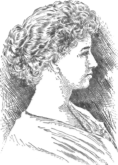
HELEN KELLEK
for Helen Keller. Miss Sullivan came, and has with wonderful patience and skill taught Miss Keller to understand the pressure of another person's hand on hers, so that she can converse easily and quickly with her hands. By this means it is possible for Miss Sullivan to sit beside her and report the speech of a lecturer as fast as he utters it. Miss Keller has also ' learnt to utter words, though not perfectly. She can of course read the regular print used for the blind. She can also get something of a person's peculiarities of speech by placing her hand on the mouth and throat of the speaker. Her sense of smell is very keen, and is the source of many of her pleasures. She has actually succeeded in taking a regular college course at Radcliffe, with Miss Sullivan's aid; and she now writes fluently and well for The Ladies' Home Journal and other magazines. She has a wonderful imagination; and the way she speaks of visible things suggests that she still retains something from the first 18 months of her life when she could see and hear. She seems happy, and is thoroughly amiable under what would seem an intolerable burden of misfortune. See The Story of My Life by Helen Keller and The Pop. Sci. Monthly, May, 1903.
Kel'logg, Clara Louise, an American operatic singer of rare gifts was born of northern parentage, at Sumterville, S. C, in 1842. Her musical education was obtained at New York city, and in the winter of 1861-62 she sang in its Academy of Music. Later she appeared in Her Majesty's theater in London, where she met with a brilliant reception and was engaged for the following season. She returned to the United States in 1872, and, after singing ir all the principal cities, both north and souti', accepted another engagement in Lonaon and sang with Nilsson at Drury Lane. After a tour on the European continent, including visits to St. Petersburg and Vienna, she retired in 1880, and appeared afterwards chiefly in concerts. The successes she met with were mainly in the rôles of Marguerite in Gounod's Faust, Rigoletto in the Barber of Seville and Lucia in Lucia di Lammermoor. In 1887 Miss Kellogg married Carl Strakosch, a nephew of Max Strakosch, the great impresario
Kelly, William, the inventor of the steelmaking process called Bessemer's or the pneumatic process, was born at Pittsburg, Pa., in 1811 and died at Louisville, Ky., in 1888. In 1847, while manufacturing iron, he discovered that for melted meta! air is fuel and other fuel is needless. He saw a white spot at the edge of molten iron in a furnace. At this spot the iron was incandescent and almost gaseous, though no fuel was burning at this spot in the iron. Air alone was blowing on the


My Books

