


SOUTH CAROLINA 1784 SOUTH CAROLINA
Description
This page of the book is from "The New Student's Reference Work: Volume 4" by Chandler B. Beach, Frank Morton McMurry and others.
SOUTH CAROLINA 1784 SOUTH CAROLINA
about 1730, and incorporated in 1816. Its chief manufacturing establishments are woolen and cotton mills, shuttle-works, optical instruments, printing and knife works. The town has good public and parochial schools, a high school, a fine library, several churches and a Y. M. C. A. building. Southbridge is on a branch of the New York, New Haven and Hartford railroad. Population 12,592.
South Car'oli'na, one of the original states of the American Union, popularly known as the Palmetto State, lies between North Carolina on the north, North Carolina and the Atlantic on the east, the Atlantic and Georgia on the south and Georgia on the west. It is shaped like a triangle. Its area is 33,393 square miles, and there are 41 counties'. Population 7,515,400. Capital: Columbia (26,319). Chief cities: Charleston (58,833); Greenville (15,741); and Spartanburg (17,517).
Sui}ace. The state consists of two dis-thxv, belts, the coastal plain and the Piedmont plateau, and i:; naturally divided into sections known locally as low country and up-country. Theaa sections are separated by high sand-hills parallel to the coast and the mount sins, forming the head of navigation on a,fl the principal rivers. The coastal plain itself is what is called a belted coastal plait), being divided according to form, soil and vegetation into four belts parallel to the shore line : The coastal belt; the lower pine-belt; the upper pine-belt; and the hill-belt. Above the sandhills are the Piedmont region, which stretches to the foot of the mountains, and the Alpine region, which begins at the foot-hills of the Appalachian Mountains and occupies the northwest corner. The Alpine region ranges from 900 to 3,000 feet in altitude. Mount Pinnacle 111 Pickens County, the highest point in the state, is 3,436 feet above sea level.
Rivers. The main river-systems are the Pedee, the Santee and the Savannah. These rise in the Appalachian region of North Carolina, and are navigable to the falls' line. Between the Santee and the Savannah system are the minor river-systems, which include Ashley, Cooper, Edisto and Combahee Rivers. The Ashley and Cooper, which are arms of the sea rather than rivers, unite in forming Charleston harbor.
Climate. The climate is equable and healthful, except in swampy portions near the coast. The summer's heat is tempered by the influence of the mountains in the northwest and by the sea-breezes in the southeast. The mean annual temperature is 63e F. The annual rainfall is 48.70 inches. The mountains in the higher part of the state are pleasant summer-resorts, while the dry, bracing atmosphere and the long-leaf pine-forests of the sand-hills make
that section an ideal winter-home for invalids and pleasure-seekers.
Resources. The field and forest products are more varied, perhaps, than those of any other state. There is a variety of climate from the coast, where the sea is tempered by the Gulf-Stream, to the mountains, where it is too cold for cotton to mature. The products range from oranges, lemons and grape-fruit to rye, barley and wheat; the forest-trees from the palmettoes, cypress and magnolias to the ash, white pines and hemlocks. South Carolina leads the world in the yield of corn per acre, as demonstrated in world-contests; in the yield of upland cotton per acre; in the yield of rice per acre; in the quality of sea-island cotton; and in the quality of rice. South Carolina has the only successful tea-gardens in America. In cotton-manufacturing it is second only to Massachusetts. In production of gold it leads all states east of the Rockies. In volume of cotton-crop it ranks fifth. The following shows the value and development of this agricultural industry:

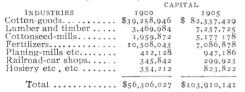
Manufactures. In all lines of manufacturing advance has been made as shown by the following summary:

Minerals. There are two valuable goldmines in operation, and several undeveloped gold mines. Rich deposits of kaolin and fine brick-clay extend entirely across the state. Granite quarries are numerous. A valuable tin-mine has recently been opened, and is proving a noteworthy success. There are deposits of iron, fuller's earth, manganese, monazite, asbestos, mica, nickel and many other minerals of commercial value, but the most valuable mineral resources are the beds of phosphate rock near Chaileston and Beaufort. These


My Books

