


TISSOT I9ï6 TITMOUSE
Description
This page of the book is from "The New Student's Reference Work: Volume 4" by Chandler B. Beach, Frank Morton McMurry and others.
TISSOT I9ï6 TITMOUSE
(g. v.) are the grandest of all in Greece. ' The walls were over 20 feet thick, formed of unknown stones of enormous size.
Tissot (íḗ'sō'), James Joseph Jacques, an
eminent French genre painter, famous for his series of pictures representing the life of Christ on earth, painted during a ten years' visit to the Holy Land, was born at Nantes, Oct. 15, 1836. He was educated at Ecole des Beaux Arts in Paris and under such masters in art as Lamothe and Flandrin. He made his first appearance in the Paris Salon in 1859, with a number of fine water-colors, etchings etc., and in 1861 he painted his Rencontre de Faust et Marguerite, now in the Luxembourg, Paris. His other notable canvases include Return of the Infant Prodigal, Confidence, A Widow, An Interesting Story, The Captain s Daughter, On the Thames, A Young Girl in a Boat and A Young Woman in Church. Tissot then turned his attention to his series of religious subjects illustrating the Life of Christ, for which a firm of French publishers, it is said, paid him over a million francs. The series, 365 in number, were painted each on the spot traditionally associated with its subject, and were exhibited in London and Paris, where they won fame for the distinguished artist. The originals are in Brooklyn's Institute of Art. He died on Aug. 9, 1902.
Titans (iî'ianz), The, in Greek story, were the sons of Uranus (Heaven) and Gæa (Earth). Urged by their mother, the Titans, headed by Kronos, rose against their father, dethroned him, and set free from Tartarus their brothers the Hekaton-cheires (hundred-handed) and the Cyclopes. Kronos made himself king, and for fear he should be dethroned by one of his children as it was foretold he would be, he swallowed each as soon as it was born. The only son to escape was Zeus, who was saved by his mother causing Kronos to swallow a stone wrapped in a cloth, believing it to be his child. Zeus at the end of a ten years' war conquered the Titans and hurled them into a dungeon below Tartarus, surrounded by a brazen wall and guarded by the hundred-handed.
Titian (ftsh'an) or Tiziano, Vecelli, one of the greatest of painters, was born at Capo del Cadore, Italy, in the Alps of Friuli, in 1477. His father sent him to Venice to study painting when he was ten. He was very quick at reproducing the special features of any artist's work, and sometimes beat his masters. The completion for the Venetian senate of a picture begun by Bellini, who was one of his teachers, gained him fame and an office worth 300 crowns a year. He became acquainted with the duke of Ferrara and Ariosto, the poet, whose portraits he painted, and on his return to Venice painted one of his grandest pictures, the Assumption of the Virgin.
Pope Leo X and Raphael invited him to Rome, and Francis I to France. He painted the portrait of Charles V, and spent three years in Spain. There is no complete catalogue of Titian's works, but over 600 of his pictures are known. Far beyond his power as a designer and beyond his gifts of imagination are the splendor, boldness and truth of his coloring. He died at Venice in 1576. See his Life by Northcote.
Titicaca (íĭí'ḗ-kä'kā), a South American lake, 12,000 feet above the sea. It lies partly in Bolivia and partly in Peru, and is 100 miles long and about 35 broad. Some remarkable ruins on its small islands seem to belong to a higher civilization than was found in the country when it was conquered by the Spaniards. There are pyramids covering several acres and doorways, pillars and statues sculptured in peculiar style. On the cornice of a doorway is a human figure with a crown of rays and crested serpents. The statues were all on a large scale, and the whole region is strewn with the great sculptured blocks. Two steamers ply on the lake, having been carried in pieces across the Andes in 1871, and a railroad from Arequipa to the lake has been built, which opens the country, with its rich stores of silver, copper and timber and its products of chocolate, coffee and alpaca-wool. See Andes, Argentina, Bolivia, Chile and Peru.
Tit'lark, a class of small birds, coming between the larks and the wagtails. They live in all parts of the world, building their nests of dry grass, lined with hair, on the ground. The American titlark is a little over six inches long, olive- brown, shading to a yel-lowish-b r o w n and white, with black bill and feet. In the fields or prairies it often is found in flocks of tens or hundreds running on the ground. The Missouri titlark is the American bird which is most like the skylark of Europe.
Tit'mouse, the common name of a number of small birds related to the warblers. There are about 75 species, found chiefly in the Old World. Four species inhabit the eastern United States. The commonest of these is the well-known black-capped chickadee, which is a winter as well as a summer resi-ident in the southern part of its range. This bird is about five inches long, gray above and white below washed with brown. The
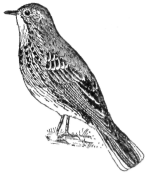
TITLARK


My Books

